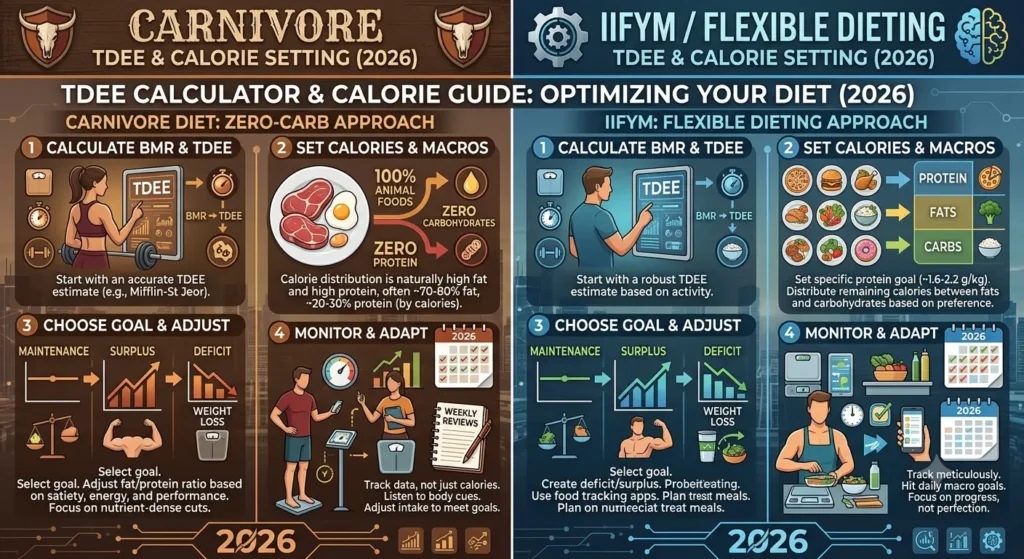
If you've searched for a carnivore TDEE calculator or a TDEE calculator for IIFYM, you've probably noticed something odd: most generic TDEE tools give you a calorie number and a standard 40/30/30 macro split, then leave you to figure out the rest yourself. That split makes zero sense if you're eating only meat, or if you're trying to flexibly track macros around whatever fits your day. This guide walks through how to calculate your TDEE correctly for both approaches, how to reverse-engineer your macros from that number, and where each diet tends to go wrong in practice.
What Is the Carnivore Diet (And Why Regular TDEE Calculators Fall Short)
The carnivore diet is an animal-based eating pattern built entirely around meat, fish, eggs, and in most versions, some dairy. Plant foods, grains, legumes, and added sugar are removed completely. Carbohydrate intake typically drops to near zero, which means your calories come from exactly two sources: protein and fat.
A standard TDEE calculator, including most of the free ones you'll find online, is built around a three-macro model: protein, carbs, and fat, usually split by percentage. Feed that same percentage split to a carnivore eater and it breaks immediately, since there's no carb intake to allocate a percentage to in the first place. You need a calculator, or a manual adjustment, built around a two-macro protein-and-fat model instead.
How TDEE Calculation Changes on a Zero-Carb Diet
Here's the part that surprises a lot of people: your TDEE itself, the total number of calories you burn in a day, doesn't change because you're eating carnivore. Your Basal Metabolic Rate, activity level, and total energy expenditure are governed by your body size, muscle mass, and movement, not by which macronutrient you're eating. What changes is how you split that calorie total once you have it.
Why Carnivore Uses a Protein-to-Fat Split Instead of Three Macros
Once you know your TDEE, carnivore macro planning becomes a two-variable problem instead of a three-variable one. You set a protein target first, based on your body weight and goal, then fill the remaining calories with fat. There's no carb column to worry about, which is part of why a lot of carnivore eaters find tracking simpler once they get past the initial adjustment period.
Katch-McArdle vs Mifflin-St Jeor for Carnivore Dieters
If you know your body fat percentage, the Katch-McArdle formula tends to give a more accurate BMR estimate than Mifflin-St Jeor, because it calculates based on lean body mass rather than total weight. This matters more for carnivore dieters specifically, since many people adopting the diet are already relatively lean and active, and Katch-McArdle handles that population better than a formula built on general population averages. If you don't know your body fat percentage, Mifflin-St Jeor is still a solid starting point; our formula comparison guide breaks down when each one fits best.
What Is IIFYM and How It Works With Your TDEE
IIFYM stands for "If It Fits Your Macros." Instead of restricting specific foods, you set daily targets for protein, carbs, and fat, and you can eat anything, from chicken and rice to pizza, as long as you land inside those numbers by the end of the day. It's not a diet in the traditional sense. It's a tracking framework layered on top of whatever foods you actually want to eat.
Reverse-Engineering Your Macros From a TDEE Number
Here's the practical process once you have your TDEE. First, set a calorie target: your TDEE for maintenance, minus roughly 300-500 calories for a cut, or plus 200-350 for a lean bulk. Second, set your protein target, typically 1.6-2.2 grams per kilogram of body weight, since protein needs stay fairly constant across cutting and bulking phases and this is the macro that protects your muscle mass. Third, set a fat floor of at least 0.6-0.8 grams per kilogram to support hormone production. Whatever calories remain after protein and fat are accounted for become your carbohydrate allowance. This order matters. If you set carbs first and protein last, you'll frequently end up short on protein on lower-calorie days, which is a common reason people plateau while technically "hitting their macros."
Macro Breakdown Examples by Diet and Goal
Here's how the numbers actually look for a 80kg (176 lb) person with a maintenance TDEE of roughly 2,500 calories, split across both approaches.
Swipe sideways on mobile to see the full table.
| Diet & Goal | Calories | Protein | Fat | Carbs |
|---|---|---|---|---|
| Carnivore — Maintenance | 2,500 kcal | 160g (640 kcal) | 207g (1,860 kcal) | <5g |
| Carnivore — Cut | 2,100 kcal | 176g (704 kcal) | 155g (1,395 kcal) | <5g |
| Carnivore — Bulk | 2,850 kcal | 176g (704 kcal) | 239g (2,150 kcal) | <5g |
| IIFYM — Cut | 2,100 kcal | 176g (704 kcal) | 64g (576 kcal) | 205g (820 kcal) |
| IIFYM — Maintenance | 2,500 kcal | 160g (640 kcal) | 70g (630 kcal) | 307g (1,230 kcal) |
| IIFYM — Bulk | 2,850 kcal | 176g (704 kcal) | 79g (711 kcal) | 359g (1,436 kcal) |
Calorie Deficit and Surplus Examples for Carnivore and IIFYM
Carnivore Cutting Example
Using the table above, a cut sits at 2,100 calories, a roughly 400-calorie deficit from maintenance, which lines up with a sustainable 0.4-0.5kg per week loss for most people. Protein stays high at 176g to protect muscle, and fat fills the rest of the calorie budget since there are no carbs to adjust.
Carnivore Bulking Example
A carnivore bulk runs about 350 calories above maintenance. Protein stays anchored at 176g, and the surplus comes almost entirely from added fat, since dietary fat is the only lever available to increase calories once protein is set.
IIFYM Cutting Example
The same 2,100-calorie cut on IIFYM looks very different in composition. Protein and calories match the carnivore version, but instead of filling the rest with fat, the plan sets a modest fat floor around 64g and lets carbohydrates make up the bulk of remaining calories, which suits people who perform better with carbs around training.
IIFYM Bulking Example
On a bulk, IIFYM again keeps protein steady and pushes the surplus mostly into carbohydrates, which is often preferred by lifters who want more glycogen availability for heavier training volume.
Common Mistakes on Carnivore and IIFYM Diets
Electrolyte and Mineral Gaps on Carnivore
This is the single most common carnivore mistake, and it's backed by actual nutrient analysis, not just anecdote. A detailed nutrient composition study of the carnivore diet found that multiple versions of the diet exceeded sodium thresholds while falling short on magnesium, potassium, calcium, thiamin, and Vitamin C, even when meal plans were built out carefully. A separate scoping review of carnivore diet research reached a similar conclusion, flagging potential deficiencies in vitamins C and D, calcium, magnesium, and iodine across the human studies it examined. In practice, this means carnivore eaters should pay deliberate attention to sodium balance (both getting enough and not overdoing it), consider organ meats or supplementation for magnesium and potassium, and not assume that "just eating meat" automatically covers every micronutrient need.
Fiber and Digestive Concerns on Carnivore
Zero plant intake means essentially zero dietary fiber, and research consistently confirms this gap: the same nutrient composition study found fiber intake was significantly below recommended levels across every carnivore meal plan tested. For some people this isn't an issue and digestion actually improves. For others, especially in the first few weeks, this shows up as constipation or irregular digestion as the gut adjusts to a completely different intake pattern. This is worth monitoring rather than ignoring, particularly if it persists beyond the initial adaptation period.
IIFYM Mistakes: Hitting Macros While Ignoring Food Quality
The most common IIFYM mistake isn't a math problem, it's a food-quality problem. Hitting your macros with mostly processed, low-fiber foods technically satisfies the numbers but tends to leave people hungrier, more prone to blood sugar swings, and short on micronutrients that don't show up on a macro label at all. A randomized controlled trial comparing flexible and rigid dieting in resistance-trained individuals found that both approaches produced comparable results for fat loss and muscle retention, which supports the core IIFYM premise, but the same research consistently frames flexible dieting as most effective when the bulk of daily intake still comes from nutrient-dense whole foods, with flexibility reserved for the remaining portion of the day rather than the whole diet.
Which Approach Fits You: Carnivore or IIFYM
Carnivore tends to suit people who do better with a simplified, rules-based approach and want to eliminate the decision fatigue of tracking three macros and dozens of ingredient choices. It also has a legitimate track record for appetite control, since high protein and fat intake is naturally satiating for a lot of people. IIFYM suits people who want food freedom and flexibility, particularly those training around variable schedules, social eating, or performance goals that benefit from carbohydrate availability. Neither approach is inherently superior for fat loss or muscle gain. Both come down to calorie balance first, protein intake second, and long-term adherence third, which is the actual deciding factor for almost everyone.
Frequently Asked Questions
Can I use a regular TDEE calculator for the carnivore diet?
Yes, for the calorie number itself. TDEE calculation doesn't change based on what you eat. What you'll need to adjust manually is the macro split, since carnivore uses only protein and fat rather than the standard three-macro breakdown most calculators default to.
What macro ratio should I use for carnivore TDEE?
Set protein first, typically 1.6-2.2g per kilogram of body weight, then fill remaining calories with fat. There's no fixed percentage split since it depends entirely on your calorie target and protein needs.
Is IIFYM the same as flexible dieting?
Yes, IIFYM and flexible dieting refer to the same approach: hitting daily macro (protein, carb, fat) targets rather than restricting specific foods.
How do I reverse-engineer macros from my TDEE for IIFYM?
Start with your calorie target, set protein based on body weight (1.6-2.2g/kg), set a fat floor around 0.6-0.8g/kg, then fill the remaining calories with carbohydrates.
Do I need electrolyte supplements on a carnivore diet?
Many carnivore eaters benefit from paying close attention to sodium, magnesium, and potassium intake specifically, since research has found these nutrients frequently fall short of recommended levels on carnivore meal plans. Talk to a healthcare provider before starting any supplementation routine.
Why is fiber a concern on carnivore but not on IIFYM?
Carnivore eliminates all plant foods, which are the only meaningful dietary source of fiber, so fiber intake drops to near zero. IIFYM allows any food, including fiber-rich carb sources, so fiber intake depends entirely on individual food choices rather than the framework itself.
Which is better for fat loss, carnivore or IIFYM?
Neither has a clear scientific edge for fat loss specifically. Both work through the same underlying mechanism, a sustained calorie deficit, and research comparing flexible versus rigid dieting approaches has found comparable outcomes when protein intake and adherence are similar.
Should I recalculate my TDEE differently for carnivore versus IIFYM?
No. Your TDEE calculation itself stays the same regardless of diet style. Only the macro split changes, so you can use the same adaptive TDEE calculator for either approach and simply adjust how you divide the calories.
About the Author: This guide was written by Ray, a fitness and nutrition tech developer who builds calorie and macro tracking tools at MyTDEECalculatorPro.
Medical Disclaimer: This article is for educational purposes only and does not constitute medical or nutritional advice. The carnivore diet is a significant dietary restriction that may not be appropriate for everyone, particularly those with existing health conditions. Consult a physician or registered dietitian before making major changes to your diet, especially if you have kidney, liver, cardiovascular, or digestive conditions.
Pingback: Acai Bowl Calories: With Granola & Peanut Butter