How Many Calories Are in Dry Roasted Peanuts?
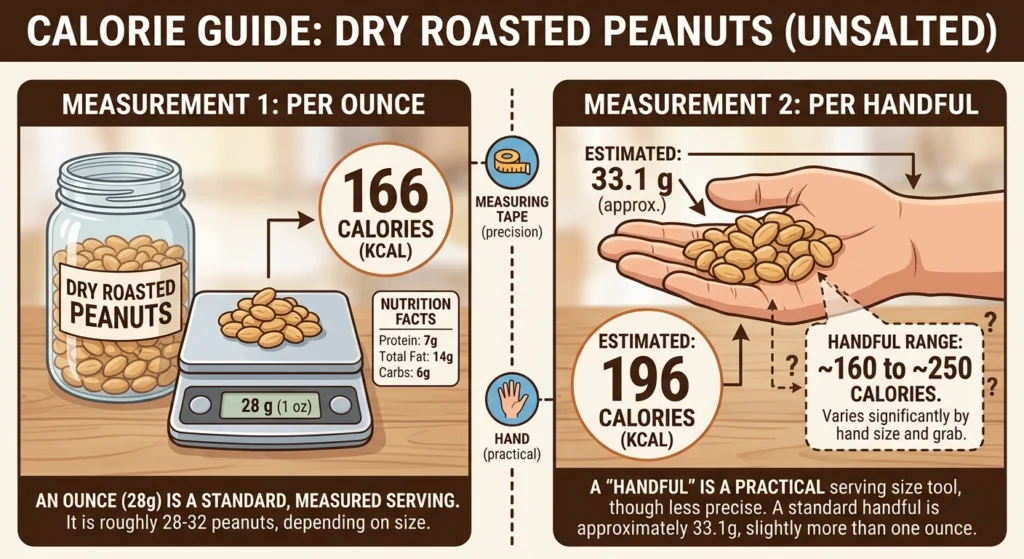
An ounce of dry roasted peanuts, about 28 grams, has 166 calories. That works out to roughly 7 grams of protein and 14 grams of fat per serving, making peanuts one of the more calorie-dense snacks on a per-ounce basis.
Below, we break down calories by amount, tackle the tricky question of what counts as “a handful,” and compare salted versus unsalted versions.
Dry Roasted Peanut Calories By Amount
| Amount | Calories | Protein | Fat |
|---|---|---|---|
| 1 oz (28g) | 166 kcal | 7g | 14g |
| 1/4 cup | 207 kcal | 9g | 18g |
| 1/2 cup | 414 kcal | 17g | 35g |
| 1 cup | 828 kcal | 34g | 70g |
Peanuts pack a lot into a small volume. A full cup carries over 800 calories, close to half of some people’s entire daily target in one snack bowl.
Dry Roasted Peanut Calories by Weight
If you use a kitchen scale, measuring peanuts by grams makes calorie tracking much easier. USDA-based nutrition data puts dry roasted peanuts at about 587 calories per 100 grams. The exact number can vary by brand and product.
| Weight | Approx. Calories | Portion |
|---|---|---|
| 10g | 59 kcal | Small portion |
| 20g | 117 kcal | Light snack |
| 28g | 166 kcal | About 1 oz |
| 30g | 176 kcal | Standard snack portion |
| 50g | 294 kcal | Large snack |
| 100g | 587 kcal | Large amount |
These numbers are estimates. Different brands can have slightly different calorie values because of peanut variety, roasting, moisture, serving size, and added ingredients. If you are tracking a specific product, use its nutrition label.
How Many Calories Are in One Dry Roasted Peanut?
One dry roasted peanut contains about 6 calories when using a common USDA-based reference. Ten peanuts would therefore be roughly 60 calories, while 20 peanuts would be roughly 120 calories.
The exact number can change because peanuts are not all the same size. Weighing peanuts is more accurate than counting individual nuts when you need precise calorie tracking.
Calculate Your Exact Peanut Calories
Use this calculator to check your total based on how much you are eating.
Dry Roasted Peanut Calculator
166 kcal
See how this fits your day → Calculate Your TDEE
The Problem With “A Handful” as a Measurement
Nutrition guidelines default to a 1-ounce serving for peanuts, but almost nobody actually measures out an ounce before snacking. A real handful varies enormously depending on hand size and how tightly peanuts are grabbed.
Estimates for a typical handful range anywhere from 160 to 250 calories, which is a meaningful swing if you are trying to track intake closely. The only reliable way to know your actual number is to weigh out a serving once or twice with a kitchen scale, just to calibrate what your personal “handful” tends to be.
Once you know roughly how many peanuts your handful holds, you can estimate future servings without weighing every single time.
Why Do Different Sources Give Different Peanut Calories?
You may see 156, 160, 166, 170, or even 180 calories listed for a 1-ounce serving of dry roasted peanuts. This does not always mean that one source is wrong.
Calories can vary between products because brands may use different peanut varieties, roasting methods, moisture levels, serving sizes, and added ingredients. Even two bags that look very similar can have different nutrition labels.
If you are eating packaged peanuts, the nutrition label on that package is the best source for that specific product. If you need a general estimate, a USDA-based food database can provide a useful reference.
Simple rule: Use the package label for the exact brand you are eating. Use a standard food database when you need a general estimate.
Dry Roasted vs Oil Roasted vs Raw Peanuts
Dry roasted peanuts are cooked without added oil, relying on the peanut’s own natural oil content during roasting. Oil roasted peanuts, by contrast, are cooked in additional oil, which pushes the calorie count up slightly, typically to around 170-175 calories per ounce.
Raw peanuts sit close to dry roasted in calories, since roasting itself does not add or remove much energy, it mainly changes flavor and texture. The bigger calorie differences come from what is added during processing, not the roasting step itself.
Dry Roasted Peanut Calories per 100g
USDA-based nutrition data lists about 587 calories per 100g for dry roasted peanuts without salt. The same amount provides about 24.4g of protein, 49.7g of fat, 21.3g of carbohydrates, and 8.4g of fiber.
This high calorie density mainly comes from the fat naturally found in peanuts. It is also why a small bowl of peanuts can contain a large amount of energy.
Dry Roasted Peanuts: Carbs, Fiber, and Net Carbs
Dry roasted peanuts are not carb-free, but they contain fiber along with their carbohydrates. USDA-based data gives about 21.3g of total carbohydrates and 8.4g of fiber per 100g.
If you track net carbs, you can estimate them by subtracting fiber from total carbohydrates. Using those values, 100g provides about 12.9g of net carbs.
Nutrition values can vary between products, so check the package label if you follow a strict low-carb or keto diet.
Salted vs Unsalted: Does It Change Calories?
Salt itself carries no calories, so salted and unsalted dry roasted peanuts are nearly identical in calorie count, generally within a few calories of each other per ounce. The real difference is sodium, with salted versions carrying 150-230mg of sodium per ounce compared to near-zero in unsalted versions.
If you are managing sodium intake rather than calories specifically, choosing unsalted or lightly salted versions makes a bigger difference than worrying about the calorie count.
How to Calculate Peanut Calories From Any Package
If the package gives calories for a serving that is different from the amount you ate, you can calculate your own portion with a simple formula.
Calories eaten = calories per serving × amount eaten ÷ serving size
For example, if a package lists 170 calories for 28g and you eat 40g, the calculation is 170 × 40 ÷ 28, which is about 243 calories.
This method is more accurate than guessing from a handful because it uses the nutrition information for the exact product you are eating.
Why Peanuts Are Calorie-Dense But Nutrient-Rich
Peanuts carry a lot of calories for their size because they are naturally high in fat, but most of that fat is the unsaturated kind associated with heart health rather than the saturated kind linked to negative outcomes. Alongside the fat, peanuts bring real protein and fiber to the table, roughly 7 grams and 2.3 grams per ounce.
This combination of protein, fiber, and healthy fat is part of why peanuts tend to be filling in small amounts, even though the calorie count per ounce looks high compared to something like fruit or popcorn.
Our breakdown of pecan calories covers a similar calorie-dense but nutrient-rich nut, if you are comparing peanuts against tree nuts for a snack rotation.
Are Dry Roasted Peanuts a Good High-Protein Snack?
They can be. A 1-ounce serving provides around 7 grams of protein while also providing fat and fiber. This makes peanuts different from very lean protein foods.
The trade-off is simple: peanuts provide useful protein in a small package, but they also contain a lot of calories. If your main goal is getting the most protein for the fewest calories, a leaner protein food may work better. If you want protein plus fat and a crunchy snack, a measured serving of peanuts can fit well.
How Dry Roasted Peanuts Fit Your Daily Calories
At 166 calories per ounce, peanuts work best as a measured snack rather than something eaten straight from a large container. A pre-portioned small bag or container helps keep servings consistent with what you are actually tracking.
If you are working toward a specific calorie or protein target, check your TDEE Calculator first, then use the calculator above to see how your usual serving fits your day. Our blog has more nut and snack breakdowns if you are building out a full snack rotation.
A Simple Portion Guide for Dry Roasted Peanuts
If you want peanuts as a snack but do not want to measure every bite, start with a small portion and learn what it looks like. Around 20g is roughly 117 calories using the 587-calorie-per-100g reference. Around 28g is about 166 calories using the standard 1-ounce reference used in this article.
Once you have weighed your normal portion a few times, you can recognize that amount more easily. This is more useful than trying to guess what a “handful” means for everyone.
- For a smaller snack: around 10-20g
- For a standard measured serving: around 28g (1 oz)
- For a larger snack: around 40-50g
- For accurate calorie tracking: weigh the peanuts
Peanuts in Recipes and Snack Mixes
Dry roasted peanuts show up constantly in trail mix, granola bars, and Asian-inspired dishes like pad thai or peanut noodle recipes. In a snack mix, it is easy to lose track of how many peanuts you have eaten, since they blend visually with raisins, chocolate chips, and pretzels.
A half cup of a typical trail mix containing peanuts can carry 300-400 calories, with the peanuts themselves usually contributing the largest single share of that total. If you are building your own mix at home, weighing out the peanut portion specifically helps keep the whole snack’s calorie count predictable.
Dry Roasted Peanuts vs Other Common Snacks
Peanuts are different from low-calorie snacks because their calories are concentrated into a small amount of food. This can be useful when you want a filling snack without a large volume of food, but it can also make accidental overeating easy.
Fruit and air-popped popcorn can provide more food volume for fewer calories, while peanuts provide more fat and protein in a smaller serving. The better choice depends on what you want from the snack.
Peanut Allergies and Cross-Contamination Notes
Since peanuts are one of the most common food allergens, packaging often includes cross-contamination warnings even for products that do not intentionally contain peanuts. This is separate from the calorie discussion, but worth flagging if you are shopping for peanuts specifically and need to check for shared-facility warnings on other snacks in your pantry.
What to Check on a Dry Roasted Peanut Nutrition Label
Do not look at calories alone. When comparing two bags of dry roasted peanuts, check the serving size first. Then compare calories, protein, total fat, saturated fat, fiber, carbohydrates, sodium, and added sugar.
Plain peanuts may have very few ingredients, while flavored or coated versions can contain salt, sugar, starch, sweeteners, or other ingredients. Two products that both say “dry roasted peanuts” on the front can therefore have different nutrition facts.
Peanuts vs Other High-Protein Snacks
Compared to other protein-forward snacks, peanuts hold up reasonably well. An ounce of peanuts provides about 7 grams of protein, similar to a hard-boiled egg, though with considerably more calories due to the fat content.
If your goal is maximizing protein while minimizing calories, leaner protein snacks like turkey jerky or Greek yogurt edge out peanuts. If you want a combination of protein, healthy fat, and genuine satiety in a small package, peanuts remain a solid, budget-friendly option.
Common Mistakes That Add Hidden Calories
- Assuming a “handful” is a fixed, small amount, when real handfuls can range from 160 to 250+ calories
- Snacking straight from a large jar without any sense of portion size
- Choosing oil roasted peanuts expecting the same calorie count as dry roasted, when oil roasting runs slightly higher
- Focusing on calories while ignoring sodium differences between salted and unsalted versions
- Losing track of peanut portions once they are mixed into trail mix or a larger snack blend
The Most Accurate Way to Track Peanut Calories
If calorie accuracy matters, the best method is simple: use a kitchen scale and the nutrition label for the exact product you are eating.
Put your bowl on the scale, add the peanuts, and record the weight. Then use the calories per serving on the package to calculate the calories for that weight. This removes most of the guesswork caused by cups, handfuls, and different peanut sizes.
For everyday eating, you do not need perfect precision. But if you are trying to stay close to a specific calorie target, weighing your serving is much more reliable than counting individual peanuts.
Frequently Asked Questions
How many calories are in a handful of dry roasted peanuts?
A typical handful runs anywhere from 160 to 250 calories, since handful size varies significantly from person to person. A measured 1-ounce serving has 166 calories.
How many calories are in salted dry roasted peanuts?
Salted dry roasted peanuts have about 166 calories per ounce, nearly identical to unsalted, since salt itself contributes no calories.
Are dry roasted peanuts healthier than oil roasted?
Dry roasted peanuts are slightly lower in calories per ounce since no additional oil is used during cooking, though the difference is modest, typically just a few calories.
How many calories are in a cup of dry roasted peanuts?
A full cup of dry roasted peanuts has approximately 828 calories, with 34 grams of protein and 70 grams of fat.
Are peanuts good for weight loss?
In measured portions, yes. Their protein and fiber content helps with fullness, but the calorie density means portion control matters more than with lower-calorie snacks.
How many calories are in Planters dry roasted peanuts?
Planters dry roasted peanuts run close to the standard 160-170 calories per ounce, in line with most major dry roasted peanut brands.
Do dry roasted peanuts have added sugar?
No, plain dry roasted peanuts contain no added sugar. Honey roasted varieties are a separate product that does include added sugar and runs higher in calories per ounce.
How many calories are in 10g of dry roasted peanuts?
Ten grams of dry roasted peanuts has about 59 calories using a 587-calorie-per-100g reference. The exact value can vary by product.
How many calories are in 20g of dry roasted peanuts?
Twenty grams has about 117 calories using the same 587-calorie-per-100g reference.
How many calories are in 30g of dry roasted peanuts?
Thirty grams has about 176 calories using the 587-calorie-per-100g reference. A product label may show a slightly different number.
How many calories are in 50g of dry roasted peanuts?
Fifty grams has about 294 calories using the 587-calorie-per-100g reference.
How many calories are in 100g of dry roasted peanuts?
USDA-based data lists about 587 calories per 100g for dry roasted peanuts without salt. This amount also provides about 24.4g of protein and 49.7g of fat.
Why do different brands of dry roasted peanuts have different calories?
Nutrition values can vary because brands can use different peanut varieties, roasting methods, moisture levels, serving sizes, and added ingredients. Always use the nutrition label for the specific product when accuracy matters.
Are dry roasted peanuts low in carbs?
Peanuts are relatively low in carbohydrates compared with many snack foods, but they are not carb-free. USDA-based data lists about 21.3g of total carbohydrates and 8.4g of fiber per 100g of dry roasted unsalted peanuts.
How can I measure peanut calories without counting each peanut?
Use a kitchen scale. Weigh the amount you want to eat and calculate the calories from the serving information on the package. This is more reliable than counting individual peanuts because peanut sizes vary.
Sources for Dry Roasted Peanut Nutrition Data
The calorie and nutrition figures in this article are based on established food-nutrition references and product-label examples. Values can vary between products, so the package label should be used when you need the exact value for a specific brand.
- USDA-based dry roasted peanut nutrition data via MyFoodData
- USDA dry roasted peanuts reference via FatSecret
- Nuts.com dry roasted peanut product label example
- FDA food allergy and labeling information
Nutrition note: Food values are estimates and can change by product, serving size, preparation, and labeling method. For medical or allergy-related decisions, use the product label and guidance from an appropriate health professional.
Pingback: Pecan Calories: Raw, Roasted & Candied Compared