How Many Calories Are in an Acai Bowl With Granola?
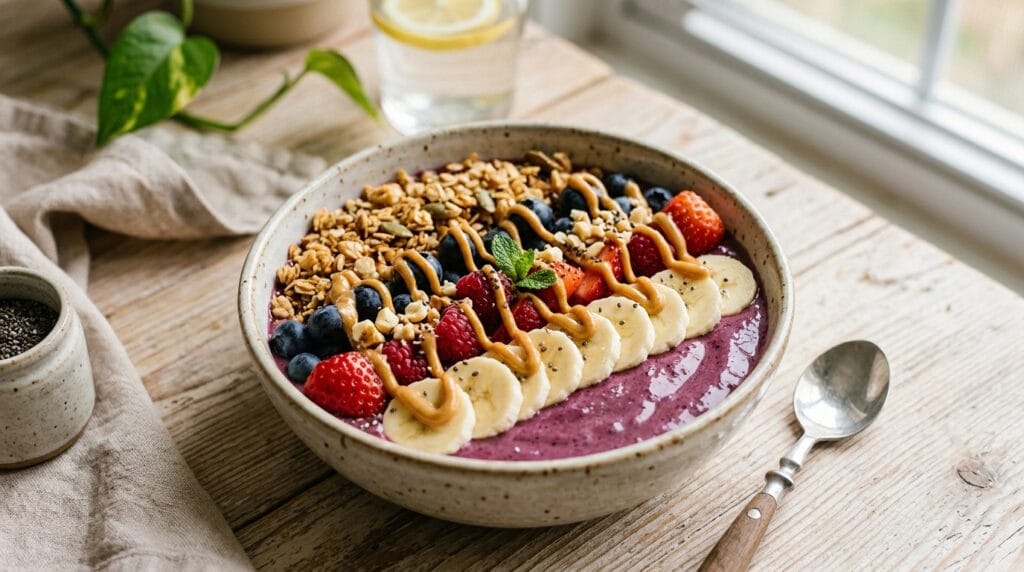
A small acai bowl with granola has about 300-450 calories. Add peanut butter, and the total can climb to 600-750 calories, depending on how many scoops and how much granola gets added.
By Ray Smith. Below, we break down calories by size, topping, and real brand, look at the sugar and blood sugar angle most breakdowns skip, and compare a simple berry-topped bowl to a loaded peanut butter version.
Acai Bowl Calories by Size and Toppings
| Bowl Type | Calories | Protein |
|---|---|---|
| Small, acai + berries only | 150-200 kcal | 2-3g |
| Small with granola | 300-400 kcal | 4-6g |
| With granola + peanut butter | 450-600 kcal | 10-14g |
| Signature/loaded peanut butter bowl | 600-750+ kcal | 15-20g |
The gap between a simple berry bowl and a loaded peanut butter version can be 400-500 calories, almost entirely from toppings rather than the acai base itself.
Acai Bowl Calories by Brand
Packaged and grab-and-go acai bowls vary a surprising amount, largely based on how much added sugar and how large the portion is.
| Brand | Serving | Calories |
|---|---|---|
| Clovis Farms Organic Acai Bowl | 241g, w/ granola | 210 kcal |
| Tattooed Chef Organic Acai Bowl | 1 bowl w/ topping | 230 kcal |
| Project Juice Acai Bowl & Granola | 2 oz package | 220 kcal |
| Safeway Acai Bowl with Granola | 12 oz | 450 kcal |
Notice the more than 2x spread between the lightest and heaviest packaged options. Frozen grocery-brand bowls tend to sit lower, while juice bar and cafe versions, built fresh with generous granola and nut butter, run closer to the 450-750 calorie range.
Calculate Your Exact Acai Bowl Calories
Use this calculator to build your bowl and see the total.
Sugar Content: The Real Number to Watch
Calories are only half the story with acai bowls. Unsweetened frozen acai on its own is genuinely low in sugar, but the puree packs many cafes use are often pre-sweetened with juice or syrup, and toppings like honey, granola, and sweetened milk stack on top of that.
A basic 6 oz bowl can carry around 11-19 grams of sugar, but a fully loaded commercial bowl with sweetened puree, banana, granola, and honey can climb to 50-75 grams of sugar in a single serving, which is close to the sugar in a can of soda. The American Heart Association recommends women cap added sugar at about 25 grams a day and men at about 36 grams, so a single loaded bowl can use up a full day’s limit before lunch. Asking for unsweetened acai and going light on honey or sweetened granola keeps a bowl in a much more reasonable sugar range.
Is an Acai Bowl Keto-Friendly?
Usually not as typically served. A standard acai bowl with granola and fruit toppings runs 15-18+ grams of net carbs per serving, and a loaded version with banana, honey, and a large granola portion can push well past 30-40 grams, more than an entire day’s carb budget on strict keto.
The acai berry itself is a different story. Unsweetened frozen acai carries only about 2 grams of net carbs per 100 grams, making it genuinely low-carb on its own. A keto-friendly version is possible by using unsweetened acai, a small amount of berries instead of banana, a keto sweetener instead of honey, and skipping granola or swapping in a low-carb seed topping. If keto or low-carb eating is part of your routine, our carnivore and IIFYM calculator can help you see how a bowl like this fits into a stricter daily carb target.
Acai Bowls and Blood Sugar
Because most of an acai bowl’s carbs come from sugar rather than starch, a large, sweetened bowl can raise blood sugar quickly, especially without much protein or fat to slow digestion. This matters most for anyone managing diabetes or watching blood sugar closely, since a “healthy-looking” breakfast bowl can behave more like a dessert once juice-sweetened puree, banana, and honey are all stacked together.
Choosing an unsweetened acai base, swapping banana for a smaller portion of lower-sugar berries, and adding a protein source like Greek yogurt or a scoop of protein powder all help blunt that blood sugar response. Building the bowl around berries and protein rather than banana and honey is the simplest way to keep it steadier.
Why the Acai Base Itself Is Not the Problem
Pure acai puree is relatively modest in calories, and most of what it contributes comes from natural fruit fat, since acai is unusual among fruits for getting a large share of its calories from healthy fat rather than sugar. A plain acai and banana base without any toppings typically lands around 150-200 calories for a standard bowl size.
It is the toppings, not the acai itself, that push a bowl from a light snack into a 700+ calorie meal. This is worth knowing if you assume “acai” automatically means low calorie, since the base and the finished bowl can be very different numbers.
Granola: The Single Biggest Topping Contributor
Granola is calorie-dense by nature, since it typically includes oats, nuts, seeds, and some form of oil or sweetener baked together. A quarter cup, a common single topping portion, adds roughly 150-200 calories on its own.
Sweetened or oil-heavy granolas run toward the higher end of that range, while a simple, low-sugar seed-based granola sits closer to 130-150 calories for the same portion. If you are trying to manage calories without giving up the crunch, checking the granola’s sugar content specifically, not just portion size, makes a real difference.
Peanut Butter: Small Amount, Big Impact
A single tablespoon of peanut butter adds 90-100 calories, and it is easy to use two or three tablespoons on a “loaded” bowl without measuring. This is a major reason signature peanut butter acai bowls at juice bars and cafes often land in the 600-750 calorie range, even though the base itself started much lighter.
If you enjoy the flavor but want to manage calories, using half a tablespoon or drizzling rather than scooping generously keeps the peanut butter flavor without doubling its calorie contribution.
What About the Antioxidant Claims?
Acai is frequently marketed as a superfood, and it is a genuine source of antioxidant plant compounds called anthocyanins, along with fiber and healthy fats. That said, it is worth keeping the marketing in perspective. According to Cleveland Clinic, most of the stronger claims around acai, like dramatic weight loss or disease reversal, are not well supported by human research, even though the fruit itself is nutritious and worth eating in an unsweetened form.
In practice, this means the healthiest way to think about an acai bowl is as a fiber and antioxidant-rich fruit base, not a medicinal food, with the real calorie and sugar impact coming almost entirely from how it is built and topped.
Building a Lighter Acai Bowl
A few simple swaps meaningfully change the total without giving up the format entirely.
- Choose a smaller base size: a 12 oz bowl saves 150-250 calories compared to a 24 oz version
- Ask for unsweetened acai: cuts a meaningful amount of sugar before toppings are even added
- Measure granola instead of free-pouring: keeps toppings closer to a quarter cup rather than a heaping half cup
- Use fresh berries over banana and honey: lowers sugar while still adding sweetness and volume
- Go easy on nut butter: half a tablespoon instead of two or three keeps flavor without doubling calories
How an Acai Bowl Fits Your Daily Calories
At 300-450 calories for a standard bowl with granola, or 600-750+ for a loaded peanut butter version, an acai bowl can work as a full breakfast or light meal depending on how it is built. If you are working toward a specific target, check your TDEE calculator first, then use the calculator above to build your bowl and see the total. Our guide on how much protein you need per day is useful here too, since a basic acai bowl is fairly low in protein unless nut butter or a protein topping is added.
Our breakdown of dried cherries calories and dry roasted peanuts calories cover two common acai bowl toppings in more detail, if you are building out a full topping combination. Our guide on Noosa yoghurt calories covers a similar breakfast bowl option, if you are comparing acai against a yogurt-based alternative.
Acai Bowls at Home vs Juice Bars
Making an acai bowl at home gives significantly more control over portion size, sweetness, and toppings compared to ordering from a juice bar or smoothie shop. Homemade bowls built with unsweetened acai, fresh fruit, and measured toppings typically land closer to 250-450 calories, generally lower than many commercial signature bowls that stack multiple scoops of nut butter and larger granola portions.
If you order out regularly, asking for unsweetened acai, toppings on the side, or a lighter granola portion gives you similar control to making it yourself, without needing to measure ingredients at home.
Acai Bowls as a Breakfast vs Dessert
Whether an acai bowl functions as a light breakfast or a dessert-like treat depends almost entirely on toppings. A base with berries, a protein source, and a modest granola portion works well as a balanced breakfast, while a version loaded with chocolate, multiple nut butter scoops, and honey drizzle starts to resemble a sundae more than a morning meal.
Neither approach is wrong, but knowing which category your bowl falls into helps set realistic expectations for how it fits into your day’s overall calorie and sugar budget.
Common Mistakes That Add Hidden Calories
- Assuming “acai bowl” automatically means low calorie, when toppings can push a bowl past 700 calories
- Not checking whether the acai puree itself is pre-sweetened, which adds sugar before any toppings go on
- Free-pouring granola instead of measuring, since a heaping half cup can double the intended portion
- Adding multiple scoops of nut butter without tracking that each tablespoon adds close to 100 calories
- Choosing a large base size out of habit when a smaller size would still feel satisfying with the same toppings
- Treating a loaded, dessert-style bowl the same as a simple breakfast bowl when tracking daily intake
Frequently Asked Questions
How many calories are in a small acai bowl?
A small acai bowl with basic fruit toppings has about 150-250 calories, while adding granola brings it closer to 300-400 calories.
How many calories are in an acai bowl with peanut butter?
An acai bowl with granola and peanut butter typically has 450-600 calories, and signature loaded versions can reach 600-750+ calories depending on portion sizes.
How many calories are in an acai bowl with granola?
An acai bowl with a standard granola topping has approximately 300-400 calories for a small size.
Is an acai bowl healthy?
The acai base offers fiber and antioxidants, but calorie and sugar counts depend heavily on toppings and whether the puree is pre-sweetened, so portion control matters for keeping it a balanced choice.
How much sugar is in an acai bowl?
A basic bowl can have 11-19 grams of sugar, while a fully loaded commercial bowl with sweetened puree, banana, and honey can carry 50-75 grams, close to the sugar in a can of soda.
Is an acai bowl keto-friendly?
Not usually as served, since a typical bowl runs 15-18+ grams of net carbs. An unsweetened acai base with berries instead of banana and no granola can be built closer to keto-friendly.
How many calories are in a large acai bowl?
A large 24 oz acai bowl can exceed 700 calories once granola, fruit, and nut butter toppings are added, compared to 300-400 for a smaller 12 oz version.
Are acai bowls good for weight loss?
They can be, if built with a smaller base, unsweetened acai, measured granola, and light nut butter use. Loaded, dessert-style versions with multiple toppings run high enough in calories and sugar to work against a weight loss goal.
How many calories are in an acai bowl with just fruit?
An acai bowl topped only with fresh fruit, no granola or nut butter, typically has 200-280 calories, making it one of the lighter ways to enjoy the format.