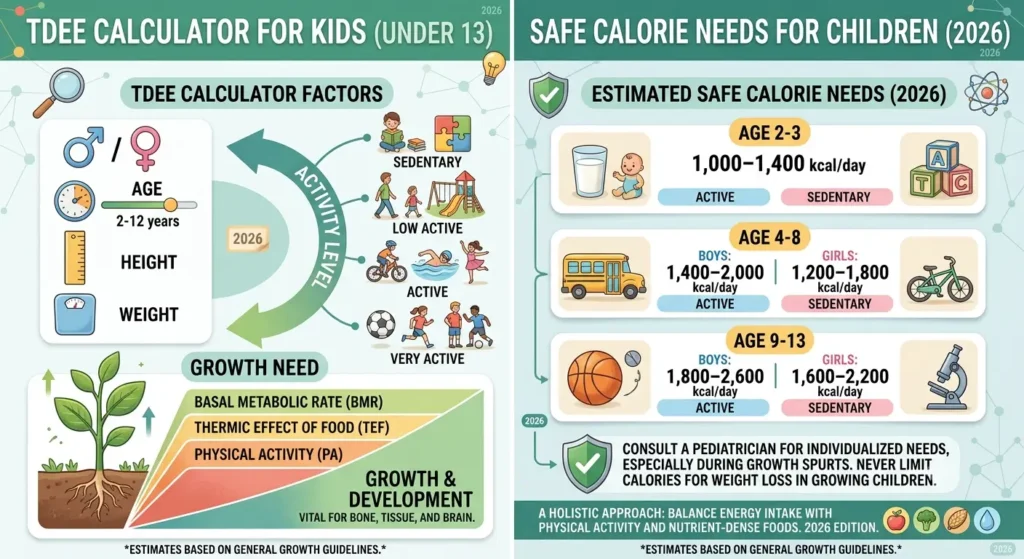
Important note before you read further: This article is written for parents and caregivers as an educational reference, not as a calorie-counting or weight-loss tool for children. Children under 13 should never be placed on a calorie-restricted diet without direct guidance from a pediatrician. If you have any concern about your child's weight, growth, or eating habits, the right first step is always a conversation with your child's doctor, not a calculator. Everything below is meant to help you understand how children's energy needs work and why growth monitoring, not calorie tracking, is the appropriate approach for this age group.
Why Adult TDEE Formulas Don't Apply to Children Under 13
If you've used a TDEE calculator for yourself, you've likely seen it built on the Mifflin-St Jeor equation. That formula was developed and validated using adult data, and it assumes a body that's no longer growing. Children's bodies are doing something adult bodies aren't: building new bone, muscle, and organ tissue every single day. That growth process requires its own dedicated energy allowance on top of basic metabolic needs, something adult formulas simply don't account for.
This is exactly why pediatric researchers use different, age-specific equations rather than adult formulas scaled down. Applying an adult-calibrated formula to a growing child's body risks under- or overestimating their real energy needs, in a period of life where getting it wrong has real developmental consequences.
The Schofield Equation: The Pediatric-Appropriate Alternative
The Schofield equation is one of the most widely used formulas in clinical pediatric nutrition for estimating resting energy expenditure in children. Unlike Mifflin-St Jeor, it was developed with age-and-sex-specific coefficients derived from studies that included pediatric populations, and it's the formula referenced most often in pediatric nutrition and hospital dietetics settings, precisely because general-population adult equations don't hold up for growing children.
It's worth being clear about what this equation is actually for. In clinical and research settings, the Schofield equation helps healthcare professionals estimate a child's baseline energy needs, often in a hospital or specialist nutrition context. It is not a tool intended for parents to use for everyday calorie tracking or restriction at home. Even within pediatric medicine, researchers note these equations only estimate energy needs within a reasonable range and can under- or overestimate individual children's actual requirements, which is exactly why clinical energy assessments in children are supervised by trained professionals rather than done through a home calculator.
Typical Calorie Ranges by Age Group (For Context Only)
The ranges below come from the U.S. Department of Agriculture's Dietary Guidelines for Americans, which publish estimated calorie needs by age, sex, and activity level for the general population. These numbers exist to help nutrition professionals and researchers understand population-level energy needs. They are not targets to track, restrict toward, or use as a daily goal for an individual child. Every child's actual needs vary based on their growth pattern, activity, and body composition, which is exactly why your pediatrician, not a table, is the right authority on your specific child.
Swipe sideways on mobile to see the full table.
| Age Group | Typical Range (USDA reference) | Context |
|---|---|---|
| 4-6 years | ~1,200-1,600 kcal/day | Varies by sex and activity level; not a target |
| 7-9 years | ~1,400-2,000 kcal/day | Range widens as activity level differences grow |
| 10-12 years | ~1,600-2,200 kcal/day | Approaching pre-puberty growth acceleration in many children |
Notice how wide these ranges are, and that's the point. A healthy, active 8-year-old and a healthy, less active 8-year-old can have genuinely different energy needs, and both can be perfectly normal. This is fundamentally different from adult TDEE tracking, where narrowing in on a specific number is often the goal. For children, the goal is making sure a balanced range of nutritious food is available, not hitting an exact number.
Why Calorie Restriction or Dieting Is Not Appropriate for This Age Group
This is the most important section of this article. Children under 13 are in an active growth phase, and restricting calories during this window can interfere with normal growth, bone development, and long-term metabolic health. It can also contribute to disordered eating patterns that carry into adolescence and adulthood. Pediatric nutrition guidance consistently emphasizes that any weight-related concern in a child should be addressed through a pediatrician, not through independent calorie counting or restriction started by a parent at home.
If you're concerned about your child's weight, appetite, or eating habits, please bring it directly to your child's pediatrician. They can assess growth trends over time, consider your child's individual health history, and determine whether any intervention is appropriate, and if so, what kind. This is not a decision to make based on an online calculator or a generic calorie chart, for any child of any age, but especially not for a child under 13.
Growth Chart Tracking: The Correct Alternative to Calorie Counting
Instead of calorie counting, pediatric medicine relies on growth chart tracking as the standard way to monitor a child's healthy development. This is what your pediatrician is actually doing at every well-child visit when they measure height and weight.
For children under 2 years old, the U.S. Centers for Disease Control and Prevention and the American Academy of Pediatrics jointly recommend using the WHO Child Growth Standards, which describe how children should grow under optimal health conditions. For children 2 years and older, including the 4-12 age range this article focuses on, the CDC growth reference charts become the standard tool, tracking height-for-age, weight-for-age, and BMI-for-age as percentiles rather than fixed numbers.
Percentile tracking matters more than a single measurement. A child consistently tracking along the 40th percentile for weight-for-age is generally considered to be growing normally, even though "40th percentile" might sound low to a parent unfamiliar with how these charts work. What actually raises a flag for a pediatrician is a child's percentile shifting significantly up or down over time, not where they sit on any single visit. This is precisely why growth monitoring is done by trained professionals plotting data across multiple visits, rather than parents interpreting a single number at home.
It's also worth knowing that the World Health Organization deliberately built caution into its own growth standards for this exact reason. In its official guidance on the standards, WHO notes that its conservative approach to defining overweight risk in young children is specifically intended to avoid the risk of parents placing young, growing children on restrictive diets based on a single growth measurement. That's a deliberate safeguard built into international pediatric standards, and it's a good reason for parents to lean on their pediatrician's interpretation of these charts rather than trying to self-diagnose a growth concern.
What Parents Can Actually Do
If you want to support your child's healthy growth without turning to calorie counting, the most effective approach recommended by pediatric nutrition guidance is straightforward: offer a variety of nutrient-dense foods across food groups, let your child's own hunger and fullness cues guide portion sizes, keep mealtimes relatively structured and free of pressure around eating more or less, and bring any specific concerns to your pediatrician rather than addressing them through independent tracking. The American Academy of Pediatrics' nutrition guidance for families is a genuinely useful resource for age-appropriate feeding practices if you want to go deeper on this.
If your child is 13 or older, the picture starts to shift somewhat as adolescent growth patterns and activity levels change substantially. Our TDEE for Teenagers guide covers that age range specifically, still with an emphasis on healthy growth rather than restriction, but reflecting the different physiological stage teenagers are in.
Frequently Asked Questions
Should I use a TDEE calculator for my child under 13?
No. Standard TDEE calculators are built on adult formulas and aren't appropriate for growing children. If you have concerns about your child's energy needs, growth, or weight, talk to your pediatrician, who can assess your specific child using proper pediatric growth tracking.
What is the Schofield equation and is it meant for parents to use at home?
The Schofield equation is a clinical formula used by pediatric healthcare professionals to estimate a child's resting energy needs, most often in medical or research settings. It's not designed or intended for home use by parents for everyday calorie tracking.
Is it safe to put my 10-year-old on a calorie-restricted diet?
No, calorie restriction is not appropriate for children under 13 without direct pediatrician involvement and supervision. Restricting calories during active growth years can interfere with development. Any weight concern should be discussed with your child's doctor first.
How do doctors actually monitor whether my child is growing healthily?
Pediatricians use growth charts, either WHO standards for children under 2 or CDC growth reference charts for children 2 and older, tracking height, weight, and BMI-for-age as percentiles over multiple visits, rather than counting calories.
What should I do if I'm worried about my child's weight?
Talk to your pediatrician. They can review your child's growth history, consider individual factors, and recommend an appropriate path forward if one is needed, which is a very different process than calorie counting at home.
Why do the calorie ranges for kids vary so much even within the same age group?
Children's energy needs depend on activity level, growth rate, body size, and individual metabolism, which naturally vary a lot even among healthy kids the same age. This is exactly why a single calorie number isn't a useful target for an individual child; a pediatrician evaluating growth trends over time is far more meaningful.
About the Author: This guide was written by Ray, a fitness and nutrition tech developer at MyTDEECalculatorPro.
Medical Disclaimer: This article is for general educational purposes only and is not a substitute for professional medical advice. It is not intended for use as a calorie-counting or dieting tool for children of any age. Children under 13 should never have their calorie intake restricted without the direct involvement and supervision of a pediatrician. If you have concerns about your child's growth, weight, or eating habits, please consult your child's pediatrician or a registered pediatric dietitian.