For most people who land on this site, TDEE is about managing weight — figuring out a deficit, a surplus, a maintenance number. For teenagers, it’s a completely different question. TDEE for a teenager is really about fuel: how much energy a body that’s growing taller, building bone density, adding muscle, and going through one of the biggest developmental shifts of a human life actually needs just to keep up with itself.
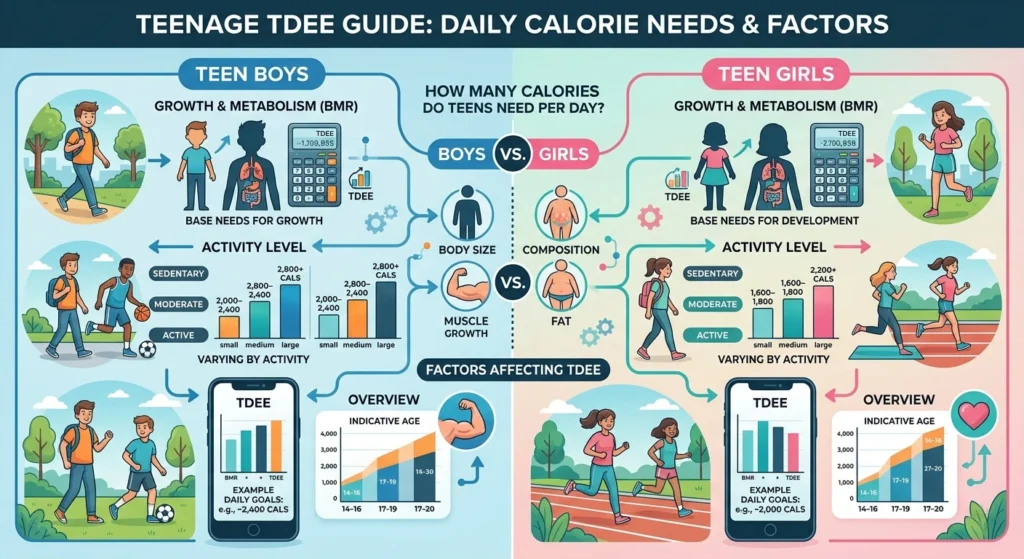
Here’s the headline number, stated plainly: teenagers need significantly more calories relative to their size than adults do — often somewhere between 2,000 and 3,200 calories a day, depending on age, sex, and how active they are. That’s normal. That’s healthy. That’s necessary. It is not a sign that a teen “needs to watch their weight,” and it’s not a number to be nervous about.
This article covers how TDEE differs between teen boys and girls (and why those differences are real and meaningful, not arbitrary), how the timing of growth spurts affects calorie needs differently depending on sex, how to actually calculate TDEE for a teenager using a validated formula, how much protein matters during these years, and — probably the most important section for any parent of an active teen — why calorie restriction during adolescence is something that needs medical involvement, not a DIY approach. If you want to see the numbers for your own teen, our free TDEE calculator is a useful starting point for understanding what a growing body actually needs — think of it here as a growth-nutrition tool, not a dieting tool.
Why Teenagers Need So Many More Calories Than Adults
Adolescence is the second-fastest period of growth a human goes through — only infancy is faster. During the peak of a growth spurt, a teenager can gain somewhere between 10 and 15 centimetres in height and 4 to 6 kilograms in body weight in a single year. That’s not just “getting bigger” in a vague sense — it’s bone lengthening and densifying, organs growing to match a larger body, and, particularly for boys, a substantial increase in muscle mass.All of that construction work costs energy — energy that sits on top of the baseline TDEE number a formula like Mifflin-St Jeor would calculate. This is why a 16-year-old boy who happens to be 175 cm tall and weighs 68 kg has a noticeably higher TDEE than a 30-year-old man with the exact same height and weight. The adult’s body has finished building itself. The teenager’s body is still under construction, and that construction has a calorie cost that gets added on top of everything else.Why Boys and Girls Have Different Calorie Needs During Adolescence
If you’ve ever watched a teenage boy and a teenage girl of similar ages eat completely different amounts and wondered whether that’s actually normal — it is, and there are two specific, well-documented reasons why.The first is timing and shape of the growth spurt itself. Boys tend to hit their growth spurt later — typically peaking somewhere between 14 and 16 — but it’s a more dramatic spurt, and a much larger share of that growth goes into lean muscle mass. Girls tend to hit their growth spurt earlier, typically peaking between 12 and 14, and proportionally more of that growth involves fat mass gain, which is a normal and essential part of female reproductive development.The second factor is what happens by the end of adolescence: the gap in lean body mass between males and females, which is relatively small in childhood, widens considerably during these teenage years. This is, in a real sense, the period where the adult male-female difference in calorie needs actually forms — it isn’t something teenagers are born with, it’s something that develops during these specific years.In practical terms, major nutrition guidelines — including the Dietary Guidelines for Americans and guidance from the American Academy of Pediatrics — put teenage boys aged 14–18 at roughly 2,800–3,200 calories per day at moderate activity, while teenage girls of the same age sit at roughly 2,000–2,400 calories per day. To be clear, this isn’t a statement that girls “need less” in any diminished sense — it reflects genuinely different growth trajectories and different end points in body composition. If you’re a parent trying to figure out whether your teenager’s appetite is in the normal range, these numbers are a solid, evidence-based reference point.When Calorie Needs Peak — The Growth Velocity Timeline
Here’s a detail that rarely gets explained clearly anywhere: calorie needs don’t rise in a straight line through adolescence, and they don’t peak at the same age for boys and girls.For boys, TDEE climbs steadily from around age 12, with the steepest rise happening between 13 and 16, and typically peaks around 16–17 — the period of peak height velocity. An active teenage boy in this window can have a TDEE of 3,000–3,200 calories or more. After 17, TDEE gradually eases back down toward adult baseline levels as growth slows.For girls, the curve shifts earlier. TDEE starts rising around age 11, peaks earlier — typically around 14–15 — coinciding with peak height velocity and the usual timing of menarche, and then plateaus before gradually declining toward adult levels by 16–17.What this means practically: a 14-year-old girl’s calorie needs may already be close to where they’ll settle as an adult, while a 14-year-old boy’s needs are still climbing significantly and have a couple more years of meaningful increase ahead. This is also the simple, physiological explanation for why teenage boys between roughly 15 and 17 often seem to eat constantly — they’re at or near the highest caloric requirement they’ll have in their entire life.How to Calculate TDEE for a Teenager
The good news is that the same Mifflin-St Jeor equation used throughout this site is validated for use in teenagers aged 13 and up — no separate formula needed.For male teens: BMR = (10 × weight in kg) + (6.25 × height in cm) − (5 × age) + 5. For female teens: BMR = (10 × weight in kg) + (6.25 × height in cm) − (5 × age) − 161.One important boundary to flag clearly: for teens under 13, growth-specific paediatric formulas — such as the Schofield equation — are more appropriate, and that calculation is best worked through with a paediatrician rather than independently. Everything in this article and the calculator on this site is intended for ages 13 and above.Worked Example — TDEE for an Active 16-Year-Old
Let’s run the numbers for a 16-year-old boy, 175 cm tall, weighing 68 kg, who plays football five days a week.BMR = (10 × 68) + (6.25 × 175) − (5 × 16) + 5 BMR = 680 + 1,093.75 − 80 + 5 BMR = 1,698.75 caloriesTraining five days a week with regular matches puts him in the “very active” category, with a multiplier of around ×1.725:TDEE = 1,698.75 × 1.725 ≈ 2,930 calories per dayThat’s the baseline figure — and it’s already a substantial number. But there’s an important caveat for teen athletes specifically: this figure assumes a single daily training session factored into the activity multiplier. A teenager in twice-daily training — pre-season football camps are the classic example — can need 3,500 to 4,000 calories a day or more, and the standard activity multipliers tend to underestimate this kind of demand significantly.The practical advice here is to treat the calculated TDEE as a starting point, not a ceiling. For teen athletes in heavy training blocks, the more useful signals are how their growth is tracking on their paediatric growth chart over time and how their energy levels hold up — not strict adherence to a single formula output. You can run your own teen’s numbers through the TDEE calculator to get this baseline figure as a reference point.Teenager Calorie Calculator: Find Your Teen’s Daily TDEE
Use the calculator below to estimate your teenager’s daily calorie needs (TDEE) based on the same Mifflin-St Jeor formula explained above, along with a healthy protein range for the growth years. This tool is built for understanding normal, healthy calorie needs — not for weight-loss dieting in this age group.
Estimated BMR: calories/day
Estimated TDEE: calories/day
Suggested protein range: per day
This is a maintenance estimate to support healthy growth — not a weight-loss or diet target. Any intentional calorie adjustment for a teenager should be discussed with a doctor or registered dietitian.
Protein Needs During the Growth Years
Teenagers need more protein per kilogram of body weight than a sedentary adult does — and there are two separate reasons stacking on top of each other here. The first is ongoing tissue construction: muscle, organs, and the protein matrix that bone is built around all require a steady supply of amino acids beyond simple maintenance. The second is that most teenagers are also reasonably active — school sport, PE, weekend activities — which adds training-related protein needs on top of the growth-related ones.The research-backed range for teenagers sits at roughly 1.0–1.6 grams of protein per kilogram of body weight per day, with the higher end of that range appropriate for teens involved in regular sports training. For our worked example — a 68 kg active teenager — that works out to roughly 68 to 109 grams of protein per day.You might notice that range looks quite similar to protein recommendations you'll see for adult athletes. The numbers are similar, but the purpose isn't quite the same — for an adult, that protein is mainly supporting training recovery and muscle maintenance or growth. For a teenager, the same protein is doing that job and supporting ongoing growth at the same time. Getting enough protein during these years has implications that last a lifetime — peak bone mass, largely set during adolescence and early adulthood, is influenced by adequate protein intake during this window. This isn't an optional extra to consider once other nutrition boxes are ticked; it's one of the genuine priorities of this life stage.Why Calorie Restriction During Adolescence Requires Medical Supervision
This is, honestly, the most important section in this entire article — and it's the part that most "TDEE for teens" content online gets badly wrong by simply applying adult dieting logic to a body that's still under construction.Here's the core principle: unlike an adult, a teenager's body is still growing, and it prioritises that growth — height, bone density, organ development, and for girls, reproductive maturation — using whatever energy is available. When an adult eats less than they burn, their body draws on fat stores in a relatively predictable way. When a teenager's energy intake is insufficient, the body doesn't just "burn fat" the same way — it can slow down or even pause growth processes altogether, and in some cases, those effects aren't fully reversible later.This is where the concept of RED-S — Relative Energy Deficiency in Sport — becomes genuinely important. RED-S is recognised by sports medicine organisations as a condition where someone's energy intake isn't keeping pace with the energy their training (and, in teens, their growth) is demanding. The consequences can show up across multiple systems at once: bone density, immune function, growth itself, and — for girls specifically — menstrual cycle regularity.Here's the detail that surprises a lot of people: RED-S can occur in teens who aren't underweight by any conventional measure. It's about energy availability — roughly, the calories left over for the body's basic functions once the energy cost of exercise has been subtracted, relative to lean body mass — not about how someone looks or what the scale says. Sports medicine guidance suggests that energy availability shouldn't drop below approximately 45 kilocalories per kilogram of lean body mass per day for adolescent athletes. Dropping below that threshold, even for relatively short periods, is associated with the kinds of symptoms RED-S describes. This is genuinely useful information for any family with an active teenager, and it's something that rarely gets mentioned in general nutrition content aimed at this age group.Warning Signs That a Teen May Not Be Eating Enough for Their Activity Level
These are signs worth knowing about — not as a checklist for self-diagnosis or self-correction, but as things that are worth raising with a doctor if you notice them.Getting sick often, or taking longer than usual to recover from minor colds and infections, can be a signal. So can a noticeable slowdown in height growth — something best tracked against paediatric growth charts at roughly six-month intervals rather than judged from week to week. For girls specifically, irregular or absent periods (amenorrhoea) is a significant warning sign of inadequate energy availability — and it's worth being clear that this is not "normal for athletes," despite sometimes being treated that way. Persistent tiredness that doesn't improve with rest, a noticeable dip in performance at sport or school despite continued training, and changes in mood — irritability, low motivation, trouble concentrating — can all be part of the same picture.None of these signs, on their own, mean something is definitely wrong. But if a few of them are showing up together, especially in an active teen, that combination is worth a conversation with a GP, paediatrician, or — in a sporting context — a sports medicine physician.If Weight Management Is a Genuine Concern — Why a Professional Should Be Involved
If a parent, guardian, or teenager genuinely has concerns about weight — in either direction — the right next step is a conversation with a GP or paediatrician, not an independent calorie-restricted plan borrowed from adult TDEE guidance.There's a good reason for this. A doctor can look at a teenager's growth trajectory against their own growth curve over time — which is far more meaningful than comparing against population averages — and can rule out underlying medical causes before anything dietary is even considered. If a dietary adjustment genuinely is appropriate, a registered dietitian can be brought in to design something that fits the situation. Where guidance does suggest a calorie adjustment is appropriate for a teenager, paediatric nutrition sources generally point to something modest — no more than 200–300 calories below TDEE — and always under professional supervision, because larger deficits during the growth years carry risks that simply don't exist for adults, including potential effects on final adult height, bone density, and pubertal development.To be completely clear about the purpose of this article and the calculator on this site: the goal is to help teenagers and the people supporting them understand what normal, healthy calorie needs look like during these years of rapid growth. It is not intended as a basis for independent weight-loss dieting in this age group, and we'd encourage anyone with genuine concerns to bring those to a healthcare professional rather than working through them alone.Quick Reference — Teen Calorie Needs by Age and Sex
The table below pulls together the ranges discussed throughout this article into one quick reference. As with everything else here, these are guides for understanding typical needs — not targets to hit precisely.| Age Group | Boys (moderate activity) | Girls (moderate activity) |
|---|---|---|
| 11–13 years | ~2,200–2,600 cal/day | ~1,800–2,200 cal/day |
| 14–16 years | ~2,800–3,200 cal/day | ~2,000–2,400 cal/day |
| 17–18 years | ~2,800–3,200 cal/day, easing slightly | ~2,000–2,400 cal/day, near adult levels |
| Highly active / twice-daily training (any age above) | Up to ~3,500–4,000+ cal/day | Upper end of range or above, individually assessed |
Frequently Asked Questions
How many calories does a teenage boy need per day?
Based on major nutrition guidelines — including the Dietary Guidelines for Americans and the American Academy of Pediatrics — teenage boys aged 14–18 typically need roughly 2,800–3,200 calories per day at moderate to high activity levels, with needs peaking around age 16–17 during peak growth velocity. Boys aged 11–13 generally need around 2,200–2,600 calories per day. Highly active teen athletes, particularly those training twice a day, may need 3,500–4,000 calories or more. These are figures that support normal growth — not numbers that suggest any need for restriction.How many calories does a teenage girl need per day?
Teenage girls aged 12–18 typically need around 2,000–2,400 calories per day depending on activity level. Calorie needs rise from around age 11, peak earlier than boys' — around 14–15, alongside peak height velocity and the usual timing of menarche — then plateau and gradually ease toward adult levels by 16–17. Active girls involved in regular sport should sit at the higher end of this range or above; restricting below typical guidelines during this period carries specific risks to bone density and menstrual health, covered in more detail in the energy availability section of this article.Is it normal for a teenager to be hungry all the time?
Yes — and this is especially true for teenage boys roughly between 14 and 17, when calorie needs are at their highest point for their entire lives so far, driven by the growth spurt. A teenager who seems to be eating constantly and is still hungry is, very often, simply responding accurately to genuinely elevated energy needs during this window. This is a normal, healthy signal rather than something to be concerned about — and certainly not something to respond to by limiting food — as long as the food choices are reasonably balanced and growth is tracking normally on standard growth charts.Should teenagers count calories or track macros?
Generally, no. For most teenagers, structured calorie or macro tracking isn't recommended and can contribute to disordered eating patterns during what's already a developmentally sensitive period. The focus for this age group is better placed on regular, balanced meals — adequate protein, whole grains, fruit and vegetables, and calcium-rich foods — rather than hitting specific numerical targets. The exception is teen athletes working with a registered sports dietitian as part of a structured, professionally supervised performance nutrition plan, where tracking can serve a specific, monitored purpose. For general use, this article and the calculator on this site are meant to help parents and teens understand typical calorie needs for context, not to function as a personal daily tracking tool for adolescents.What is RED-S and why does it matter for teen athletes?
RED-S — Relative Energy Deficiency in Sport — is a condition recognised by sports medicine organisations where someone's energy intake doesn't keep up with the combined energy demands of training and, in adolescents, growth. In teenagers, RED-S can affect bone density development (with potential long-term effects on peak bone mass), suppress immune function, disrupt growth, and in girls, cause menstrual irregularity or its absence altogether. Importantly, it can occur in athletes who look perfectly healthy and aren't underweight — because it's about energy availability rather than body weight or appearance. Any teen athlete showing the warning signs covered in this article — frequent illness, slowed growth, menstrual irregularity, ongoing fatigue, or a drop in performance — should be assessed by a sports medicine physician or paediatrician.If your teenager is an athlete in a heavy training block and you want to understand how their calorie needs translate into a practical eating plan, the macros from TDEE guide is a useful next read — the same principles around protein, carbohydrates, and fats apply, just scaled to a growing body's higher overall needs. And if you're newer to the idea of TDEE altogether, our beginner's guide to TDEE covers the fundamentals the calculations in this article are built on.For further reading on the topics referenced in this article, dietary energy guidance for adolescents from the Dietary Guidelines for Americans is available via the U.S. Department of Health and Human Services, information on RED-S and its effects on young athletes is published by the International Olympic Committee, and growth chart resources for tracking adolescent development are available through the Centers for Disease Control and Prevention.