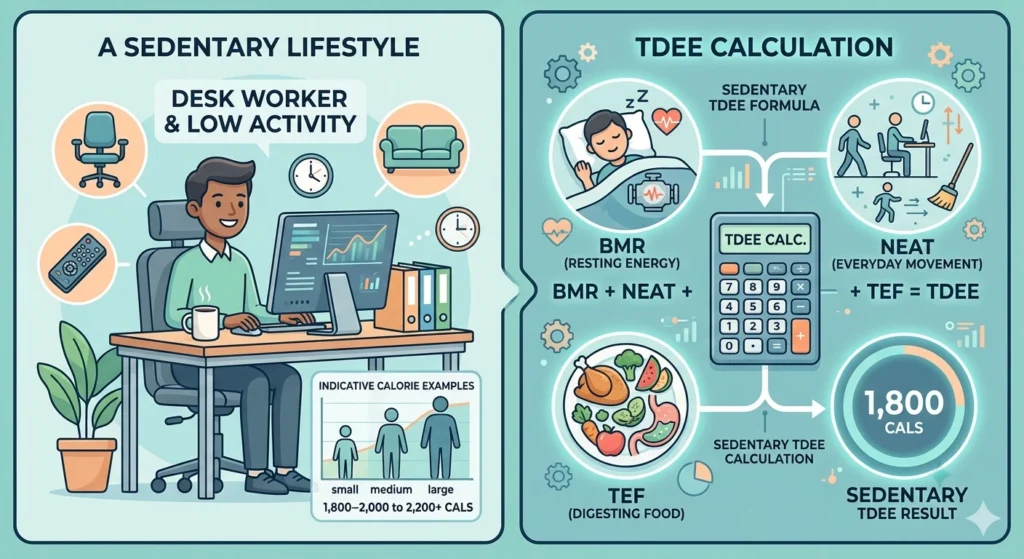
Your sedentary TDEE is the number of calories you burn in a day if most of your time is spent sitting — and if you’ve typed “sedentary” into a calorie calculator, there’s a good chance that describes you: an office worker, a remote employee, a student, or someone whose job simply involves sitting most of the day, regardless of what you do in the evenings. So let’s clear something up right away: “sedentary,” in a TDEE context, describes your job and your daily movement pattern. It says nothing about your character, and it doesn’t necessarily say anything about your gym habits either.
Here’s the thing that trips up more people than almost anything else on this topic: someone who trains hard three times a week but sits at a desk for 8–9 hours a day is still, by TDEE classification standards, sedentary or only lightly active. That gap between “I work out regularly” and “my TDEE classification” is the single most common source of calorie-target errors people run into.
This article covers what “sedentary” actually means in TDEE terms — with the research behind it — why overestimating your activity level is the most common mistake on this whole topic, real calorie ranges for sedentary men and women across different body sizes, the health context that makes getting this right matter more than it might seem, and practical ways to shift your baseline without changing your job at all. The fastest way to apply any of this to your own numbers is the free TDEE calculator — and once you’ve read the next section, you’ll know exactly which activity level to actually select.
What “Sedentary” Actually Means in a TDEE Calculation
Most articles define “sedentary” with something vague like “little to no exercise” and leave it there. Let’s be more precise, because there’s actual research behind this.
A 2013 study published in BMC Public Health by Parry and Straker at Curtin University fitted 50 office workers with accelerometers for seven days straight and tracked exactly how their time broke down. The result: sedentary time accounted for 81.8% of work hours, with light activity making up just 15.3% and moderate-to-vigorous activity a mere 2.9%. Even more telling, the study found office workers had significantly fewer breaks in their sedentary time during work hours compared to non-work hours — meaning the workday itself, not the evenings or weekends, is what drives the bulk of someone’s total daily sedentary exposure.
This is the real-world data behind the ×1.2 “sedentary” multiplier used in TDEE calculations. It isn’t a judgement, and it isn’t an arbitrary round number — it’s a measured description of what a desk-based workday genuinely looks like for most people, with over 80% of working hours spent sitting and very little incidental movement filling the gaps.
The Most Common Mistake — A Gym-Goer Who Classifies Themselves as Active
This is, without exaggeration, the single highest-value correction in this entire article — and it quietly sabotages more diet plans than almost anything else.
The activity multiplier in a TDEE formula describes your entire day, not just the time you spend training. If you work a desk job for 8–9 hours and then train hard for 45–60 minutes, three or four times a week, the overwhelming majority of your waking hours are still sedentary. The correct classification for this is “lightly active” (×1.375) — not “moderately active” (×1.55) or anything higher.
Here’s why that distinction matters so much in practice. For someone with a BMR of 1,600 calories, the difference between these two multipliers works out like this: 1,600 × 1.55 = 2,480 calories, versus 1,600 × 1.375 = 2,200 calories. That’s roughly a 280-calorie gap — large enough to completely cancel out an intended 300-calorie deficit. Someone who picks “moderately active” when they should have picked “lightly active” isn’t running a fat loss plan. They’re running an accidental maintenance plan, and they likely won’t understand why the scale isn’t moving.
Here’s the rule, stated plainly: three to four structured training sessions a week, combined with a desk job, equals “lightly active” — not “moderately active.” “Moderately active” is appropriate for people whose jobs themselves involve regular movement — retail, healthcare, teaching — on top of training, or for people training five or more days a week with meaningful additional daily movement on top of that. If there’s one piece of information in this entire article worth taking away, it’s this one.
How Many Calories Should a Sedentary Woman Eat?
Here’s a direct answer, using an average height of 163 cm and an average age of 35, across four common body weights, calculated with the Mifflin-St Jeor equation at the sedentary multiplier (×1.2).
| Body Weight | BMR (approx.) | Sedentary TDEE (approx.) |
|---|---|---|
| 50 kg | ~1,235 | ~1,482 |
| 60 kg | ~1,335 | ~1,602 |
| 70 kg | ~1,435 | ~1,722 |
| 80 kg | ~1,535 | ~1,842 |
So as a practical range: a sedentary woman of average height typically has a TDEE somewhere between roughly 1,450 and 1,900 calories per day, depending on body weight — lighter women toward the lower end, heavier women toward the higher end. If you’re outside this height and weight range, the table is a useful anchor, but running your own numbers through the calculator will get you much closer to your actual figure.
Calorie Needs for Short Women — Why Height Matters More Than People Realise
Height is a direct term in the Mifflin-St Jeor formula — it contributes 6.25 calories per centimetre. That sounds small, but it adds up: two women of identical weight but different heights can have meaningfully different TDEEs purely because of this. A woman who is 150 cm (4’11”) and weighs 60 kg will have a BMR roughly 75 calories lower than a woman who is 170 cm (5’7″) at the exact same 60 kg — just from that height difference in the formula.
The practical consequence is that shorter women, even at a perfectly healthy body weight, often land at the very low end of typical TDEE ranges — sometimes as low as 1,300–1,450 calories on a sedentary day. That creates a genuine challenge: a maintenance level of 1,300–1,400 calories leaves very little room for a calorie deficit before bumping into the commonly cited 1,200-calorie floor.
Here’s a worked example. A 152 cm, 58 kg, 30-year-old sedentary woman has a BMR of approximately 1,178 calories and a sedentary TDEE of approximately 1,414 calories. A standard 300-calorie deficit would put her at 1,114 — below the 1,200 floor. For someone in this position, the better approach is a smaller deficit — 150–200 calories — combined with increasing daily movement (NEAT) to create additional room, rather than pushing calorie intake any lower. If you’re a shorter woman and a “500-calorie deficit” never seemed to fit your numbers, this is likely why.
TDEE for Sedentary Men — Office Workers and Desk-Based Roles
Same approach for men — average height of 178 cm, average age of 35, across four body weights.
| Body Weight | BMR (approx.) | Sedentary TDEE (approx.) |
|---|---|---|
| 65 kg | ~1,492 | ~1,790 |
| 75 kg | ~1,592 | ~1,910 |
| 85 kg | ~1,692 | ~2,030 |
| 95 kg | ~1,792 | ~2,150 |
So a sedentary man of average height typically has a TDEE somewhere between roughly 1,750 and 2,200 calories per day, depending on body weight. Now here’s where this gets genuinely useful: a lot of men anchor their sense of “normal” eating to the commonly cited 2,500-calorie guideline that shows up in general dietary guidelines. The thing is, that 2,500 figure is a population average across all activity levels — sedentary, lightly active, moderately active, and beyond, all blended together. A genuinely sedentary man’s actual TDEE is very likely lower than that — often by 300–700 calories. That gap explains a pattern a lot of men describe: “I eat around 2,500, which I thought was supposed to be normal, but I’ve slowly gained weight over the years.”
TDEE for Tall Men — Why the “Average” Numbers Underestimate Your Needs
The height effect from the formula works in reverse for taller men. A man who is 193 cm (6’4″) and weighs 90 kg will have a BMR roughly 95 calories higher than a man who is 175 cm (5’9″) at the same 90 kg — purely from the extra 18 cm in the formula’s height term.
Here’s a worked example: a 193 cm, 95 kg, 35-year-old sedentary man has a BMR of approximately 1,879 calories and a sedentary TDEE of approximately 2,255 calories — noticeably higher than the “average sedentary man” figures in the table above, purely because of his height.
The practical takeaway: if you’re a tall man following generic population-average calorie guidance — which tends to be calibrated around 175–178 cm — you may be significantly underestimating your actual TDEE. This can show up in two ways: either you end up in a bigger deficit than you intended without realising it, or you find yourself needing to eat more than “the recommended amount” just to maintain your weight, and feel like something’s wrong. Nothing is wrong — your actual TDEE is genuinely higher than the population-average figure assumes, and that’s a perfectly normal reflection of your height.
The Health Context of Sedentary Work — Why TDEE Accuracy Matters More Here
This isn’t just about getting a number right for a single diet. The World Health Organization has linked sedentary behaviour to higher rates of obesity, type 2 diabetes, hypertension, stroke, sleep apnoea, gallstones, degenerative arthritis, and certain cancers including colon cancer — and this risk exists independently of whether someone exercises outside of work hours.
This is sometimes called the “active couch potato” phenomenon — someone who exercises regularly but spends 8 or more hours sitting still each day still faces elevated health risks from the sitting itself, separate from how fit they are otherwise. The connection back to TDEE accuracy is straightforward but important: because sedentary TDEE is genuinely lower than a lot of people assume — as the tables above show — the gap between “eating what feels normal” and actual energy expenditure tends to widen slowly, year after year, for desk-based workers. That’s the mechanism behind the experience so many office workers describe: “I don’t eat any differently than I did at 25, but I’ve gained 8 kg by 35.”
Getting your TDEE right for a sedentary lifestyle isn’t really about one diet plan. It’s about understanding a baseline that, left unaddressed, quietly compounds over years into a meaningfully different body weight — without anything dramatic ever happening to explain it.
Small Changes That Shift the Baseline Without Changing Your Job
The good news is that you don’t need to overhaul your working life to shift this baseline meaningfully. A handful of small, repeatable habits add up to genuine extra calories burned over a day.
Standing for phone calls and video meetings burns roughly 50 more calories per hour than sitting — and yes, that applies even with the camera off. Taking the stairs for anything under about four floors, parking further away or getting off public transport one stop early, a 10-minute walk after lunch (which, as a bonus, also helps blunt the post-meal blood sugar spike), and setting an hourly reminder for a two-minute walk around the office or home — these are all small individually, but combined, they can add up to roughly 150–300 extra calories of daily expenditure without any dedicated exercise time at all.
Remember the 200–300 calorie gap between “sedentary” and “lightly active” classifications mentioned earlier? These habits are how you actually close that gap in practice — not by reclassifying yourself on a form, but by genuinely shifting your day’s movement pattern enough that the higher classification becomes accurate.
Frequently Asked Questions
How many calories should a sedentary woman eat to maintain weight?
For a woman of average height (around 163 cm), sedentary TDEE typically ranges from approximately 1,450 to 1,900 calories per day depending on body weight, across a 50–80 kg range. Shorter women tend to sit toward the lower end of this range or below it; taller women toward the higher end. For your specific number, calculate using the calculator with your actual height, weight, and age — population averages can be off by 150–250 calories in either direction for anyone outside the average height range.
Is a desk job considered sedentary even if I exercise?
Yes, for TDEE purposes. The activity multiplier reflects your entire day, not just your training sessions. A desk job for 8 or more hours combined with 3–4 training sessions per week is correctly classified as “lightly active” (×1.375), not “moderately active” or higher. This is the most common classification error people make, and it’s frequently the reason a calculated calorie target “feels too high” — the activity level selected doesn’t match the actual daily movement pattern, which is dominated by the working day regardless of how hard the evening training session was.
What is the TDEE for an average sedentary office worker?
For an average-height man (around 178 cm, 65–95 kg), sedentary TDEE ranges from approximately 1,790 to 2,150 calories per day. For an average-height woman (around 163 cm, 50–80 kg), sedentary TDEE ranges from approximately 1,480 to 1,840 calories per day. These figures often sit lower than the commonly cited “2,000 for women, 2,500 for men” guidelines — those numbers represent averages across all activity levels, not specifically sedentary individuals. A genuinely desk-based, low-movement lifestyle typically corresponds to a TDEE below those commonly cited figures.
Why do I gain weight slowly over the years at a desk job even though I eat the same?
Three things compound together. First, your actual sedentary TDEE is often lower than the figure most people assume is “normal” for their size — so eating at a level that feels normal may represent a slow surplus of 50–150 calories per day, which adds up to several kilograms over a decade. Second, TDEE itself declines gradually with age — roughly 1–2% per decade after 30 — due to lean mass loss, so identical eating habits represent a growing surplus year over year unless intake is adjusted. Third, NEAT (incidental daily movement) often decreases gradually as routines become more fixed over the years — less walking, more delivery and remote-work convenience. Together, a lower-than-assumed baseline, gradual age-related decline, and gradually decreasing incidental movement explain the very common “I haven’t changed anything but I’ve gained weight” experience among long-term desk workers.
Should I choose “sedentary” or “lightly active” if I have a desk job?
Choose “sedentary” (×1.2) if your job is desk-based, you take minimal walks during the day, and you do little to no structured exercise. Choose “lightly active” (×1.375) if your job is desk-based but you do 1–3 structured exercise sessions per week, or you have meaningfully more daily walking than a typical desk job — a consistent 10,000+ step habit or an active commute, for example. Don’t select “moderately active” or higher purely because of evening or weekend training if your working day itself is sedentary — that’s the most common overestimation error. After choosing an activity level, track actual weight change over 2–3 weeks against your calorie target. If your weight is stable when you intended a deficit, the activity level you selected was likely too high.
Once you’ve got your activity level sorted, the next step is turning your TDEE into a practical eating plan — our guide to calculating macros from TDEE walks through exactly that. And if the numbers above suggest you’re working with a smaller calorie budget than you expected, our article on calorie deficits and weight loss covers how to set a deficit that’s appropriate and sustainable for your specific numbers, rather than defaulting to a generic 500-calorie target.
For further reading on the research referenced in this article, the Parry and Straker 2013 accelerometer study on office workers is available via the National Library of Medicine, and the World Health Organization’s guidance on physical activity and sedentary behaviour is available on the WHO website.