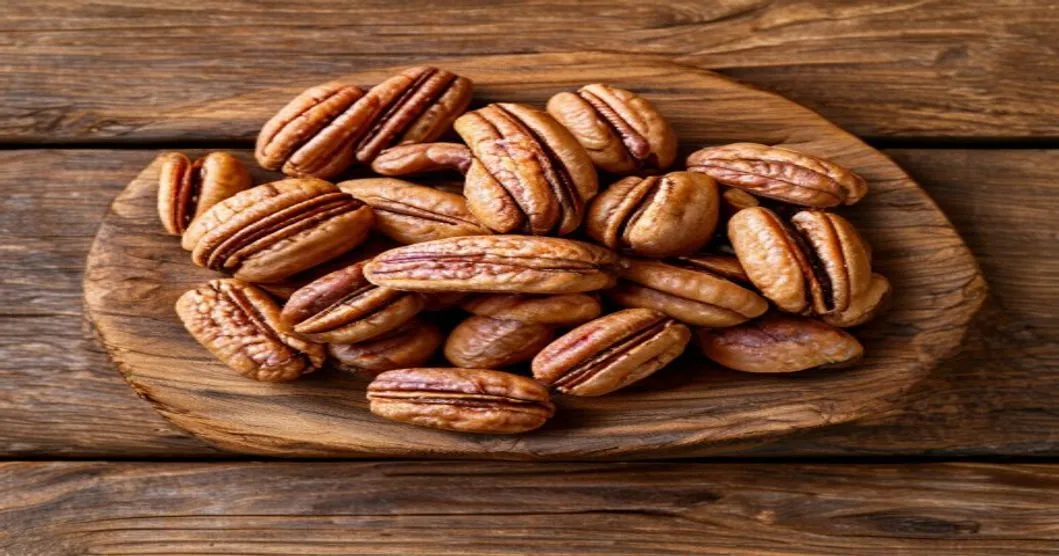
How Many Calories Are in a Pecan?
An ounce of pecans, about 19 to 20 halves or a small handful, has roughly 196 calories. That makes pecans one of the more calorie-dense nuts, but almost all of those calories come from heart-healthy unsaturated fat, not sugar or starch.
Below, we break down calories by serving size, walk through the full nutrition label, compare raw pecans to roasted and candied versions, show how pecans stack up against other common nuts, look at pecan pie and baked treats, and check what clinical research actually says about pecans and weight.
Pecan Calories By Serving Size
| Serving | Calories | Fat | Fiber |
|---|---|---|---|
| 1 half | ~10 kcal | 1g | 0.1g |
| 1 handful / 1 oz (19 halves) | 196 kcal | 20g | 2.7g |
| 1/4 cup | ~180 kcal | 18g | 2.5g |
| 1.5 oz (28 halves) | ~294 kcal | 31g | 4g |
| 1 cup halves | ~750 kcal | 78g | 10g |
Nearly 60% of the fat in pecans is monounsaturated and another 30% is polyunsaturated, leaving very little saturated fat. That fat profile is a big reason pecans are considered heart-healthy despite the calorie density.
Full Nutrition Label: Pecans (1 oz / 28g)
Here is the complete label for a standard one-ounce serving of raw pecans (about 19 halves), with percent daily values based on a 2,000-calorie diet.
| Nutrient | Amount | % Daily Value |
|---|---|---|
| Calories | 196 | - |
| Total Fat | 20g | 26% |
| Saturated Fat | 1.7-2g | 9% |
| Sodium | 0mg | 0% |
| Total Carbohydrate | 4g | 1% |
| Dietary Fiber | 2.7g | 10% |
| Sugars | 1.1g | - |
| Protein | 2.6-3g | - |
| Manganese | 1.1mg | ~55% |
| Copper | 0.3mg | ~38% |
| Magnesium | 34mg | ~8% |
The standout numbers here are manganese and copper. A single ounce of pecans covers roughly half your daily manganese needs, a mineral involved in bone formation and metabolic regulation, along with more than a third of your daily copper. Pecans are also cholesterol-free and virtually sodium-free, which is unusual for a snack food this calorie-dense.
Pecans also carry a small but real amount of vitamin E, an antioxidant, along with B vitamins and zinc. On the blood sugar side, pecans have a glycemic load of roughly 1 per serving, among the lowest of any snack food, since almost none of their calories come from carbohydrate. That makes them a reasonable snack option for people watching blood sugar, though portion size still matters for total calorie intake.
Calculate Your Exact Pecan Calories
Use this calculator to check your total based on how you are eating your pecans.
Raw vs Roasted vs Candied Pecans: Calorie Comparison
How pecans are prepared changes the calorie count more than people expect, mostly because of added oil, butter, and sugar.
| Type (1 oz) | Calories | Sugar |
|---|---|---|
| Raw pecans | 196 kcal | 1g |
| Dry roasted, unsalted | 200 kcal | 1g |
| Oil roasted, salted | 210-220 kcal | 1g |
| Candied | 180-260 kcal | 12-20g |
Candied pecans have the widest range because recipes vary so much. A light sugar glaze adds modest calories, while a thick praline-style coating with butter and sugar syrup can push a single ounce well past 250 calories, more than 50% higher than plain roasted pecans. Dry roasting barely changes the calorie count since no oil is added, while oil roasting adds 10-20 calories per ounce from the roasting oil itself, on top of any sodium from added salt.
Calories in Pecan Pie and Other Pecan Treats
Pecans in a pie are a completely different calorie situation than pecans on their own, since the sugar syrup and butter filling adds far more than the nuts do. Here's how it breaks down for common versions of pecan pie and one popular baked treat.
| Item | Calories | Sugar |
|---|---|---|
| Homemade slice (1/8 of a 9" pie) | ~500-530 kcal | ~20g |
| Store-bought slice (e.g. Sara Lee) | ~410-450 kcal | ~22g |
| Restaurant slice (e.g. Southern-style) | ~670-730 kcal | ~30-35g |
| Pecan shortbread cookie | ~76 kcal | ~4g |
A restaurant-style slice can run close to 730 calories, more than a third of an entire day's calorie budget on a moderate calorie target, mostly from the sugar and butter in the filling rather than the pecans themselves. According to FatSecret's pecan pie nutrition data, even a standard homemade slice carries more sugar than most people expect from a "nut pie." If you love the flavor but want to keep the number down, a small tart or individual-size pecan pie, closer to 245-366 calories, is a reasonable middle ground.
Pecans vs Other Popular Nuts
Pecans are on the higher end of the calorie scale compared to other common nuts, per ounce:
- Cashews: about 155-157 calories
- Almonds: about 160-164 calories
- Pistachios: about 159 calories
- Walnuts: about 185 calories
- Pecans: about 196 calories
- Macadamia nuts: about 200-204 calories
Pecans have roughly 30 more calories per ounce than almonds, mainly due to a higher fat content. Protein tells a different story: almonds carry about 6g of protein per ounce, more than double the roughly 2.6g in pecans, so if protein is your priority, almonds edge out pecans even though pecans have more total calories. Peanuts sit closer to pecans on protein per ounce too, and if you want the full breakdown, our guide on calories in dry roasted peanuts covers that comparison in detail. If you are tracking a daily protein number in general, our protein per day guide can help you see where nuts fit against a target built from your own TDEE. In exchange for the lower protein, pecans carry more monounsaturated fat, while walnuts stand out for their omega-3 content. WebMD's nutrition overview notes that both nuts offer real health benefits, so the "best" choice depends more on your goals than raw calorie count alone.
What Does the Research Actually Say About Pecans and Weight?
Pecans have been studied more closely than most tree nuts when it comes to cardiometabolic health, and the results are fairly consistent. A randomized controlled trial from the University of Georgia, published in The Journal of Nutrition, had adults at risk for cardiovascular disease add or substitute about 68g of pecans daily for eight weeks. Both approaches led to meaningful drops in total cholesterol, LDL cholesterol, and triglycerides.
A larger 2025 trial in the American Journal of Clinical Nutrition followed 138 adults at increased cardiometabolic risk for 12 weeks, comparing a snack of 57g of pecans daily against a usual-diet control group. The pecan group again saw significant improvements in total cholesterol, LDL cholesterol, non-HDL cholesterol, and triglycerides, along with a higher overall diet quality score. It is worth noting honestly: body weight in that trial trended slightly higher in the pecan group (about 0.7kg over 12 weeks) compared to the control group, though the difference was not statistically significant. That is a useful reality check against claims that nuts are automatically weight-neutral regardless of portion size, and it reinforces why measured servings matter more than the "nuts are healthy so more is fine" mindset.
The likely mechanism behind the cholesterol benefits is the combination of monounsaturated fat, fiber, and plant compounds in pecans, which several studies link to better lipid profiles even when total calorie intake goes up slightly.
Where Pecans Come From
Pecans (Carya illinoinensis) are the only major tree nut native to North America, growing wild across the Mississippi River valley long before European settlers arrived. Native American communities harvested and traded wild pecans for centuries, and the word "pecan" itself comes from an Algonquian term describing nuts that need a stone to crack. Commercial pecan orchards took off in the southern United States in the late 1800s, and today Georgia, Texas, and New Mexico produce the majority of the U.S. crop. That southern connection is also why pecans show up so often in regional dishes like pecan pie, pralines, and pecan-crusted proteins, rather than being a general-purpose baking nut the way almonds or walnuts are used worldwide.
Buying and Storing Pecans for Fewer Wasted Calories
Pecan halves and pieces cost roughly the same per pound, so buying pieces is usually the better value if you plan to bake or cook with them rather than eat them whole. Because pecans are so high in unsaturated fat, they go rancid faster than more shelf-stable nuts like almonds if left at room temperature. Shelled pecans keep for about 3 months in a sealed container at room temperature, up to 9 months refrigerated, and roughly 1-2 years in the freezer without a meaningful change in taste or texture. Buying in bulk and freezing what you will not use within a few weeks is one of the simplest ways to avoid the temptation to finish an entire bag in one sitting, which is where most of the "hidden calorie" problem with pecans actually comes from.
How Pecans Fit Your Daily Calories
At about 196 calories per ounce, pecans work well as a satiating snack rather than a low-calorie filler food. If you are tracking toward a specific calorie or fat target, check your TDEE Calculator first, then use the calculator above to see how a handful fits your day. Since pecans are calorie-dense but nutrient-rich, they can be a smart addition even on a calorie-controlled plan, as long as portions are measured rather than eaten straight from a large bag.
If you are in a calorie deficit, pecans are easiest to fit in as a pre-portioned snack earlier in the day, since a measured ounce is filling enough to bridge a gap between meals. If you are trying to gain weight, pecans are one of the more efficient ways to add calories without adding much bulk to a meal, since a small handful adds nearly 200 calories.
Pecans as a Pre- or Post-Workout Snack
Because pecans release energy slowly rather than spiking blood sugar, a small handful 30 to 60 minutes before training can provide steady fuel without the crash that comes from a sugary pre-workout snack. The fat and fiber slow digestion, so the energy shows up gradually instead of all at once.
After a workout, pecans are not a replacement for a proper protein source, but the manganese and zinc they provide play a supporting role in recovery. If you train regularly and want to know how a handful of pecans fits into your total daily burn, including the extra calories from activity itself, our guide on NEAT and daily movement explains how everyday activity and structured workouts both factor into your real calorie needs.
Common Mistakes That Add Hidden Calories
- Eating straight from the bag without measuring, which often means 3-4 ounces instead of 1
- Choosing candied or honey-roasted versions without realizing they can run 50+ calories higher per ounce than plain
- Adding pecans to salads or oatmeal without accounting for the extra 150-200 calories they contribute
- Assuming "healthy fat" means unlimited portions, when a single cup of pecan halves runs about 750 calories
- Confusing a small handful of raw pecans with a slice of pecan pie, which can carry two to three times the calories from added sugar and butter alone
If you tend to underestimate portions like this across your day, our guide on tracking calories accurately covers practical ways to close that gap without weighing every single bite.
Frequently Asked Questions
How many calories are in a handful of pecans?
A small handful, about 1 ounce or 19 halves, has approximately 196 calories.
How many calories are in candied pecans?
Candied pecans typically have 180-260 calories per ounce, depending on how much sugar and butter are used in the coating.
How many calories are in roasted pecans?
Dry roasted pecans have about 200 calories per ounce, very close to raw. Oil roasted versions run slightly higher at 210-220 calories per ounce due to added oil.
How many calories are in a slice of pecan pie?
A standard homemade slice, about 1/8 of a 9-inch pie, runs 500-530 calories. Store-bought slices tend to be a bit lower, around 410-450 calories, while restaurant-style Southern pecan pie can reach 700+ calories per slice.
Are pecans good for weight loss?
In moderate, measured portions, pecans are linked to better satiety and improved cholesterol markers in clinical trials. That said, at least one recent trial noted a small, non-significant upward trend in body weight among daily pecan eaters, so portion control still matters even with a "healthy" nut.
Are pecans healthier than walnuts?
Both are healthy choices. Pecans have slightly more calories and monounsaturated fat, while walnuts have more omega-3 fatty acids. Neither is clearly "healthier," they simply offer different nutritional strengths.
Do pecans lower cholesterol?
Multiple randomized controlled trials, including studies published in The Journal of Nutrition and the American Journal of Clinical Nutrition, found that daily pecan consumption of roughly 57-68g reduced total cholesterol, LDL cholesterol, and triglycerides compared to usual diets.
Do pecans raise blood sugar?
Not much on their own. Pecans have a glycemic load of roughly 1 per serving, one of the lowest of any common snack, since they carry very little carbohydrate. Pecan pie is a different story, since the sugar syrup filling behaves very differently from the plain nut.
How much manganese and copper do pecans provide?
One ounce of pecans provides roughly 55% of the daily value for manganese and about 38% for copper, making them one of the most concentrated dietary sources of both minerals.