Research consistently shows that people underestimate how much they eat by 20 to 40 percent — and this is not a beginner problem. A landmark study found that even trained dietitians underreport their own calorie intake by a meaningful margin. The gap between what someone believes they eat and what they actually eat is the single most common reason a calorie deficit feels like it is not working.
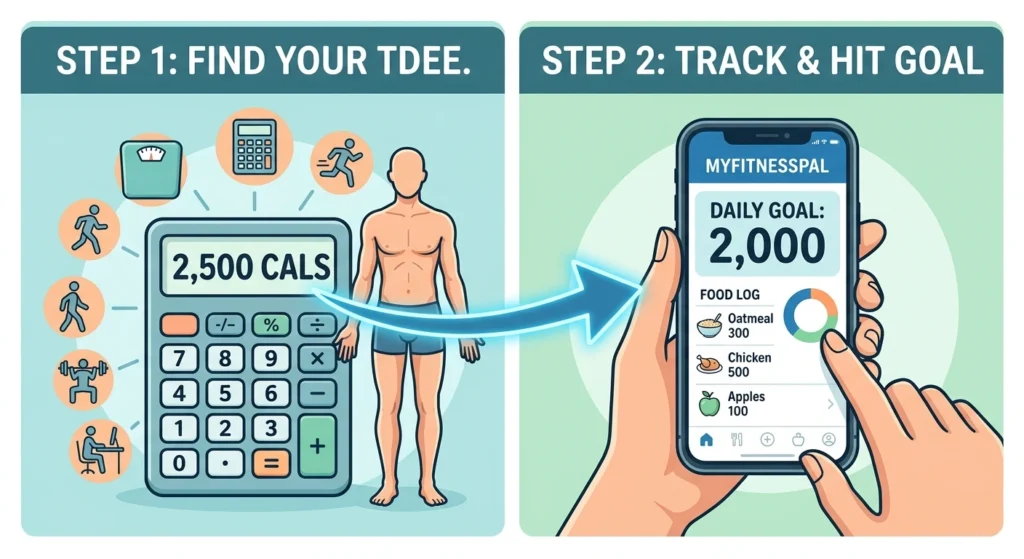
This article explains exactly how to set up calorie tracking using your TDEE as the starting target, covers the five most common tracking errors that silently erase a deficit, and gives you the practical tools to track accurately without turning every meal into a science experiment. Before anything else, calculate your TDEE here and set that number as your calorie goal. Everything in this guide is built around that number.
One more thing before we start: accuracy does not mean perfection. Tracking within 10 to 15 percent of your true intake, consistently, is enough to produce steady fat loss. The goal here is not obsession — it is calibration.
Why Most People Are Eating More Than They Think
This is the most important thing to understand before you open any tracking app. In a widely cited study published in the New England Journal of Medicine, obese participants underreported their food intake by an average of 47 percent and simultaneously overreported their physical activity by 51 percent. That is not dishonesty. It is what happens when human memory and portion estimation go up against actual food weights.
Three specific mechanisms cause this, and understanding each one gives you a genuine edge over every person who just downloads an app and starts guessing.
Portion size blindness. Humans are genuinely bad at estimating volume and weight by eye — particularly for calorie-dense foods like oils, nuts, cheese, and nut butters. The brain anchors to visual cues like surface area rather than depth, which means a wide shallow bowl of food looks like less than a narrow deep bowl of the same food. This is not laziness. It is how visual perception works.
Calorie amnesia. Bites, tastes, and small additions to meals are consistently forgotten before logging. The splash of milk in three coffees. The drizzle of oil before roasting vegetables. The small handful of almonds while cooking dinner. None of these feel significant in the moment, but they add up to 200 to 400 calories that simply never make it into the log.
Database errors. Many entries in calorie tracking apps — particularly MyFitnessPal — are user-submitted and have never been verified. Restaurant meals and home-cooked dishes are especially unreliable. A chicken tikka masala listed at 380 calories in the database may reflect a small restaurant serving; your actual portion at a different restaurant may contain 650. Choosing the wrong entry silently distorts the count.
Understanding these three mechanisms is empowering. Once you know why underestimation happens, you can take specific steps to prevent it — rather than wondering why the deficit is not working.
The Gap Between Estimated and Actual Intake — What the Numbers Show
Let’s make this concrete, because abstract statistics do not change behavior — specific numbers do.
Imagine a person who believes they are eating 1,700 calories per day and considers themselves in a 300-calorie deficit below their TDEE of 2,000. In reality, they may be consuming closer to 2,100 calories — putting them in a 100-calorie surplus. The scale does not move. They cannot figure out why.
Here is where those 400 extra calories are hiding:
- Olive oil: One tablespoon is 119 calories. Most people pour 2 to 3 tablespoons when cooking — that is 240 to 360 calories that never make it into the log because it was added “to the pan.”
- Nuts: A handful of mixed nuts estimated as “about 100 calories” typically weighs 40 g on a scale — which is 240 calories, not 100.
- Peanut butter: A “tablespoon” scooped without measuring weighs 25 to 35 g. The database entry for one tablespoon is 16 g. That difference is 60 to 110 unlogged calories per serving.
- Coffee additions: Whole milk in three coffees across the day adds approximately 120 calories. A splash of oat milk adds more.
These are not edge cases. They are daily occurrences for most trackers. The numbers above explain why a food scale is the single most impactful change most people can make to their tracking accuracy — not a better app, not a new strategy.
Step 1 — Set Your Calorie Target From Your TDEE, Not From the App’s Default
This is the step most people skip, and it is the one that makes every other step either work or fail.
Apps like MyFitnessPal generate their own calorie goal when you sign up. They ask for your age, weight, height, goal, and activity level — and then they spit out a number. The problem is that MFP’s internal TDEE calculation overestimates calorie needs by 200 to 500 calories for many users because it applies broad activity multipliers and cannot account for individual metabolic variation. Trusting that default number means starting with a calorie ceiling that may be too high to produce any meaningful fat loss.
The correct approach:
- Calculate your TDEE independently using an accurate calculator. Use this TDEE calculator to get your number before touching the app settings.
- Subtract your intended deficit from that number. For steady fat loss, a deficit of 400 to 500 calories below TDEE is a reliable starting point. Read more about how to use your TDEE to lose weight if you want a full breakdown of deficit sizing.
- Override the app’s default with your calculated number manually.
In MyFitnessPal, here is exactly how to do it:
- Open the app and tap More (bottom-right).
- Go to Goals.
- Tap Calorie, Carbs, Protein and Fat Goals.
- Tap the calorie field and enter your TDEE-based target manually.
- Save.
That one change — replacing the app’s estimate with an independently calculated number — corrects a foundational error that most MFP users never know they have.
Not sure how your TDEE is calculated in the first place? The complete beginner’s guide to TDEE on this site walks through the Mifflin-St Jeor equation, activity multipliers, and how all the components fit together.
Should You Log Exercise Calories in MyFitnessPal?
This is the most common setup error after the calorie goal itself — and it is built into how MyFitnessPal works by default.
MFP’s default behaviour is to add back calories burned during exercise. If you log a gym session and MFP estimates you burned 350 calories, it raises your calorie budget for that day by 350. This feature was designed for people who calculated their TDEE using a sedentary multiplier and need to account for exercise separately.
But here is the problem: if you used a moderate or higher activity multiplier when calculating your TDEE — meaning exercise is already factored into that number — then logging exercise in MFP creates double-counting. You get 350 calories added on top of a TDEE that already included those 350 calories. That silently erases your entire deficit on every training day.
Simple rule:
If your TDEE was calculated as moderately active or above (meaning exercise is baked in), turn off automatic exercise calorie addition in MFP. Go to Settings → Diary Settings → and disable “Exercise Calories.” If you set your TDEE as sedentary and exercise is genuinely extra activity, keep it on — but treat the number MFP gives you conservatively, because MFP overestimates exercise calorie burn by 20 to 40%.
Step 2 — Use a Food Scale, Not Cups or Tablespoons
If there is one change that consistently separates people who make progress from people who stay stuck, it is this one. A digital kitchen food scale costs between £8 and £15 (under $15 in the US), takes up about as much space as a coffee mug, and eliminates the single largest source of tracking error in most people’s diets.
Volume measurements introduce enormous variability. A “cup of oats” can weigh anywhere from 80 g to 120 g depending on how loosely or tightly it is packed — a difference of roughly 200 calories that you would never notice without weighing. A tablespoon of peanut butter scooped generously off the jar typically lands at 25 to 35 g when placed on a scale, not the 16 g that the database entry assumes.
Weigh everything that is calorie-dense: oils, nut butters, cheese, nuts, seeds, grains, pasta, rice, meat, and sauces. These are the foods where errors compound quickly.
You do not need to weigh fruits and vegetables for most calorie tracking purposes. The difference between a 130 g apple and a 160 g apple is about 20 calories. That is not worth optimising. Save your precision for the foods where it actually matters.
This distinction — weigh the dense stuff, estimate the rest — is what makes tracking feel manageable rather than obsessive.
Raw vs Cooked — The Tracking Error That Adds Hundreds of Calories
This is the most common tracking mistake that experienced trackers make — and the one that causes the most confusion because the error is invisible. The rule is simple, but most articles never explain it clearly enough.
Always weigh food in the same state that matches your database entry.
Cooking changes the weight of food without changing its calorie content. Water evaporates or is absorbed. A chicken breast that weighed 200 g raw weighs roughly 140 to 150 g after cooking — but the calories are identical. If you weigh the cooked chicken at 150 g and log it under a raw chicken breast entry, you are logging approximately 80 fewer calories than you ate. Do that across a week and you have a 560-calorie unlogged surplus.
The same logic applies in reverse for rice and pasta. These gain water during cooking. 100 g of dry rice becomes roughly 280 to 320 g once cooked. If you log 200 g cooked but select the dry/raw database entry, you will log nearly three times the calories you actually consumed.
The table below shows the raw vs cooked conversion for the four most commonly tracked foods, along with the exact calorie error from logging the wrong state:
| Food | Raw weight | Cooked weight | Error (logging wrong state) |
|---|---|---|---|
| Chicken breast | 200 g raw → 168 kcal | ~145 g cooked → 168 kcal | Weigh cooked, log raw entry = −58 kcal undercount |
| Beef mince (5% fat) | 200 g raw → 212 kcal | ~160 g cooked → 212 kcal | Weigh cooked, log raw entry = −53 kcal undercount |
| White rice | 100 g dry → 364 kcal | ~300 g cooked → 364 kcal | Weigh 200 g cooked, log dry entry = +364 kcal overcount |
| Pasta (dry weight) | 100 g dry → 352 kcal | ~230 g cooked → 352 kcal | Weigh 200 g cooked, log dry entry = +305 kcal overcount |
The fix is simple: decide which state you will weigh your food in, and always select the matching database entry. Most people find it easier to weigh raw (before cooking) and log the raw entry. If you are cooking for multiple people and weighing the full batch, weigh raw before cooking and divide by portions.
Step 3 — Log Everything, Including the Small Things
Main meals are rarely the problem. Most people track their breakfast, lunch, and dinner with reasonable accuracy. The deficit disappears in the gaps — in everything that gets added to food, poured into cups, sprayed into pans, and eaten between meals without a second thought.
Here is what is typically missing from the log:
- Milk in coffee: 30 to 50 calories per cup. Three to four coffees per day = 90 to 200 unlogged calories.
- Cooking oil or butter: 40 to 120 calories per meal depending on quantity. A “small drizzle” of olive oil in a pan is often 1 to 2 tablespoons (120 to 240 calories).
- Salad dressing: Poured rather than measured, a typical serving is 3 to 4 tablespoons — 150 to 300 calories.
- Condiments and sauces: Ketchup, mayonnaise, hot sauce, BBQ sauce, soy sauce with added sugar — these add 50 to 200 calories depending on use.
- Bites while cooking: A slice of cheese here, a spoon of sauce there. Difficult to log but real in terms of calorie contribution.
Collectively, these small additions account for 200 to 400 unlogged calories per day for most people who track main meals but ignore everything else.
The most useful way to think about this is as a two-week calibration exercise rather than a permanent obligation. Log everything — including every minor addition — for 14 days. After that period, you will know exactly where your hidden calories are hiding, and you can decide what to do about them. Some people choose to log these items permanently. Others adjust their cooking habits to eliminate the biggest offenders. Either way, the two-week picture gives you the information you need to make a real decision — rather than wondering why progress has stalled.
Do Calories From Alcohol Count Toward Your TDEE?
Yes — completely. Alcohol provides 7 calories per gram, which puts it above protein (4 kcal/g) and carbohydrates (4 kcal/g) and only slightly below fat (9 kcal/g). These calories count toward your daily total in exactly the same way as calories from food.
A standard 250 ml glass of wine at 12% ABV contains approximately 175 calories. Two 330 ml beers at 5% ABV contain roughly 300 calories combined. A gin and tonic with a standard measure adds around 140 to 180 calories depending on the tonic. These numbers are not trivial — two drinks on a Friday evening can consume 300 to 400 calories of your daily budget without contributing any protein, fibre, or micronutrients.
There is one nuance worth knowing: alcohol has a thermic effect of roughly 20%, meaning approximately 20% of its calories are used during the metabolic process of breaking it down. This slightly reduces the net calorie impact compared to the gross figure. However, this effect is small enough that it does not justify ignoring alcohol in your tracking. Log all alcohol — either by using the drink entries in your app database, or by calculating calories from the percentage ABV and volume. For a quick method: multiply the volume in ml by the ABV percentage by 0.006 to get approximate calories from ethanol alone.
If you track Monday to Friday accurately and then drink freely on weekends without logging, your weekly average calorie total will not reflect your actual intake. Calorie cycling strategies can help you plan for higher-calorie social days without derailing the week.
Thermic Effect of Food — Why Protein Calories Work Harder for You
The thermic effect of food (TEF) is the energy your body spends digesting, absorbing, and processing the food you eat. It accounts for approximately 10% of total daily energy expenditure — meaning a small but real portion of your TDEE is already assigned to the act of eating itself.
Not all macronutrients have the same thermic cost. Protein requires the most energy to process — roughly 25 to 30% of its calories are burned during digestion. Carbohydrates sit at 5 to 10%, and dietary fat has a very low thermic effect at just 0 to 3%. This means that a diet high in protein produces a slightly larger real-world energy deficit than the raw numbers suggest, because more of those calories are burned before they can be stored.
A practical example: eating 150 g of protein per day versus 80 g per day, with the same total calorie intake, produces a real energy difference of approximately 70 to 80 calories per day from TEF alone. Over a month, that compounds to a meaningful difference in fat loss rate. This is one of the reasons high-protein diets consistently outperform lower-protein diets in controlled fat loss research — even when total calories are matched. If you want to understand how protein fits into your overall macro targets, the macro calculation guide covers the exact split in detail.
Step 4 — Log Immediately, Not From Memory
The longer the gap between eating and logging, the less accurate the log becomes. Studies on dietary recall accuracy consistently show that same-day logging is 30 to 40% more accurate than next-day recall. This is not a minor difference — it can mean hundreds of missing calories across a day’s log.
There are two approaches that both work well:
Log after each meal. Scan or search the food immediately after eating while the amounts are still clear. This is the most accurate method because nothing has time to be forgotten.
Pre-log the whole day in the morning. Plan what you will eat for the day, log all of it before breakfast, and then eat to the plan. This approach works especially well for people who follow a routine diet or meal prep. Pre-logging also has a psychological advantage — it makes deviations visible before they happen. You can see that adding a chocolate bar after lunch would push you 200 calories over target, and you have the choice to adjust before the fact rather than discovering the damage at bedtime.
Both approaches are equally valid. The right one is whichever you will actually do consistently.
Does Meal Timing Affect TDEE or How Calories Are Counted?
No — meal timing does not meaningfully change how many calories your body burns or how it processes the food you eat. The same 2,000 calories consumed across two meals produces the same weight outcome as 2,000 calories spread across five or six meals, when measured consistently over weeks. Total daily calorie intake is the lever that matters for body weight. Distribution across the day is not.
There is one technical nuance: very large, infrequent meals may produce a slightly higher acute thermic effect per sitting compared to the same food spread across many smaller meals. But the daily difference amounts to fewer than 50 calories and has no meaningful impact on fat loss outcomes.
Eat at whatever frequency works for your schedule and hunger patterns. If three meals a day suits your lifestyle, eat three meals. If you prefer two larger meals, that works too. Meal timing and frequency are preference variables, not metabolic levers — and treating them as anything else creates unnecessary anxiety around something that simply does not matter.
Step 5 — Use the Weekly Average, Not the Daily Number
This is the most practically liberating instruction in this entire guide, and the one that makes long-term tracking feel sustainable rather than punishing.
Daily calorie intake naturally fluctuates. One day you eat more, the next day you eat less. What matters is the 7-day average relative to your weekly calorie budget — not whether any individual day hit the target precisely.
Here is how this looks in practice. Target: 1,800 calories per day. Weekly budget: 12,600 calories.
| Day | Calories Eaten | Running Total |
|---|---|---|
| Monday | 1,780 | 1,780 |
| Tuesday | 1,650 | 3,430 |
| Wednesday | 1,900 | 5,330 |
| Thursday | 1,720 | 7,050 |
| Friday | 1,850 | 8,900 |
| Saturday | 2,200 | 11,100 |
| Sunday | 1,600 | 12,700 |
Weekly average: 1,814 calories. That is 14 calories per day above target — well within the 100 to 150 calorie tolerance that still produces consistent progress. Saturday was 400 calories over. Sunday was 200 under. Neither day derailed the week.
This framing also eliminates the “I ruined everything” thinking that causes many people to abandon tracking entirely after one difficult day. Nothing is ruined. One meal, one day, one event does not delete a week of consistent effort. The weekly number is what counts.
How Accurate Does Calorie Tracking Need to Be for Weight Loss to Work?
Here is the permission-giving section that most tracking articles never include: you do not need laboratory precision to lose fat consistently.
Research and practical experience consistently show that tracking within 10 to 15% of your true daily calorie intake produces the same fat loss outcomes as obsessive precision. The reason is simple: the margin of error in your TDEE estimate itself is already 10 to 15%. Your calculated TDEE of 2,100 calories may reflect a true metabolic rate anywhere between 1,900 and 2,300, depending on individual variation, measurement error in your activity estimate, and day-to-day fluctuations in NEAT (non-exercise activity thermogenesis).
A food scale cannot compensate for that uncertainty in the TDEE calculation — because the TDEE itself is an estimate. The goal of tracking is not exactness. It is consistent awareness of what you are actually eating and whether the total is in the right range.
The practical standard that is sufficient for consistent progress:
- Weigh calorie-dense foods on a scale
- Log everything including condiments, cooking oils, and drinks
- Match your database entry to the state you weigh (raw or cooked)
- Track consistently across the full week, not just on weekdays
That level of accuracy, applied consistently, is all you need. Consistent progress comes from honest tracking — not from a degree of precision that even research laboratories cannot guarantee.
Tracking Tools — MyFitnessPal, Cronometer, and When Each Works Best
Both apps do the job. The choice between them comes down to what matters most to you.
| Criteria | MyFitnessPal | Cronometer |
|---|---|---|
| Database size | Very large (user-submitted, 14M+ items) | Smaller but growing |
| Data accuracy | Variable — user entries can be wrong; look for green-tick verified entries | High — entries verified against official nutrition databases (USDA, NCCDB) |
| Ease of use | Fast, barcode scanning, good mobile UX | Slightly more involved setup, excellent for detail-oriented users |
| Micronutrient detail | Basic — focuses on macros and calories | Excellent — tracks vitamins, minerals, amino acids |
The practical recommendation: For pure calorie tracking accuracy, Cronometer’s verified database is the stronger choice — you will find fewer phantom entries and fewer user-error submissions that inflate or deflate a food’s calorie count. For speed, food variety, and the most seamless daily logging experience, MyFitnessPal wins for most people. If you use MFP, filter for green-tick verified entries on packaged foods and cross-check restaurant meals against the actual nutrition information on the restaurant’s website wherever possible.
Either way, the accuracy of the app is secondary to the accuracy of what you enter into it. A perfectly verified database is useless if you are logging two tablespoons of oil as one, or cooked weights under raw entries.
For further reading on how the underlying calorie equations work and why different formulas produce slightly different TDEE estimates, the Mifflin-St Jeor vs Harris-Benedict comparison on this site explains the differences in plain terms.
If you have been stuck at a plateau for more than four weeks despite consistent tracking, the issue is usually one of three things: a calorie target that needs adjusting, metabolic adaptation, or a persistent tracking error that has become invisible because it is habitual. The detailed guide on what a weight loss plateau actually means covers all three scenarios and how to address each one systematically.
You may also want to consider whether a body recomposition approach fits your goals — particularly if you are close to your target weight and want to improve body composition rather than simply lower the number on the scale.
For those who want to go deeper into the research, three resources are worth bookmarking. The NIH review of dietary assessment methods is one of the most thorough academic examinations of why self-reported calorie intake is systematically inaccurate and what conditions improve accuracy. The FDA guidance on reading Nutrition Facts labels explains the legal tolerance bands that food manufacturers operate within — including the ±20% calorie labelling margin that affects every packaged food you scan. And for a comprehensive breakdown of how physical activity levels interact with calorie expenditure, the Harvard T.H. Chan School of Public Health overview of physical activity and energy balance provides authoritative context from a credible academic source.
Frequently Asked Questions
How do I track calories with MyFitnessPal using my TDEE?
Start by calculating your TDEE using the TDEE calculator. Subtract 400 to 500 calories for fat loss to get your daily calorie target. Open MyFitnessPal, go to More → Goals → Calorie, Carbs, Protein and Fat Goals, and enter your target manually — do not use the app's generated number.
Next, go to Settings → Diary Settings and turn off automatic exercise calorie additions if your TDEE was calculated at a moderate activity level or higher. Use a food scale to weigh everything calorie-dense. Choose verified (green-tick) database entries for packaged foods. Always log food in the same state you weigh it — raw weights with raw database entries, cooked weights with cooked entries.
Do I need to track calories forever to maintain my weight?
No. Most people track actively for 8 to 16 weeks — long enough to build a genuine, calibrated understanding of what they eat and how much different foods actually weigh. After that period, many people maintain their results with intermittent spot-checking rather than daily logging — perhaps a few days every month to catch any drift in portion sizes or eating habits.
Research suggests that the calorie awareness built through structured tracking persists for 12 to 24 months after active tracking stops. The goal of tracking is to make portion estimation and food awareness automatic — not to create a permanent dependency on an app.
Why am I tracking calories but still not losing weight?
Three causes account for the vast majority of cases, in order of probability:
- Tracking inaccuracy: The most common cause. Logging cooked weights under raw database entries (or vice versa), not weighing oils and condiments, and forgetting drinks and small additions are where the hidden calories usually sit. Add a food scale and log every addition for one week — including cooking oils, milk in coffee, and condiments — and see if the number changes.
- TDEE overestimation: The selected activity level may be too high, making the calorie target larger than actual energy expenditure. Recalculate TDEE at current weight using an honest assessment of actual activity. Many people overestimate how active they are.
- Metabolic adaptation: After an extended period of dieting, the body can reduce TDEE through adaptive thermogenesis — lowering NEAT and reducing the energy cost of various physiological processes. If tracking is genuinely accurate and the TDEE estimate is reasonable, the guide on understanding weight loss plateaus covers this scenario specifically.
Should I track calories on weekends too?
Yes — consistently. Studies show that people who track Monday to Friday but skip weekends consistently underestimate their weekly average intake, because weekend eating tends to be higher in calories (social meals, alcohol, restaurant food, larger portions) and lower in tracking accuracy.
The practical fix: plan for higher-calorie weekend days within the weekly budget rather than trying to hit the exact same daily target every day. If your weekly budget is 12,600 calories, eating 1,500 per day Monday to Friday leaves 5,100 calories across Saturday and Sunday — roughly 2,550 per day, which accommodates a social meal and a drink without undermining the week. This is the weekly average approach in action.
Are food labels accurate enough to trust for calorie tracking?
Mostly, yes — but with a known margin of error. The USDA permits food manufacturers a tolerance of ±20% on calorie labelling. In practice, this means a product listed at 200 calories per serving may contain anywhere from 160 to 240. Manufacturers also tend to understate rather than overstate (for commercial reasons), so your tracked totals from labelled foods are likely slight underestimates.
For most calorie trackers, this margin is acceptable — it is far smaller than the error introduced by estimating portion sizes without a scale. To keep label-based tracking as accurate as possible: use verified database entries rather than user-submitted ones, and weigh your serving rather than trusting the listed portion size, which is often unrealistically small.
Pingback: Small Blizzard Calories: Mini vs Small Compared
Pingback: Does Water Have Calories? Full Breakdown + Calculator