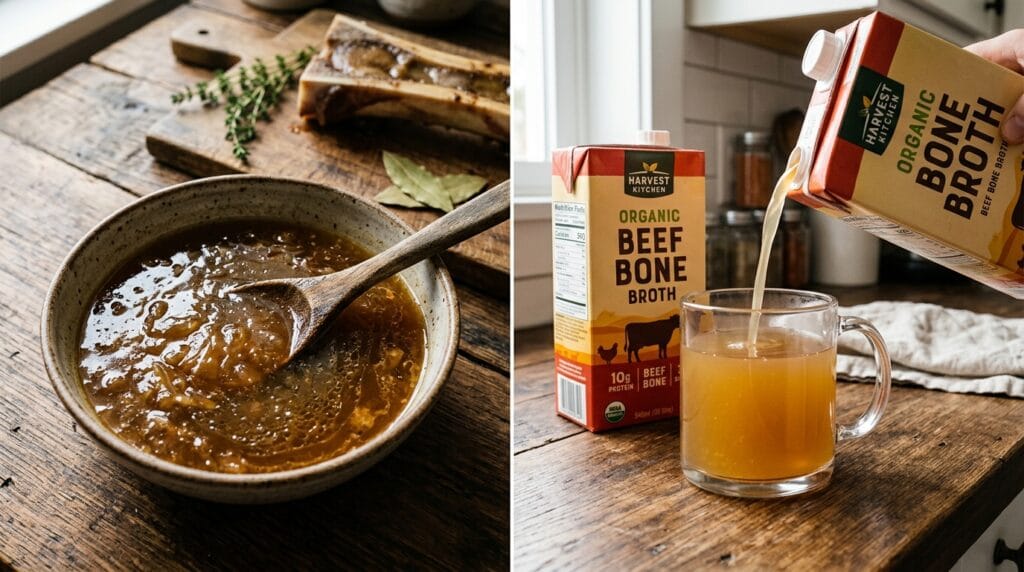
How Many Calories Are in Beef Bone Broth?
A cup of beef bone broth has about 35-50 calories for most standard preparations, whether homemade or store-bought. Richer versions made with marrow-heavy bones and left unskimmed can run significantly higher, sometimes 100-200+ calories per cup.
By Ray Smith. Below, we compare real store brands, break down calories by preparation type, cover the keto angle and the glycine/collagen science competitors gloss over, and explain exactly why the bones you use change the final number so much.
Beef Bone Broth Calories by Brand
Store shelves carry a real spread. Checking the label on your specific brand beats assuming a fixed number.
| Brand (1 cup) | Calories | Sodium |
|---|---|---|
| Sam's Choice Beef Bone Broth | 35 kcal | 700mg |
| Pacific Beef Bone Broth | 40 kcal | 360mg |
| Nature's Promise Beef Bone Broth | 40 kcal | ~500mg |
| Simple Truth Organic Beef Bone Broth | 45 kcal | ~450mg |
| Bo & Marrow Classic Beef Bone Broth | 49 kcal | ~500mg |
Notice that calories stay fairly close across brands, generally 35-50 per cup, while sodium is where the real spread shows up, ranging from about 360mg to 700mg per cup. That gap matters more than the calorie difference for most people.
Beef Bone Broth Calories by Preparation Type
| Type | Calories (1 cup) | Protein |
|---|---|---|
| Homemade, fat skimmed | 30-50 kcal | 7-10g |
| Store-bought (standard brands) | 35-50 kcal | 8-14g |
| Homemade, marrow-heavy, unskimmed | 100-200+ kcal | 10-15g |
The wide range here comes down almost entirely to fat content. A well-skimmed broth from lean bones stays light, while a rich, gelled broth made with marrow bones and no skimming can carry substantially more calories per cup.
Calculate Your Exact Bone Broth Calories
Use this calculator to check your total based on preparation and amount.
Beef Bone Broth Calorie Calculator
40 kcal
See how this fits your day → Calculate Your TDEE
Is Beef Bone Broth Keto-Friendly?
Yes, and more comfortably than most foods people ask about. Plain beef bone broth typically carries 0-2 grams of carbs per cup, since almost all its calories come from protein and a small amount of fat. That makes it one of the easiest warm, savory options to fit into a strict keto or low-carb day without spending any of your carb budget.
It is also a common choice during the early days of keto to help with electrolytes and hydration, since a well-made broth naturally carries sodium and other minerals. The one thing to watch is flavored or seasoned varieties, which sometimes add small amounts of sugar, honey, or starches for texture, so a quick label check is worth it if you are tracking carbs strictly.
Collagen and Glycine: What the Science Actually Says
Bone broth's biggest selling point is its collagen and gelatin content, and the amino acid glycine in particular. Glycine is genuinely abundant in bone broth compared to most other foods, and early research links it to better sleep, gut lining support, and blood sugar regulation.
That said, it's worth being realistic about the claims. According to the Harvard T.H. Chan School of Public Health, bone broth actually contains only small amounts of the minerals it is often marketed for, and claims that it detoxifies the liver, reverses wrinkles, or repairs joints go well beyond what current evidence supports. Harvard Health Publishing notes it is genuinely a good source of protein and flavor, which is reason enough to enjoy it, without needing to lean on the bigger wellness claims to justify a bowl.
Why Bone Type Changes Everything
Not all beef bones produce the same broth. Knuckle and joint bones release a lot of collagen and gelatin but relatively little fat, which is why broths made primarily from these bones tend to stay in the lighter 30-50 calorie range per cup.
Marrow bones are a different story entirely. Marrow-heavy broths that are not skimmed can carry dramatically more fat and calories, since bone marrow itself is calorie-dense and readily renders into the liquid during long simmering.
A broth made from a mix of knuckle, joint, and a modest amount of marrow bone tends to strike a balance, offering the gelatin and flavor benefits of marrow without pushing calories into a much higher range.
Homemade vs Store-Bought: What Actually Differs
Store-bought bone broths vary by brand, generally landing between 35 and 50 calories per cup, as the brand table above shows. Some brands intentionally leave more fat in for richness and mouthfeel, while others filter more aggressively to keep the product leaner and more shelf-stable.
Homemade broth gives you full control, but that control cuts both ways. If you skim the fat layer that rises to the top after refrigeration, you can bring your broth down to the lighter end of the range. If you skip that step, especially with a batch made from richer bones, your homemade version could easily out-calorie most store-bought options.
Checking whether your homemade broth gels firmly in the fridge is actually a good sign of gelatin content, not necessarily fat content, so a well-gelled broth is not automatically a high-calorie one.
Sodium Is Often the Bigger Concern
While calories in bone broth stay relatively modest, sodium can be a bigger issue, especially with store-bought versions. As the brand comparison above shows, commercial bone broths can carry anywhere from about 360mg to 700mg of sodium per cup, compared to as little as 200-500mg in homemade versions made without added salt.
If you drink bone broth regularly as part of a health routine, checking the sodium line on the label matters just as much as checking calories, particularly if you are also managing blood pressure or watching sodium intake for other reasons. Picking a lower-sodium brand or making your own with controlled salt is the simplest fix.
Bone Broth's Real Nutritional Value
Beyond calories, beef bone broth offers a genuinely useful amount of protein for its calorie cost, often 7-15 grams per cup depending on concentration. This protein comes largely in the form of collagen and gelatin, which some people find easier to digest than protein from solid meat. You can check the full nutrient breakdown for beef stock and broth on USDA FoodData Central.
While it should not replace whole food protein sources entirely, bone broth can be a useful, low-calorie way to add protein and warmth to a meal, especially during colder months or when appetite is lower than usual.
How Beef Bone Broth Fits Your Daily Calories
At 35-50 calories per cup for most standard preparations, beef bone broth is one of the lower-calorie ways to add protein to your day. If you are tracking toward a specific target, check your TDEE calculator first, then use the calculator above to compare homemade and store-bought options. Our guide on how much protein you need per day is useful here too, since bone broth can be a genuinely efficient way to nudge your daily protein total up without adding many calories.
Our guide on tracking macros using your TDEE can help you log bone broth accurately alongside other protein sources in your day. If keto or low-carb eating is your focus, our carnivore and IIFYM calculator can help you fit bone broth into a stricter daily plan. Our calorie guide has more soup and broth breakdowns if you are comparing options for a light meal, and our blog covers more cold-weather comfort food guides like this one.
Bone Broth vs Regular Beef Broth
Regular beef broth, made by simmering meat for a shorter time (1-3 hours) rather than bones for 12-24 hours, generally lands in a similar 15-50 calorie per cup range. The bigger difference between the two is protein and gelatin content, not necessarily calories.
Bone broth's extended simmering time draws out significantly more collagen and gelatin from the bones, which is why it often gels when refrigerated while regular broth typically does not. If your main goal is the gut and joint-support amino acids associated with collagen, bone broth is the more relevant choice even though calorie counts between the two can be quite close.
Drinking Bone Broth as a Meal, Snack, or Fasting Aid
At 35-50 calories per cup, bone broth alone will not function as a full meal for most people, since it is fairly low in overall calories and lacks significant carbohydrates or fat. It works better as a warming snack, a base for soup, or a light addition alongside a more substantial meal.
Some people use bone broth during intermittent fasting windows since its minimal calorie count is less likely to break a fast compared to other beverages, though this depends on individual fasting protocols and goals. Our guide to intermittent fasting and TDEE covers how small calorie sources like this fit into a fasting schedule.
Common Mistakes That Add Hidden Calories
- Assuming all bone broth is calorically identical, when marrow-heavy, unskimmed versions can run several times higher than lean, skimmed versions
- Not skimming fat from homemade broth before drinking, which can meaningfully increase the calorie count
- Focusing only on calories while ignoring sodium, which is often the more significant nutritional concern with store-bought brands
- Assuming a well-gelled broth is automatically high in fat, when gelling is more related to gelatin content than fat
- Confusing bone broth with regular broth when comparing collagen and gelatin content
- Buying flavored bone broth without checking for added sugar if you are tracking carbs strictly
Frequently Asked Questions
How many calories are in a cup of beef bone broth?
A cup of beef bone broth typically has 35-50 calories for standard preparations, though marrow-heavy, unskimmed versions can run significantly higher.
How many calories are in homemade beef bone broth?
Homemade beef bone broth generally has 30-50 calories per cup if the fat is skimmed, but can reach 100-200+ calories per cup if made from marrow-heavy bones without skimming.
Is store-bought bone broth higher calorie than homemade?
Not necessarily. Store-bought brands typically run 35-50 calories per cup, similar to or sometimes lower than a rich, unskimmed homemade version.
Is beef bone broth keto-friendly?
Yes. Plain beef bone broth carries close to 0-2 grams of carbs per cup, making it an easy fit for keto or low-carb eating. Just check flavored varieties for added sugar.
Does bone broth actually help joints and gut health?
The evidence is mixed. Bone broth is a genuine source of collagen-derived amino acids like glycine, but major health authorities note that stronger claims, like reversing wrinkles or repairing joints, go beyond what current research supports.
Is beef bone broth good for weight loss?
It can be a useful low-calorie, high-protein addition to a weight loss plan, helping with fullness without adding significant calories, as long as portion and sodium are kept in check.
How much protein is in a cup of beef bone broth?
A cup of beef bone broth typically provides 7-15 grams of protein, depending on concentration and how long the bones were simmered.
Does bone broth break a fast?
Its low calorie count makes it less likely to significantly break a fast compared to other beverages, though this depends on the specific fasting protocol you follow.
How long should beef bones simmer for bone broth?
Most recipes call for 12-24 hours of simmering to fully extract collagen, gelatin, and minerals from the bones, much longer than a standard broth or stock.