How Many Calories Are in Balsamic Glaze?
A tablespoon of balsamic glaze has about 28-40 calories, depending on the brand. That is nearly double the 14-15 calories in the same amount of plain balsamic vinegar. The reason comes down to one thing: added sugar and concentration.
By Ray Smith. Below, we compare real brands, break down calories by serving size, cover the keto and blood sugar angle competitors skip, and show exactly how glaze fits into a normal meal.
Balsamic Glaze Calories by Brand
Not every bottle on the shelf carries the same number. Brand nutrition labels show a real spread, and it is worth checking yours instead of assuming a fixed count.
| Brand (1 tbsp) | Calories | Carbs |
|---|---|---|
| Bertolli Balsamic Glaze | 30 kcal | 7g |
| Modenaceti Balsamic Glaze | 30 kcal | 7g |
| Market District Balsamic Glaze | 35 kcal | 8g |
| Trader Joe's Balsamic Glaze | 40 kcal | 10g |
| Fig Balsamic Glaze (average) | 30-37 kcal | 8-9g |
Some low-sugar or "reduced" store brands land as low as 20 calories per tablespoon, while a few imported or extra-thick glazes push past 40. The gap comes down to how much sugar the maker adds on top of the natural sugar already in the vinegar. Checking your specific label takes ten seconds and beats guessing.
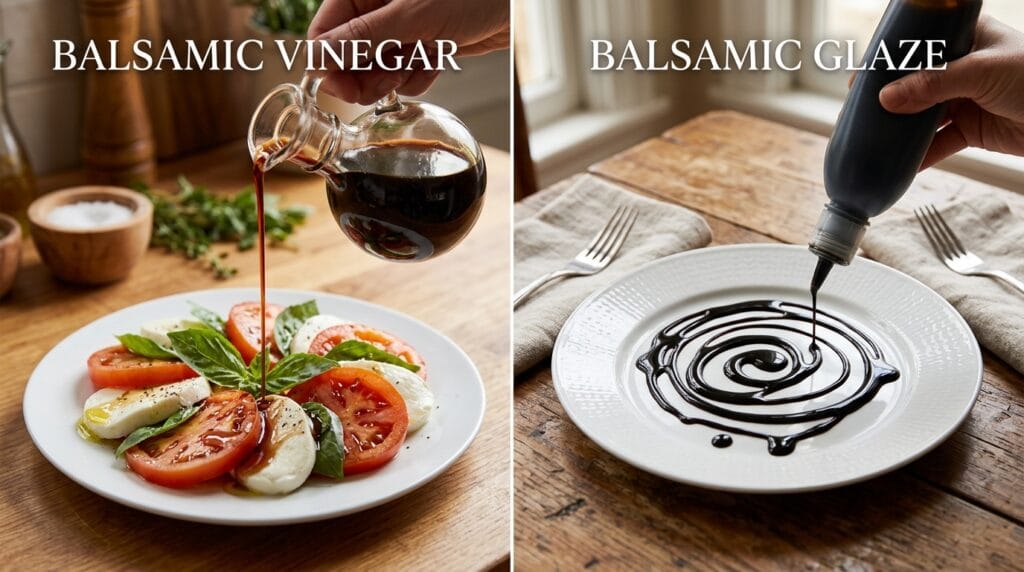
Balsamic Glaze vs Balsamic Vinegar
| Type | 1 tbsp | Sugar |
|---|---|---|
| Balsamic Vinegar (plain) | 14-15 kcal | 2g |
| Balsamic Glaze (typical) | 28-40 kcal | 6-10g |
| Balsamic Glaze (1/4 cup) | 225-320 kcal | 24-40g |
The jump from vinegar to glaze roughly doubles the calorie count per tablespoon. The bigger practical difference shows up when you pour generously, since glaze is easy to over-pour compared to thin vinegar. Plain balsamic vinegar itself is a very low-calorie condiment, and looking it up on USDA FoodData Central confirms how much the reduction and sugar-adding process changes the final number.
Calculate Your Exact Balsamic Glaze Calories
Use this calculator to check your total based on type and amount used.
Balsamic Glaze Calorie Calculator
32 kcal
See how this fits your day → Calculate Your TDEE
Is Balsamic Glaze Keto-Friendly?
Mostly, no. Most store-bought balsamic glaze runs 6-11 grams of net carbs per tablespoon, and some heavily reduced or imported brands push past that. That is enough to eat into a large chunk of a typical 20-30 gram daily net carb budget on strict keto, especially if you are drizzling more than one tablespoon.
| Product (1 tbsp) | Net Carbs | Keto Fit |
|---|---|---|
| Standard store-bought glaze | 6-11g | Poor fit, small amounts only |
| Premium/imported glaze | Up to 18g | Avoid on strict keto |
| Homemade sugar-free reduction | 3-6g | Workable in small amounts |
The carbs come from two places: the natural sugar already in balsamic vinegar, and the added sugar or syrup used to thicken it into glaze. If you want a genuinely keto-friendly version, a homemade reduction made with a sugar substitute like allulose or monk fruit keeps net carbs closer to 3-6 grams per tablespoon. If keto tracking is part of your routine, our carnivore and IIFYM calorie calculator can help you fit small condiment carbs into a daily target that still works for your goals.
Balsamic Glaze and Blood Sugar: What to Know
Plain balsamic vinegar has a low glycemic index and is not known to spike blood sugar in normal serving amounts. Glaze is a different story, because the added sugar changes the picture. A single tablespoon of glaze can carry 6-12 grams of sugar, and there is no fiber in it to slow that sugar's absorption.
For context, the American Heart Association recommends women cap added sugar at about 25 grams a day and men at about 36 grams. Two generous tablespoons of glaze on a salad can already use up a third of that daily limit before you have eaten anything else. This does not make glaze dangerous in small, measured amounts, but anyone watching blood sugar or managing diabetes should treat it like a light sweetener rather than a plain vinegar substitute, and measure rather than free-pour.
Why Glaze Has So Much More Sugar Than Vinegar
Balsamic glaze starts as balsamic vinegar, but the process changes it. Glaze is made by simmering balsamic vinegar, usually with added sugar, until it reduces into a thick, syrup-like consistency.
That reduction concentrates the natural sugars already in the vinegar while often adding more on top, which is why sugar roughly triples between vinegar and glaze for the same tablespoon. The thicker texture is part of the appeal too, since it clings to food and creates a visible drizzle that thin vinegar cannot.
None of this makes glaze a "bad" ingredient. It simply means the two products serve different purposes in the kitchen and carry different calorie and sugar counts as a result. According to the Harvard T.H. Chan School of Public Health, added sugars in any form are worth tracking even when they come from a small condiment rather than a dessert.
How Much Are You Really Drizzling?
A tablespoon sounds small, but glaze's thick consistency makes it easy to use more than planned, especially straight from a squeeze bottle over a salad or caprese plate. A generous drizzle across a full dinner plate can easily total 2-3 tablespoons without much thought.
At 28-40 calories per tablespoon, that generous drizzle adds up to 60-120 calories from glaze alone, which is meaningful for something most people treat as a garnish rather than a real ingredient. Measuring with an actual tablespoon once, just to see what your usual drizzle looks like, calibrates future servings fast.
Balsamic Glaze vs Other Dressings and Dips
Compared to typical creamy dressings, balsamic glaze is on the lighter end. A tablespoon of ranch runs 65-75 calories, and Caesar dressing can reach 80-90 calories, both well above glaze's 28-40.
A basic oil-and-vinegar vinaigrette sits in between at roughly 45-60 calories per tablespoon, mostly from the olive oil. This gap exists because glaze contains no oil at all, relying entirely on concentrated vinegar and sugar for its calories, while creamy dressings and vinaigrettes get most of theirs from oil or mayonnaise. If you want to lighten a salad without losing flavor, balsamic glaze is a reasonable middle ground between a full oil-based dressing and plain vinegar.
White Balsamic Glaze and Fig Balsamic Glaze: Same Calories?
Close, but not identical. White balsamic glaze, made from white balsamic vinegar instead of the dark aged version, typically runs about 28-32 calories per tablespoon, close to standard glaze since the sugar-and-reduction process is the same.
Fig balsamic glaze usually lands a touch higher, around 30-37 calories per tablespoon, because it often includes added fig puree or concentrate on top of the standard glaze base. Both are worth checking on the specific label rather than assuming they match plain balsamic glaze exactly, since flavored versions frequently add extra sugar for taste.
Common Uses and Portion Awareness
Balsamic glaze shows up most often drizzled over caprese salads, roasted vegetables, grilled meats, and even fresh strawberries or vanilla desserts. Because it is used in small amounts across such different dishes, it rarely becomes the main calorie source in a meal, but it is easy to underestimate across multiple dishes at one sitting.
If you are serving it at a dinner party or buffet-style meal, portioning it into a small squeeze bottle rather than leaving a large bowl out for free pouring keeps servings closer to the intended tablespoon amount across your guests.
Making Balsamic Glaze at Home
A homemade version is simple: simmer balsamic vinegar alone, or with a small amount of added sugar or honey, until it reduces by about half its original volume. This gives you direct control over how much sugar goes in, which can bring the calorie and carb count down closer to plain vinegar if you skip added sweeteners entirely.
A sugar-free reduction, made with just vinegar, heat, and optionally a keto-friendly sweetener like allulose, will naturally concentrate the vinegar's existing sugars but will not carry the added sugar load of a store-bought glaze. That puts it around 10 calories and 3-6 net carbs per tablespoon, a reasonable middle ground for anyone watching sugar or carbs closely.
How Balsamic Glaze Fits Your Daily Calories
At 28-40 calories per tablespoon, balsamic glaze is unlikely to be the biggest calorie item in any meal, but it adds up with generous or repeated use. If you are tracking toward a specific target, check your TDEE calculator first, then use the calculator above to see how your typical drizzle compares to plain vinegar.
Our breakdown of mayo packet calories covers a similar small-condiment situation, where a seemingly minor addition meaningfully changes a meal's total. Our calorie guide has more condiment and dressing breakdowns if you are comparing options for a salad or grilled dinner. Our guide on calculating macros from your TDEE can help you see how small condiment additions fit into your daily carbohydrate target. Our blog has more salad and dressing comparisons if you are building out a full meal plan.
Common Mistakes That Add Hidden Calories
- Confusing balsamic glaze with plain balsamic vinegar, which has less than half the calories
- Free-pouring thick glaze without measuring, since it is easy to over-pour
- Assuming a vinegar-based condiment is automatically low calorie or low carb
- Not counting glaze used across multiple dishes at the same meal
- Assuming all brands carry the same calorie count without checking the label
- Treating glaze as keto-friendly just because it started as vinegar
Frequently Asked Questions
How many calories are in a tablespoon of balsamic glaze?
A tablespoon of balsamic glaze has about 28-40 calories, depending on the brand and sugar content.
Is balsamic glaze higher calorie than balsamic vinegar?
Yes, roughly double. Plain balsamic vinegar has about 14-15 calories per tablespoon, while glaze runs 28-40 due to added sugar and concentration.
How many calories are in a quarter cup of balsamic glaze?
A quarter cup of balsamic glaze has approximately 225-320 calories, based on standard per-tablespoon values across brands.
Is balsamic glaze keto-friendly?
Not usually. Most store-bought glaze has 6-11 grams of net carbs per tablespoon, and some brands run as high as 18 grams. A homemade sugar-free reduction is a better fit for keto.
Does balsamic glaze spike blood sugar?
It can, more than plain vinegar, because of its added sugar and lack of fiber. Small, measured amounts are generally fine, but anyone managing blood sugar should treat it as a light sweetener rather than a plain vinegar swap.
Is balsamic glaze lower calorie than ranch dressing?
Yes, significantly. A tablespoon of glaze has roughly half the calories of ranch, since glaze contains no oil.
Are white balsamic glaze and fig balsamic glaze the same calories as regular glaze?
Close. White balsamic glaze runs about 28-32 calories per tablespoon, and fig balsamic glaze runs about 30-37, slightly higher due to added fig puree.
Can I use balsamic glaze on a low-calorie diet?
Yes, in measured amounts. A single tablespoon fits most calorie budgets, though it is worth measuring rather than free-pouring given its thick, easy-to-over-serve consistency.
Does balsamic glaze contain gluten?
Most balsamic glaze is naturally gluten-free, made from grape must and vinegar, but check the label if you have a gluten sensitivity, since some brands add thickeners.
Is balsamic glaze healthy?
In moderate, measured amounts, it fits reasonably into a balanced diet and offers some antioxidants from its vinegar base. Its added sugar content means portion size matters more than it does with plain vinegar.