Most people struggle with weight loss or muscle gain because they confuse BMR and TDEE, but they are actually very different. Your BMR (Basal Metabolic Rate) is the number of calories your body burns at complete rest just to keep you alive, like breathing and heartbeat. Your TDEE (Total Daily Energy Expenditure) is your real daily calorie burn, including walking, exercise, digestion, and all movement.
This is why understanding tdee vs bmr is so important. BMR alone cannot guide your diet, but TDEE shows your true daily calorie needs. When you know your TDEE, you can easily plan for fat loss (eat less than TDEE), muscle gain (eat more than TDEE), or maintenance (eat equal to TDEE). In simple terms, bmr vs tdee for weight loss helps you stop guessing and start controlling your calories in a smart and accurate way.
What Is BMR (Basal Metabolic Rate)?
What BMR Actually Means
Basal Metabolic Rate (BMR) is the number of calories your body burns at complete rest.
Think of it like this:
Even if you stayed in bed all day—did not walk, eat, or move—your body would still burn calories. That energy is your BMR.
It keeps you alive by powering essential functions like:
- Breathing
- Heart beating
- Brain activity
- Organ function
- Body temperature control
In simple words, BMR = the energy your body needs just to survive.
This is also why calories burned at rest are never zero. Your body is always working.
Why BMR Is Not Your Daily Calorie Needs
A very common mistake is assuming BMR = how much you should eat daily.
This is wrong.
Your daily calorie needs are always higher than BMR because you also:
- Walk
- Exercise
- Work
- Digest food
- Move around daily
So while BMR is the foundation, it does NOT represent your real-life calorie burn.
This is where the confusion in bmr vs tdee explained starts.
Factors That Affect Your BMR
Your BMR is not the same for everyone. It depends on:
- Age (younger = higher BMR)
- Gender
- Lean body mass (more muscle = higher BMR)
- Body size
- Genetics
- Hormones
People with more muscle mass usually have a higher resting metabolic rate, meaning they burn more calories even when doing nothing.
What Is TDEE (Total Daily Energy Expenditure)?
If BMR is your “idle mode,” then TDEE (Total Daily Energy Expenditure) is your “full-day mode.”
TDEE tells you how many calories you burn in a full day including all activity.
This is the most important number for weight loss and muscle gain.
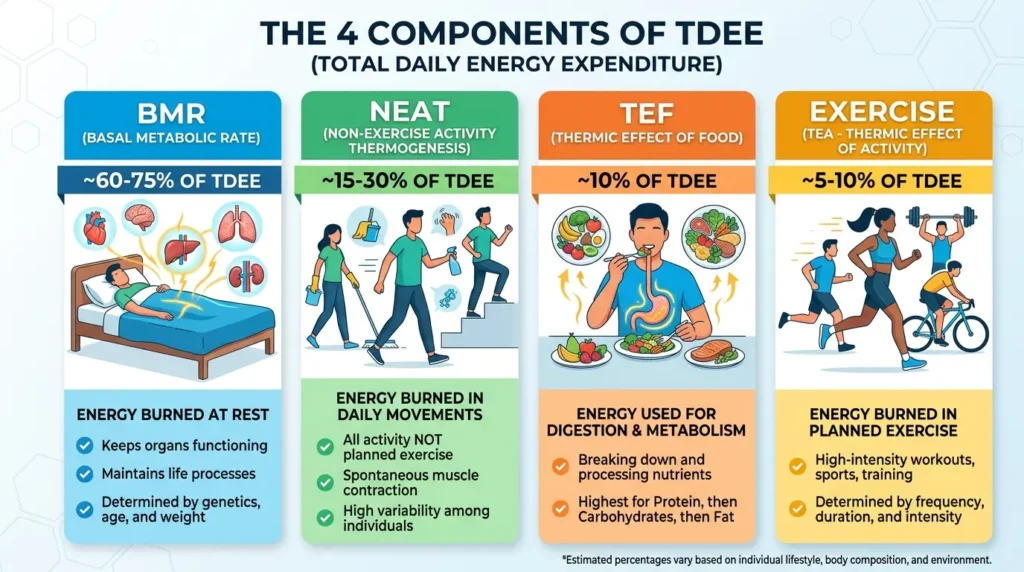
The 4 Components of TDEE
To fully understand tdee vs bmr difference, you need to understand what makes up TDEE.
BMR
This is your base calorie burn at rest.
TEF (Thermic Effect of Food)
This is the energy your body uses to digest food.
Yes—eating burns calories.
Protein has the highest thermic effect of food, meaning it burns more calories during digestion compared to carbs and fats.
TEA (Exercise Activity)
This includes all planned exercise:
- Gym workouts
- Running
- Sports
- Training sessions
This is the most obvious part of calorie burning.
NEAT (Non-Exercise Activity Thermogenesis)
This is the hidden calorie burner most people ignore.
It includes:
- Walking
- Cleaning
- Standing
- Fidgeting
- Daily movement
For some people, NEAT can burn more calories than workouts.
Why TDEE Changes Every Day
Unlike BMR, your tdee and bmr meaning is not static.
Your TDEE changes based on:
- Activity level
- Workout intensity
- Steps per day
- Food intake
- Lifestyle
For example:
- Rest day → lower TDEE
- Gym day → higher TDEE
- Active job → much higher TDEE
That’s why tdee vs bmr calories are always different in real life.
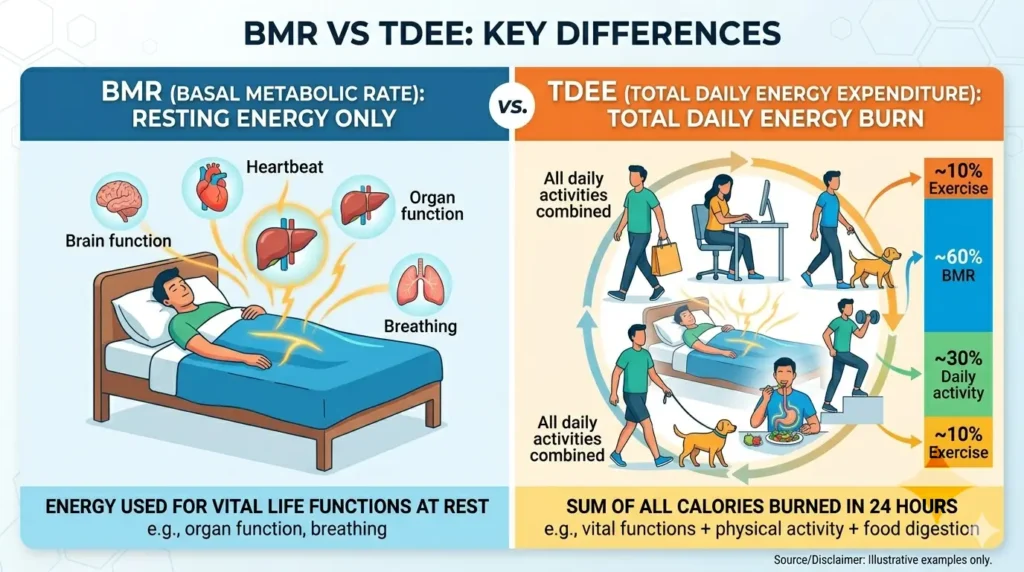
BMR vs TDEE: Key Differences
Now let’s clearly compare bmr vs tdee so you never confuse them again.
Simple Comparison Table
Factor | BMR | TDEE |
Meaning | Calories at rest | Total daily calories burned |
Includes exercise | ❌ No | ✅ Yes |
Includes movement | ❌ No | ✅ Yes |
Changes daily | ❌ Mostly stable | ✅ Changes daily |
Used for dieting | ❌ Not directly | ✅ Yes |
Which One Matters for Weight Loss?
If your goal is fat loss, then TDEE matters more.
Why?
Because fat loss depends on your calorie deficit, and that is calculated using TDEE—not BMR.
So when people ask:
- bmr or tdee for fat loss?
The answer is simple: TDEE is the one that matters.
Common Misconceptions
Let’s clear up confusion around tdee vs bmr for beginners:
Misconception 1: “BMR is my diet calories”
- Wrong
- Your diet is based on TDEE
Misconception 2: “Eating below BMR is better”
- Not true
- Extreme restriction slows metabolism and harms performance
Misconception 3: “TDEE calculators are always accurate”
- Wrong
- They are estimates only
How to Calculate Your BMR
To understand bmr vs tdee calculation, we first calculate BMR using scientific formulas.
Mifflin-St Jeor Formula
This is the most commonly used modern formula:
- Men:
BMR = (10 × weight) + (6.25 × height) − (5 × age) + 5 - Women:
BMR = (10 × weight) + (6.25 × height) − (5 × age) − 161
This is known as the mifflin st jeor equation and is considered very accurate.
Harris-Benedict Formula
An older formula used for estimating BMR:
It is still useful but slightly less accurate for modern body types.
Katch-McArdle Formula
This formula uses lean body mass, making it more accurate for athletes.
It is ideal if you know your body fat percentage.
How to Calculate Your TDEE
Once you know your BMR, you estimate your TDEE using activity levels.
This is the core of tdee formula understanding.
Choosing the Right Activity Level
You multiply BMR by activity factor:
- Sedentary (little movement): 1.2
- Light activity: 1.375
- Moderate activity: 1.55
- Very active: 1.725
- Athlete level: 1.9
This gives your maintenance calories.
Why TDEE Calculators Can Be Wrong
Even though a calorie calculator is useful, it is not perfect.
Reasons include:
- Incorrect activity selection
- Genetic differences
- Muscle mass variations
- Inconsistent daily movement
That’s why real tracking is more accurate than calculators alone.
Manual vs Calculator Method
- Calculator: Fast but estimated
- Manual tracking: More accurate but takes time
Best approach = use calculator first, then adjust using real progress
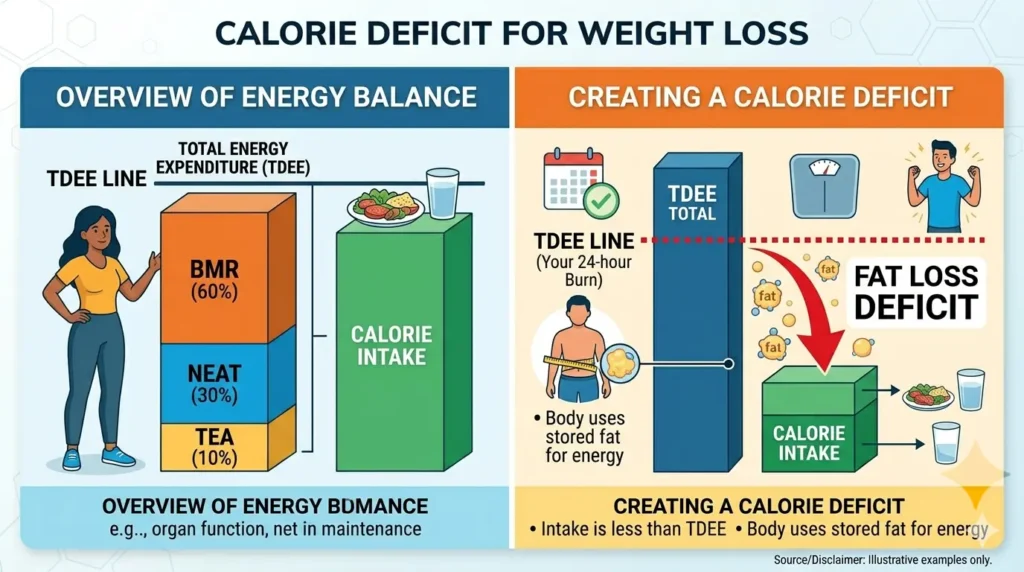
How to Use BMR and TDEE for Weight Loss
Now we come to the most important part: bmr vs tdee for weight loss
Creating a Calorie Deficit
To lose fat, you must eat below TDEE.
This is called a calorie deficit.
Example:
- TDEE = 2500 calories
- Fat loss intake = 2000–2200 calories
This forces your body to use stored fat for energy.
Safe Rate of Fat Loss
Healthy fat loss guidelines:
- 0.5 kg per week (safe)
- 0.25–1% body weight per week
Too aggressive deficits can lead to:
- Muscle loss
- Low energy
- Slow metabolism
Real-Life Example Plan
Let’s make it simple:
Person:
- TDEE: 2400 calories
- Goal: Fat loss
Plan:
- Calories: 1900–2000
- Protein: High
- Training: 3–5 days/week
- Steps: 8,000–10,000 daily
This creates a sustainable fat loss system without starving.
How to Use TDEE for Muscle Gain
Once you understand tdee vs bmr, the next step is learning how to use TDEE correctly for building muscle. Muscle gain is not about eating randomly—it is about controlled calorie surplus, smart training, and consistency.
Your total daily energy expenditure gives you the baseline, and from there you adjust calories upward for growth.
Clean Bulk vs Dirty Bulk
There are two main approaches to gaining weight:
Clean Bulk
A clean bulk means eating slightly above your maintenance calories using nutritious foods.
Focus on:
- Lean proteins
- Whole grains
- Healthy fats
- Controlled calorie surplus
Pros:
- Minimal fat gain
- Better body composition
- Easier to cut later
Dirty Bulk
A dirty bulk involves eating in a large calorie surplus without food quality control.
Pros:
- Fast weight gain
Cons:
- Excess fat gain
- Poor insulin control
- Harder cutting phase later
In most cases, clean bulking is better for long-term results in muscle gain.
Ideal Calorie Surplus
To gain muscle efficiently:
- Add +250 to +500 calories above TDEE
This small surplus supports muscle growth without excessive fat storage.
Example:
- TDEE = 2500 calories
- Muscle gain intake = 2750–3000 calories
This balance is key in tdee vs bmr for muscle gain strategies.
Avoiding Excess Fat Gain
To keep gains lean:
- Track weekly weight changes
- Adjust calories slowly
- Prioritize protein intake
- Train with progressive overload
If weight increases too fast, you are likely gaining fat instead of muscle.
Why Your TDEE May Be Inaccurate
Many people get confused when results don’t match their expectations. The truth is, calorie expenditure is not fixed.
This is why tdee vs bmr explained always includes variability.
Overestimating Activity Level
One of the biggest mistakes is selecting a higher activity level than reality.
For example:
- Sitting most of the day but choosing “very active”
- Light gym training but selecting “athlete level”
This leads to overestimated TDEE and stalled fat loss.
NEAT Changes
Your non-exercise activity thermogenesis (NEAT) can change without you noticing.
If you diet:
- You move less
- You fidget less
- You feel tired
This automatically reduces calorie burn even if workouts stay the same.
Metabolic Adaptation
When you stay in a long calorie deficit:
- Metabolism slows slightly
- Energy expenditure decreases
- Body becomes more efficient
This is called metabolic adaptation and is a natural survival response.
It directly affects your tdee vs bmr difference over time.
Advanced Strategies Most Guides Don’t Cover
Most beginners only use calculators. But advanced body transformation requires deeper strategies.
Reverse Dieting Explained
Reverse dieting is slowly increasing calories after a diet.
Purpose:
- Restore metabolism
- Increase energy levels
- Prevent rapid fat regain
It is especially useful after long fat loss phases.
Adaptive Calorie Tracking
Instead of sticking to fixed calories, you adjust based on:
- Weekly weight trends
- Strength levels
- Energy and recovery
This makes your calorie tracking more flexible and accurate.
Weekly vs Daily Tracking Strategy
Most beginners track daily calories only.
But a better approach is:
- Focus on weekly averages
- Allow daily fluctuations
- Maintain consistency over perfection
This prevents unnecessary stress and improves long-term adherence.
Common Mistakes to Avoid
Even with correct knowledge of bmr vs tdee, many people still fail due to simple mistakes.
Eating Too Few Calories
Extreme calorie restriction may lead to:
- Muscle loss
- Fatigue
- Hormonal imbalance
- Slow metabolism
A sustainable calorie deficit is always better than aggressive dieting.
Ignoring Protein Intake
Protein is essential for:
- Muscle preservation
- Fat loss efficiency
- Satiety control
Without enough protein, even perfect calories won’t give good results.
Inconsistent Tracking
If your tracking is random:
- You cannot measure progress
- You cannot adjust calories correctly
- Results become unpredictable
Consistency is more important than perfection in nutrition tracking.
Frequently Asked Questions
Will eating 1200 calories slow my metabolism?
Yes, for most adults it can slow metabolism over time because it is too low compared to daily calorie needs. It may also reduce energy and muscle mass.
Do I subtract calories from TDEE or BMR?
Always subtract from TDEE, not BMR.
BMR is not your eating target—TDEE is your true maintenance level.
How many calories should I eat if my BMR is 1500?
You should NOT use BMR directly.
First calculate TDEE, then:
- Fat loss: TDEE − 300 to 500
- Maintenance: TDEE
- Muscle gain: TDEE + 250 to 500
Why is my TDEE higher than my BMR?
Because TDEE includes:
- Exercise
- Walking and movement
- Food digestion
- Daily activities
BMR only includes survival functions.
Final Takeaway
Understanding tdee vs bmr is one of the most important steps in fitness.
Here is the simple truth:
- BMR = survival calories
- TDEE = real daily calorie burn
- Fat loss and muscle gain both depend on TDEE, not BMR
Once you learn how to control your calorie intake, track your energy balance, and adjust based on your progress, your results become predictable.
Whether your goal is fat loss, muscle gain, or maintenance calories control—the real game is always your total daily energy expenditure.