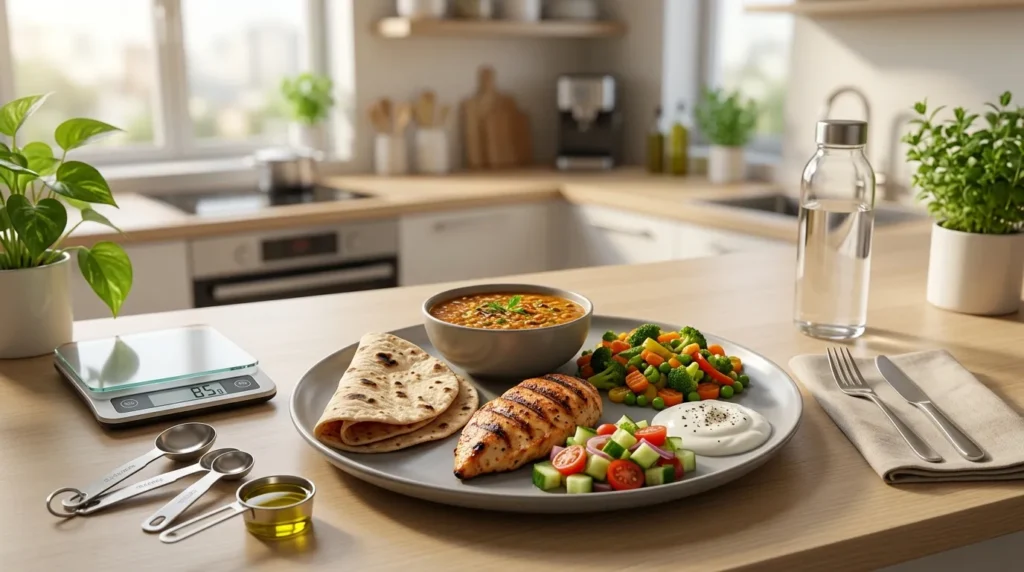
There's no single number that works for everyone, so let's be honest about that upfront. How many rotis you can eat and still lose weight depends entirely on your TDEE and your daily calorie budget — not on a rule someone posted online. That said, here's a useful starting range: a typical woman on a fat loss plan usually fits 2 to 3 rotis a day into her deficit. A typical man on fat loss usually fits 3 to 4. Those are starting points, not your final answer.The only way to get your actual number is to work backward from your own calorie needs. Start with a free TDEE calculator to find out how many calories your body burns in a day — that single number is what the rest of this math is built on. Once you have it, the roti question stops being a guess and becomes simple arithmetic. This article walks through that arithmetic step by step.
Look at what that table actually means in practice. Two butter parathas run 580 to 680 calories. Two plain rotis run 160 to 190 calories. Swap one for the other and you save 400 to 500 calories in a single meal — without cutting out bread, wheat, or anything you'd actually miss. That's the entire strategy in one sentence.
This is a starting point, not a rule. Your actual number depends on your protein intake, your activity level, and how you eat the rest of your day — which is exactly what the next section calculates.
Calories in One Roti — Getting the Number Right
Before you can calculate anything, you need an accurate calorie figure for a single roti. This sounds simple, but it's where most people get tripped up.Why Roti Calorie Counts Vary So Much Between Sources
Search "calories in one roti" and you'll get answers ranging from 70 to 120 calories for what looks like the same food. The gap comes down to three things: the thickness of the dough, the diameter of the roti, and how much oil or ghee gets brushed on while it cooks. A thin, dry-cooked roti and a thicker one finished with a light coat of ghee are not the same food, even though they look identical on a plate. For the numbers in this guide, we're using plain, dry-cooked roti made from standard atta — the version most homes make on a regular weeknight.Plain Roti vs Paratha vs Tandoori Roti — The Calorie Differences
This comparison is genuinely the most useful thing in this entire article. Most people don't realise how much calorie difference sits between roti and paratha — and that gap is where real progress hides.| Roti Type | Avg. Weight | Calories | Protein | Fat |
|---|---|---|---|---|
| Plain roti (medium) | 30–35g | 80–95 cal | 2.5g | 0.5g |
| Tandoori roti | 55–65g | 150–180 cal | 4.5g | 2g |
| Plain paratha (medium) | 80–90g | 240–280 cal | 5g | 10g |
| Butter paratha (medium) | 85–95g | 290–340 cal | 5g | 15g |
Missi Roti and Dal Roti — The Protein-Boosted Options
Plain roti is almost pure carbohydrate, with barely any protein per piece. Missi roti and dal roti fix that. Missi roti mixes besan (gram flour) into the wheat dough, and dal roti kneads leftover cooked lentils straight into the dough. Both come out slightly denser and heavier than plain roti, and both carry noticeably more protein per piece — usually 4 to 6 grams, roughly double what a plain roti gives you, for only a small calorie increase.This matters for the exact reason covered earlier in this guide: protein is what makes a meal satisfying. If your calorie budget is tight and you can't add much extra food, swapping one plain roti for one missi or dal roti most nights is a free upgrade. Same rough calorie count, meaningfully more protein, no extra cooking time.Gluten-Free and No-Wheat Roti Options
If you're cutting wheat for digestion, gluten sensitivity, or just variety, you don't have to give up roti altogether. A few common swaps:- Jowar roti (sorghum): naturally gluten-free, similar calorie range to wheat roti, slightly more fibre
- Bajra roti (pearl millet): denser and more filling per piece, a common winter staple in many households
- Ragi roti (finger millet): higher in calcium than wheat roti, with a mild earthy taste
How Many Rotis Fit in Your Calorie Budget?
Here's where the abstract question turns into a real number you can use tonight.Quick Roti Reference — Typical Ranges by Profile
Use this as a rough starting point while you work out your exact number using your own TDEE.| Profile | Typical Fat Loss Calorie Target | Typical Roti Range |
|---|---|---|
| Sedentary woman | 1,200–1,400 cal | 2 rotis/day |
| Active woman | 1,400–1,600 cal | 2–3 rotis/day |
| Sedentary man | 1,600–1,800 cal | 3 rotis/day |
| Active man | 1,800–2,200 cal | 3–4 rotis/day |
The 4-Step Method to Calculate Your Personal Roti Limit
- Step 1 — Find your TDEE. Use the TDEE calculator to get your maintenance calorie number.
- Step 2 — Set your fat loss target. Subtract 300 to 500 calories from your TDEE. Our calorie deficit guide explains how to pick the right size deficit for your goals.
- Step 3 — Subtract your protein calories. Multiply your daily protein target (in grams) by 4. Not sure what your number should be? Our protein per day guide breaks this down by body weight.
- Step 4 — Allocate the remaining budget. What's left after protein covers fat, carbs, and yes — your rotis. This is the number that actually answers "how many rotis can I eat."
Roti Calorie Calculator
Find out how many rotis can fit into your remaining daily calorie budget.
cal
cal
cal
A medium plain dry-cooked roti is commonly around 80–95 calories.
You can fit approximately
0
whole roti(s) into your remaining calorie budget.
Remaining Calories
0
calories
Calories From Rotis
0
calories
Calories Left
0
calories
This is an estimate. Roti calories vary depending on size, flour, thickness, and whether oil or ghee is added.
Worked Example — A Woman's Daily Roti Budget
Let's run real numbers through this so the method actually sticks. Picture a woman with a TDEE of 1,700 calories, aiming for a fat loss target of 1,300 calories a day, with a protein target of 110g.- Protein: 110g × 4 cal/g = 440 calories
- Remaining budget: 1,300 − 440 = 860 calories for fat and carbohydrates
- 3 plain rotis: 3 × 90 cal = 270 calories — about 31% of that remaining budget
- Left over: 860 − 270 = 590 calories for daal, sabzi, dahi, cooking oil, and rice
What to Pair With Roti for Maximum Satiety
Roti by itself is mostly carbohydrate with a small amount of fibre — it's not going to keep you full for long on its own. Pair it with a high-protein side and the entire equation changes. Always eat roti alongside at least one of the following: 100 to 150g of chicken, a full cup of daal, or two eggs. Doing this lets you eat the same number of rotis while feeling noticeably fuller, because protein slows digestion and blunts hunger far more effectively per calorie than carbs alone. This single habit — protein on the side, every time — is one of the easiest adherence boosters in the entire desi weight loss playbook.Smarter Roti Choices — Wholemeal, Mixed Grain, and Portion Adjustments
Once your roti count is set, the next question is which roti to actually make. The answer might surprise you.Is Wholemeal Atta Better for Weight Loss Than Maida?
Calorie-wise, wholemeal atta roti and plain white maida roti are nearly identical — both land around 80 to 95 calories per piece, with only a 5 to 10 calorie gap between them. So if you're switching flours expecting a dramatic calorie cut, you won't get one. What you do get is fibre: wholemeal atta typically contains two to three times more dietary fibre than maida.That fibre difference matters more than it looks on paper. A systematic review of cereal fibre research published through the National Institutes of Health found that higher-fibre grains consistently improve fullness and appetite control compared with refined versions of the same food. Wholemeal atta isn't a calorie swap — it's a satiety swap. The same number of rotis fills you up more effectively, which makes it easier to stick to your calorie target without feeling like you're white-knuckling through hunger.Multigrain and Millet Roti — Is the Upgrade Worth It?
Multigrain roti — made with a blend of wheat, bajra, jowar, or ragi — pushes the fibre advantage even further than plain wholemeal atta. Calories stay in a similar range, but the added fibre and slightly lower glycaemic load can mean steadier energy and less mid-afternoon hunger. It's not a requirement for weight loss, but if you're already buying flour, choosing a multigrain blend over plain maida costs you nothing in calories and gains you something in fullness.Three Portion Tricks That Don't Feel Like a Diet
- Make your roti slightly smaller in diameter rather than thicker — thickness adds calories faster than width does
- Skip the ghee brushing on the tawa for at least one of your daily rotis — it's an easy 25 to 40 calorie save per piece
- Serve rice and roti as alternatives rather than both at the same meal — pick one starch, not two, at dinner
Common Roti Mistakes That Quietly Add Calories
A few habits sneak past most people's tracking without ever getting questioned:- Brushing ghee on both sides of every roti out of habit, not hunger — adds up to 60 to 80 calories per piece across a day
- Estimating roti weight from memory instead of actually weighing one — most people underestimate by 5 to 10g per piece, which compounds across multiple rotis daily
- Treating "roti" and "paratha" as interchangeable when logging meals — they're not even close on a calorie chart, and mixing them up silently wrecks a calorie deficit
- Eating rice and roti at the same meal "just this once" — a habit that quietly becomes a daily 200+ calorie overshoot
- Eating roti at every single meal of the day — relying on one grain for all your carbs gets monotonous fast and can leave you low on energy; rotating in rice, millet roti, or oats at different meals usually holds up better long term
Pingback: Pakistani & Indian Food Calorie Guide (2026)