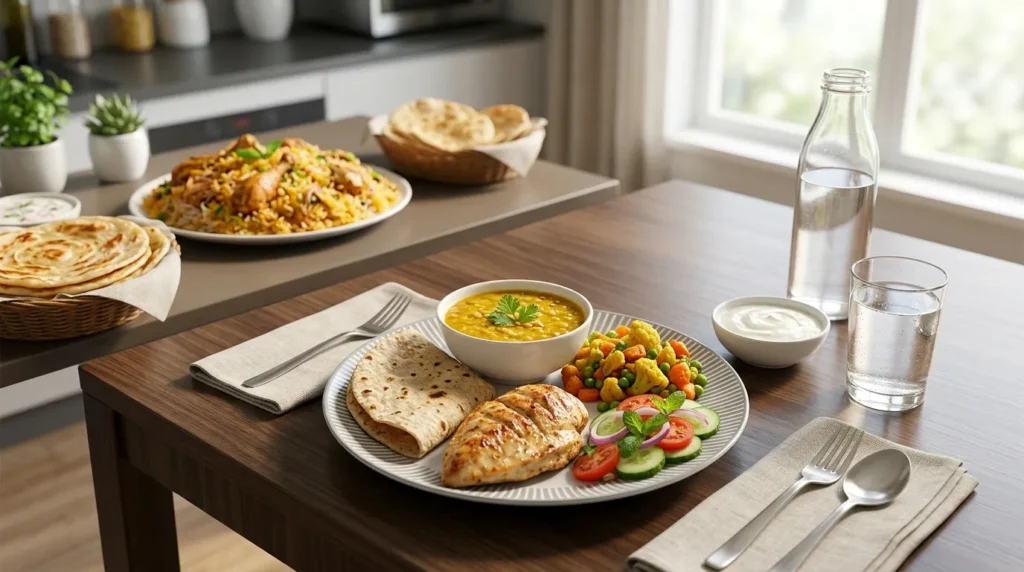
If a "weight loss plan" has ever told you to eat plain grilled chicken and a side of broccoli, you already know how useless that advice is for a desi household. Your mom is making daal and roti tonight. Your kitchen runs on ghee, basmati rice, and a tarka that hits the pan before anyone asks if you're "on a diet." Telling someone in this situation to eat bland Western diet food isn't just culturally tone-deaf — it doesn't last. Most people quit within two weeks because the food feels foreign and the meals feel like punishment.Here's the actual truth: you can lose weight while eating Pakistani and Indian food every single day. No biryani ban. No giving up roti forever. What changes is your understanding of where the calories are hiding, how big your real portions are, and how those numbers line up with your daily calorie target. If you haven't worked out that number yet, start with a free
TDEE calculator to find out how many calories your body actually needs each day — everything in this guide builds on that number. And once you're tracking your meals, our guide on
how to track calories accurately will help you log desi dishes without the usual guesswork. If you want the full food-by-food calorie breakdown first, check the
complete Desi food calorie chart — this guide focuses on the strategy side: what to actually do with those numbers.This isn't a small problem either. Weight gain is already a major health issue across the region — one national health survey found that
over 40% of Pakistani adults are overweight or obese, with the numbers rising fastest among urban women aged 25 to 45. That trend tracks closely with rising rates of diabetes and hypertension. None of that means giving up desi food. It means eating it with a clearer picture of the numbers.
Why Desi Diets Are Harder to Track — and Why That Makes TDEE More Important
Western calorie-counting tools were built around Western food. A grilled chicken breast and a baked potato are easy to weigh and log. A plate of chicken karahi shared from a communal pot at a family dinner? Not so simple. This isn't a reason to give up on tracking — it's a reason to track smarter, using your own calculated calorie needs as the anchor point instead of guessing.
The Cooking Oil and Ghee Problem
Here's something most people never think about until they actually measure it: South Asian cooking uses far more fat per dish than most Western recipes. Ghee runs about 900 calories per 100g. Regular cooking oil sits around 884 calories per 100g. Butter isn't far behind. And in desi kitchens, these fats aren't used sparingly — they're poured for tarka, used for frying, and added again at the end "just to finish the dish properly."Do the math on a simple home-cooked daal. A pot made with 3 to 4 tablespoons of ghee for the tarka alone is adding 400 to 450 calories before anyone even serves a plate. None of that shows up if you're just estimating "a bowl of daal" based on the lentils. This is the single biggest reason desi food tracking goes wrong — and it's almost never a carb problem. It's a fat tracking problem. Once you start measuring oil and ghee with a spoon instead of eyeballing it, your numbers start making sense.
The Portion Size Problem — How Pakistani and Indian Servings Differ From Database Entries
Open any generic calorie app and search "biryani." You'll usually get a number based on a 100g portion. Now picture an actual plate served at a wedding or a Sunday lunch — that's easily 400 to 500g of rice, meat, and oil. If you log "biryani" and assume it means the database's 100g entry, you've just underestimated your meal by four or five times.The same problem shows up with roti. A typical home-made roti weighs 35 to 45g, not the standardised 30g that most nutrition databases assume. It sounds like a small gap, but across three meals a day, it adds up to a meaningful miscalculation. Knowing the real household serving size — not the lab-tested 100g sample — is the first real step toward accurate desi calorie tracking. For a full breakdown of exactly how many rotis fit your personal calorie target, our
roti portion guide covers this with real numbers instead of guesswork.
The Hand Portion Method — A No-Scale Way to Judge a Desi Plate
Weighing every roti and daal bowl isn't realistic at a family dinner or a wedding. When you can't measure, your own hand gives a decent shortcut. Fill your plate using this rough guide:
- Palm-sized portion of protein — chicken, fish, daal, or paneer
- One fist of vegetables or sabzi — as much as fits without stacking
- A cupped handful of carbs — rice or one to two rotis
- A thumb-sized amount of added fat — the ghee or oil poured at the table, not just what's cooked in
This isn't exact, but it stops the two most common mistakes: piling rice past what fits your energy needs, and forgetting that the ghee spooned on at the table counts too. Use it at gatherings where a food scale simply isn't an option.
High-Calorie Desi Foods to Be Aware Of
None of the foods below are "bad." They're calorie dense, which means a small portion carries a large number. Once you know which ones fall into that category, you can plan around them instead of being surprised by them.
The Breakfast Category — Where Most People Exceed Their Calorie Budget
A classic Pakistani or Indian breakfast — two butter parathas, a side of dahi, and a cup of chai made with full-fat milk — can land anywhere between 700 and 900 calories. For a sedentary woman following a fat-loss plan, that's roughly 40 to 50% of her entire day's calorie budget gone before 9 a.m. This is exactly the kind of calorie dense food to watch in a South Asian diet, not because it's unhealthy, but because the math doesn't leave much room for lunch and dinner.The paratha itself is usually the heaviest single item on the plate, running 250 to 350 calories each once butter or ghee is added during cooking. A simple, sustainable swap: have one paratha instead of two, add two eggs for protein, and keep the dahi portion smaller. That one change alone can save 250 to 350 calories without removing the paratha from your life.
Street Food and Fried Snacks — Occasional High-Density Items
Samosas, pakoras, puri, and bhature share one thing in common: they're fried, calorie dense, and almost always eaten in multiples at social gatherings where nobody is counting. A plate of chaat (roughly 200 to 280 calories), two samosas (300 to 360 calories), and a glass of sweet lassi (200 to 250 calories) adds up to 700 to 890 calories — for what feels like a casual snack, not a full meal.These foods don't need to disappear from your life. They need to move from "daily habit" into "planned, occasional indulgence." Eat them mindfully, within your weekly calorie budget, rather than treating them as a default afternoon snack.
Best Desi Foods for Weight Loss — High Protein, High Fibre, Low Calorie Density
Here's the part most diet advice gets backwards: traditional desi cooking isn't naturally low in protein. It's high in carbohydrates and fat relative to protein. Fix that ratio — by adjusting portions, not switching cuisines — and the same meals become far more supportive of fat loss.
High Protein Desi Foods List
Use this as a quick reference when you're planning meals around your protein target. If you haven't worked out exactly how much protein your body needs, our guide on
how much protein you should eat per day walks through the calculation step by step.
| Food | Protein per 100g | Typical Serving | Protein per Serving | Approx. Calories |
|---|
| Chicken breast | 31g | 150g | 47g | 165 cal |
| Eggs | 13g | 2 eggs | 12g | 140 cal |
| Masoor daal (cooked) | 9g | 1 bowl (200g) | 18g | 190–220 cal |
| Chana daal (cooked) | 8g | 1 bowl (200g) | 16g | 230–270 cal |
| Paneer | 18g | 100g | 18g | 265 cal |
| Plain dahi/yoghurt | 5.7g | 200g | 11g | 120 cal |
| Fish (rohu) | 16–18g | 150g | 24–27g | 160–190 cal |
The pattern here matters more than any single number. Notice that the protein-rich foods on this list — chicken, fish, daal, paneer, eggs, dahi — are already part of every desi kitchen. Nobody needs a quinoa bowl. A larger portion of meat or daal paired with a slightly smaller portion of rice or roti naturally raises the protein density of the same meal you already cook, without making it taste like a "diet meal." This lines up with what nutrition researchers at the
Harvard T.H. Chan School of Public Health have found across large dietary studies: the protein source matters, but getting enough of it consistently is one of the more reliable levers for weight control.
Closing the Gap With Whey Protein — Optional, But Worth Knowing
Hitting 100 to 130 grams of protein a day through desi food alone is doable but can mean eating a lot of chicken and daal at every meal. A scoop of whey protein delivers roughly 25 grams of complete protein for about 120 calories — a far more calorie-efficient source than most whole foods. It isn't required, and it doesn't replace real food. But blended into milk after a workout or added to a bowl of dahi, it's an easy way to close the last bit of a protein target without adding many calories. Check your own number first using the
protein per day guide before deciding if a scoop actually fits your day.
Quick Decision Table: What to Eat Freely vs. What to Portion-Control
For the complete food-by-food calorie chart with exact serving sizes, see the
full Desi food calorie chart. Here's the short version — the six items that matter most for a weight-loss decision:
| Food | Weight Loss Suitability | Why |
|---|
| Masoor daal | High | High protein and fibre, light on oil |
| Plain roti | High | Easy to portion, whole wheat |
| Sabzi / vegetable dishes | High | High fibre, low calorie density |
| Biryani | Moderate | Calorie dense — fine once, skip seconds |
| Paratha (with butter) | Use with portion control | High fat — keep to one maximum |
| Fried snacks (samosa, pakora) | Use with portion control | Fried, high calorie density |
Keep this shortlist somewhere you'll actually see it — your phone notes, your kitchen, wherever. The goal isn't to memorise every number. It's to recognise which category a dish falls into before you serve yourself a second helping.
Practical Weight Loss Strategies for Desi Eating
Knowing the numbers only helps if you actually change something in your kitchen. These strategies are the highest-impact, lowest-effort changes for anyone eating desi food daily — and none of them ask you to give up a single dish.
The Cooking Oil Reduction Strategy — Save 200–400 Calories Per Day
Cutting cooking oil and ghee by 30 to 40% in your daily cooking — measured with a tablespoon instead of poured freely — typically saves 200 to 400 calories a day without changing how anything tastes. This is the single highest-impact change for most South Asian households, simply because oil is the main hidden calorie source in nearly every dish.A few ways to make this practical:
- Use a non-stick pan and a measured spoon for tarka instead of free-pouring oil straight from the bottle
- Spread a thin scraping of ghee on roti and paratha instead of a full layer
- Cook chicken and vegetables with less oil, using water or stock to keep the same texture and moisture
This isn't just a personal preference — it's backed by research on South Asian cooking fats. A review published through the National Institutes of Health on
selecting healthy edible oils in the Indian context points to high-temperature frying and heavy oil use as a consistent driver of excess calorie and saturated fat intake across South Asian diets. The fix isn't switching cuisines — it's measuring what you already cook with. For exact gram and calorie figures on ghee, oil, and butter,
USDA FoodData Central is a free, reliable reference worth bookmarking.
The Roti and Rice Portion Strategy
Roti and rice aren't the enemy — portion size is where the calories build up. Cutting one roti per meal, say from three down to two, saves roughly 90 calories per meal. Across three meals a day, that's about 270 calories saved without anyone noticing a "diet" is happening.The same logic applies to rice. Swap 50g of rice for 50g of extra sabzi or daal at each meal, and you save 80 to 100 calories per meal while adding fibre and protein at the same time — a genuine upgrade, not just a cut. For a deeper look at exactly how many rotis fit your specific calorie target, our
roti portion guide breaks it down by daily calorie target. Your overall daily target comes from your TDEE — and our guide on
how to use your TDEE to lose weight shows exactly how to turn that number into a working calorie deficit for fat loss.
Walking and Daily Movement — The Part Most Diet Plans Skip
Cutting calories only tells half the story. The other half is how much you move outside of formal exercise, something called NEAT (non-exercise activity thermogenesis) — walking to the bazaar, standing while you cook, taking the stairs instead of the lift. For a desk-based lifestyle common in Pakistani cities, this number can be surprisingly low, and raising it is often easier than cutting another 200 calories from your plate.A daily 30-minute walk, five days a week, adds a meaningful amount of extra burn on top of your TDEE without touching your food at all. If you want to understand exactly how this fits into your numbers, our guide on
NEAT and daily movement explains how small amounts of extra movement change your total calorie burn for the day.
Drink Water Before You Eat — A Small Habit With a Real Effect
One habit that costs nothing and takes no planning: a glass of water about 30 minutes before a meal. It takes the edge off appetite and makes it easier to stop at a normal portion instead of going back for seconds of biryani or a second paratha. Aim for 2.5 to 3 litres a day overall, more in hot weather or after a workout. This isn't a replacement for tracking your calories, but paired with the portion strategies above, it makes sticking to your plan noticeably easier at a family dinner.
Frequently Asked Questions
Can I eat roti and rice and still lose weight?
Yes. Roti and rice are not the reason desi diets stall on weight loss — portion size and added fat usually are. Two rotis with a generous portion of daal, sabzi, or lean protein fits comfortably into most calorie deficits. The goal is portion awareness, not elimination.
Is Pakistani food healthy for weight loss?
Pakistani food can absolutely support weight loss. The cuisine already includes high-fibre lentils, lean proteins like chicken and fish, and vegetable-based sabzi. The adjustment needed is usually around cooking oil quantity and portion size — not the food itself.
What is the best desi breakfast for weight loss?
One paratha (instead of two) paired with two eggs and a small bowl of dahi gives you protein, some fibre, and a manageable calorie count — typically 400 to 500 calories less than the standard two-paratha breakfast, while still feeling like a real desi breakfast.
How do I count calories in home-cooked desi food?
Measure your cooking oil and ghee with a spoon rather than estimating, weigh a few sample servings of roti, rice, and daal once to learn your household's real portion sizes, and log meals using those numbers instead of generic 100g database entries. Our full walkthrough on
how to track calories accurately covers this step by step, including how to estimate restaurant and takeaway meals.
Is biryani bad for weight loss?
No — biryani isn't "bad," it's calorie dense. A single plate (400 to 500g) typically runs 500 to 650 calories, which fits into most daily calorie budgets as one meal. The problem is usually a second helping, not the dish itself. Plan for it, enjoy it, and build the rest of your day around that one calorie-dense meal. For exact calorie counts of every dish, see the
complete calorie chart.
Does walking help more than dieting for weight loss on a desi diet?
Both work together rather than competing. Diet controls how many calories come in, while daily walking and movement raise how many go out. A 30-minute walk five days a week adds a meaningful amount of extra burn without changing a single meal, which makes the overall deficit easier to sustain.
Can I add whey protein to a desi diet?
Yes. It isn't required, but a scoop mixed into milk or added to dahi delivers around 25 grams of protein for roughly 120 calories, which helps close a protein gap without adding much to your daily calorie count.