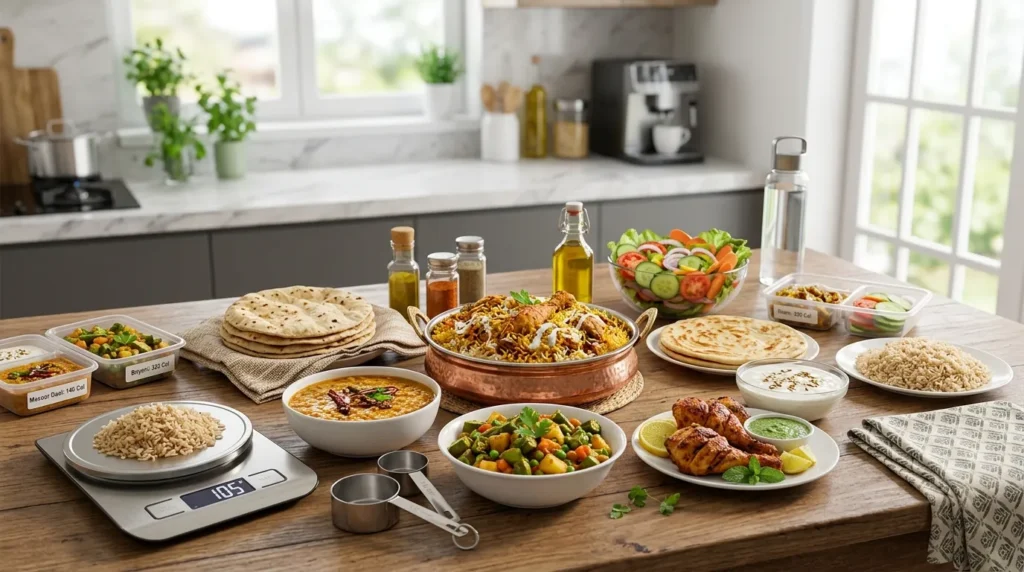
Roti made 90 calories or 140? Biryani 450 or 800? Open five different calorie apps and you’ll get five different answers for the exact same plate of desi food — and none of them agree with what your mother actually cooked.Quick answer: a medium home-made roti without oil (30g) is 85–95 calories, a home-cooked chicken biryani plate (300g) is 450–550 calories, and a home-cooked chicken karahi serving (200g) is 280–350 calories. The full breakdown — by cooking method, by size, and by home vs. restaurant — is below.Almost every mainstream calorie database (MyFitnessPal, Lose It, generic nutrition apps) was built around Western food logging. Grilled chicken breast, Greek yoghurt, overnight oats — thousands of verified entries. Roti? You’ll find “1 chapati” logged anywhere from 60 to 140 calories with no data on size, flour, or oil. Biryani entries swing from 280 to 800+ calories depending entirely on who submitted them.For the hundreds of millions of people whose daily diet is built around Pakistani and Indian food, that gap makes tracking genuinely unreliable.
Key insight: the jump from a plain roti (~90 cal) to a buttered paratha (~300 cal) is over 200 calories per piece. A typical Pakistani breakfast of 2–3 parathas can range from 170 calories (two plain rotis) to 900+ calories (three buttered parathas) — purely from bread choice. If you’re tracking for fat loss, breakfast bread choice is usually the single highest-leverage change available without cutting out any food group.
What this reveals: plain masoor daal (150–170 kcal, 10–12g protein per cup) is genuinely one of the best foods in a desi diet for a calorie deficit — filling, high fibre, low fat. Biryani has a reputation as a calorie bomb, but a home-cooked plate at 450–520 calories, eaten with raita and no extra bread, fits comfortably into most daily targets. The number that surprises people most is restaurant biryani from a specialist outlet — the extra ghee and fried onions used for flavour can push a single plate past 700–800 calories, nearly double the home-cooked version of the same dish.
Plain dahi is one of the quietest wins in a desi diet — strong protein-to-calorie ratio, pairs with almost anything. Paneer is the opposite case: raw paneer (260 kcal/100g) is a solid protein source, but frying it in ghee for curry pushes it to 310–340 kcal/100g — the paneer hasn’t changed, the cooking method has.
Methodology and sources: serving-size calorie ranges below are built from a combination of the Indian Food Composition Tables (IFCT 2017, NIN-Hyderabad / ICMR), USDA FoodData Central entries for South Asian dishes, and standard Pakistani/Indian household portion sizes (not lab-only weights, not oversized restaurant plates). Where home and restaurant versions differ meaningfully, both are listed separately, because the gap is usually 20–40% and matters for tracking accuracy.
Once you know your numbers here, use the TDEE Calculator to set your personal daily target, then match your actual meals to it using this chart.Calorie Chart — Bread and Grains (with per-100g values)
Bread carries the most tracking risk in a desi diet because the same word — “roti” or “paratha” — can mean a 25g piece or a 70g piece depending on who’s cooking. Below, each item has both a per-serving value and a per-100g value, so you can compare foods directly regardless of the size someone made.Quick answer: 1 medium roti without oil (30g) = 85–95 kcal. Add 1 tsp ghee = +45 kcal. A 40g roti (the size used in most Indian nutrition databases) runs closer to 110–120 kcal — that’s why you’ll see different “one roti” numbers across sites; they’re often different sizes, not different data.
← Swipe to scroll →
| Food | Serving Size | Calories (serving) | Calories per 100g | Protein (g) | Fat (g) |
|---|---|---|---|---|---|
| Plain roti / chapati (no oil) | 1 medium, ~30g | 85–95 kcal | 280–300 kcal | 2.5–3g | 0.5–1g |
| Roti with ghee/butter applied | 1 medium + 1 tsp ghee | 120–135 kcal | 340–370 kcal | 2.5–3g | 5–6g |
| Tandoori roti | 1 piece, ~60g | 160–180 kcal | 265–300 kcal | 5–6g | 1–2g |
| Plain paratha (tawa-fried, oil) | 1 medium, ~80g | 250–280 kcal | 310–350 kcal | 4–5g | 10–13g |
| Aloo stuffed paratha | 1 medium, ~120g | 300–350 kcal | 250–290 kcal | 5–7g | 11–14g |
| Paratha with butter on top | 1 medium + 1 tsp butter | 285–320 kcal | 320–360 kcal | 4–5g | 14–17g |
| Naan (restaurant-size, plain) | 1 piece, ~100g | 260–300 kcal | 260–300 kcal | 8–9g | 3–5g |
| Garlic naan (restaurant) | 1 piece, ~110g | 300–340 kcal | 270–310 kcal | 8–9g | 6–9g |
| Puri (deep-fried) | 1 piece, ~35g | 120–150 kcal | 340–430 kcal | 2–3g | 6–8g |
| Plain white rice (cooked) | 1 cup, ~180g | 230–250 kcal | 128–139 kcal | 4–5g | 0.5g |
| Brown rice (cooked) | 1 cup, ~180g | 210–220 kcal | 117–122 kcal | 4–5g | 1–2g |
| Basmati rice (cooked, plain) | 1 cup, ~180g | 240–260 kcal | 133–144 kcal | 4g | 0.5g |
Calorie Chart — Curries, Daal, and Main Dishes
This category has the widest real-world variance in desi cooking, because the same dish made by two different households can differ by 200+ calories purely based on oil quantity. The ranges below assume moderate home-style cooking (roughly 2–3 tbsp oil per dish serving 4); restaurant versions are listed separately where the gap is significant.Quick answer: home-cooked chicken biryani (300g plate) = 450–520 kcal. Restaurant chicken biryani (300–350g) = 520–600 kcal, and can run higher (600–800 kcal) at biryani-specialist restaurants that use more ghee and fried onions — if you eat out often, budget on the higher end.
← Swipe to scroll →
| Food | Serving Size | Calories | Protein (g) | Fat (g) |
|---|---|---|---|---|
| Masoor daal (plain, home-cooked) | 1 cup, ~240ml | 150–170 kcal | 10–12g | 3–5g |
| Daal makhani (with butter/cream) | 1 cup, ~240ml | 190–230 kcal | 9–11g | 8–12g |
| Chana daal (tarka) | 1 cup, ~240ml | 170–200 kcal | 10–12g | 5–7g |
| Chicken curry (home-cooked) | ~150g chicken + gravy | 280–320 kcal | 22–26g | 14–18g |
| Chicken karahi (restaurant-style) | 1 serving, ~200g | 350–420 kcal | 24–28g | 20–26g |
| Mutton karahi | 1 serving, ~200g | 320–400 kcal | 20–24g | 22–28g |
| Beef nihari | 1 bowl, ~250g | 300–380 kcal | 22–26g | 18–24g |
| Haleem (mixed grain and meat) | 1 cup, ~200g | 200–260 kcal | 14–18g | 8–12g |
| Chicken biryani (home-cooked) | 1 plate, ~300g | 450–520 kcal | 24–28g | 14–18g |
| Chicken biryani (restaurant) | 1 plate, ~350g | 520–600 kcal | 26–30g | 18–24g |
| Chicken biryani (biryani-specialist restaurant) | 1 plate, ~350g | 650–820 kcal | 26–32g | 28–36g |
| Vegetable biryani | 1 plate, ~280g | 350–420 kcal | 8–10g | 10–14g |
| Mutton biryani (restaurant) | 1 plate, ~350g | 600–780 kcal | 28–32g | 28–38g |
| Aloo gosht (potato and mutton) | 1 serving, ~200g | 280–340 kcal | 18–22g | 16–20g |
| Saag gosht (spinach and mutton) | 1 serving, ~200g | 260–310 kcal | 19–23g | 15–19g |
| Palak paneer | 1 cup, ~200g | 220–270 kcal | 10–13g | 14–18g |
Calorie Chart — Snacks, Fried Foods, and Street Food
These are the foods most completely missing from standard calorie apps, and the ones eaten in multiples without thinking — chai three to five times a day, samosas at every chai break, mithai at every gathering.← Swipe to scroll →
| Food | Serving Size | Calories | Protein (g) | Fat (g) |
|---|---|---|---|---|
| Samosa — beef / keema filling | 1 medium, ~65g | 150–180 kcal | 5–7g | 9–11g |
| Samosa — vegetable / aloo filling | 1 medium, ~60g | 120–145 kcal | 3–4g | 6–8g |
| Pakora (onion/vegetable) | 1 piece, ~30g | 60–80 kcal | 1.5–2g | 3–5g |
| Pakora (chicken) | 1 piece, ~35g | 75–95 kcal | 5–7g | 4–6g |
| Chaat (papri / aloo) | 1 plate, ~200g | 200–280 kcal | 5–7g | 8–12g |
| Jalebi | 1 piece, ~30g | 100–125 kcal | 1g | 3–4g |
| Kheer (full-fat milk) | 1 bowl, ~150ml | 180–225 kcal | 4–5g | 6–9g |
| Gulab jamun | 2 pieces, ~80g | 200–240 kcal | 3–4g | 7–9g |
| Lassi — full-fat, sweet | 1 glass, ~300ml | 200–255 kcal | 7–9g | 8–11g |
| Lassi — salted / plain | 1 glass, ~300ml | 140–170 kcal | 7–9g | 6–9g |
| Chai — full-fat milk, 1 sugar | 1 cup, ~250ml | 80–100 kcal | 3–4g | 4–5g |
| Chai — full-fat milk, 2 sugars | 1 cup, ~250ml | 100–120 kcal | 3–4g | 4–5g |
| Doodh patti (all-milk chai) | 1 cup, ~200ml | 130–160 kcal | 6–7g | 7–9g |
The chai math almost nobody does: 4 cups/day of full-fat, 2-sugar chai = 400–480 kcal daily, or 2,800–3,360 kcal/week — before eating a single meal. Cutting to 2 cups, or dropping one sugar, saves 150–250 kcal/day without removing chai entirely. Three samosas at a single chai break — a normal quantity, not an overeating episode — adds 360–540 kcal in one sitting.
Calorie Chart — Dairy, Yogurt, and Paneer
Dairy is treated as a “side” in most desi meals and almost never tracked properly — a bowl of dahi with lunch, paneer in a curry, a glass of lassi after dinner.← Swipe to scroll →
| Food | Serving Size | Calories | Protein (g) | Fat (g) |
|---|---|---|---|---|
| Plain dahi / yoghurt (full-fat) | 100g | 60–65 kcal | 3.5–4g | 3–4g |
| Plain dahi / yoghurt (low-fat) | 100g | 35–45 kcal | 4–5g | 0.5–1.5g |
| Paneer (raw) | 100g | 260–265 kcal | 18g | 20g |
| Paneer, fried (in curry) | 100g | 310–340 kcal | 17g | 26–29g |
| Raita (plain, cucumber) | 1 small bowl, ~100g | 45–60 kcal | 2.5–3g | 2–3g |
| Full-fat milk | 1 cup, ~240ml | 145–150 kcal | 7.5–8g | 7.5–8g |
| Buttermilk / lassi (plain, unsweetened) | 1 glass, ~250ml | 60–80 kcal | 4–5g | 2–3g |
Why the Same Dish Has Such Different Calorie Counts
The charts above are a solid starting point, but desi food is more variable than almost any other cuisine to track. The same karahi cooked by ten people gives ten different totals — not from anyone doing it “wrong,” but because oil quantity, portion size, and regional recipe all vary.Ghee and Oil — the real multiplier
This is the single biggest source of variation in desi cooking:- Ghee: ~112 kcal per tablespoon (15ml)
- Cooking oil (vegetable/sunflower): ~120 kcal per tablespoon
- Butter: ~100 kcal per tablespoon