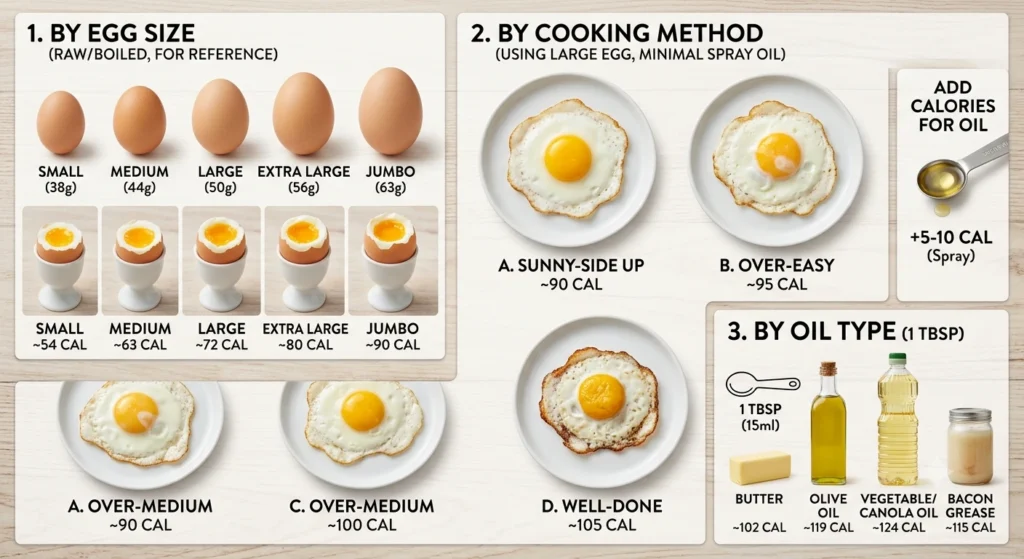
A large fried egg has about 90 calories when cooked with a little oil or butter, and around 70-77 calories if you fry it in a non-stick pan with just a spray of oil. The exact number depends on three things: how big the egg is, how much fat touches the pan, and whether that fat gets drained off or soaks straight into the egg.
Most calorie sites give you one flat number and stop there. That's not enough to actually plan a meal. Below you'll find the real breakdown by size and cooking fat, plus a calculator that turns your fried eggs into a piece of your actual daily target. If you haven't set that target yet, start with our free TDEE calculator — it takes under two minutes and gives you a number to build breakfast around.
Quick Answer: Calories in a Fried Egg
| Fried Egg Type | Calories |
|---|---|
| Large egg, non-stick pan, spray oil | 70-77 |
| Large egg, 1 tsp oil or butter | 89-90 |
| Large egg, generous butter, diner-style | 140-160 |
| Large egg, deep-fried, not drained | 110-120 |
| Medium egg, 1 tsp oil | 65-78 |
| Jumbo egg, 1 tsp oil | 95-111 |
Source: USDA FoodData Central and CalorieKing nutrition database.
Fried Egg Calorie Budget Calculator
Averages are a fine starting point, but the number that actually matters is what your fried eggs cost out of your day. Pick your cooking style, set how many eggs, and see where you land.
🍳 Fried Egg Daily Budget Calculator
Estimates only. For a precise daily target based on your body and activity, use the TDEE calculator above.
Calories in a Fried Egg by Size
Egg size changes the number more than most people expect. A jumbo fried egg can run 40% higher than a small one, even with the exact same amount of oil in the pan.
| Egg Size | Fried, No Added Fat | Fried, With Fat |
|---|---|---|
| Small | 55 | 68 |
| Medium | 65 | 78 |
| Large | 73 | 89 |
| Extra Large | 85 | 101 |
| Jumbo | 95 | 111 |
Most cartons in the store sell "large" eggs, so treat the large-egg row as your default unless the carton says otherwise.
Calories in a Fried Egg by Cooking Fat
The pan, not the egg, is where a lot of hidden calories come from. Oil adds about 120 calories per tablespoon, and eggs don't soak up as much fat as foods like bread or potatoes do — but the fat that stays on the surface still counts.
- Non-stick spray oil: adds almost nothing, roughly 70-77 calories total for a large egg.
- 1 teaspoon butter or oil: the most common home method, about 89-90 calories.
- 1 tablespoon oil, egg not drained: can push a large egg to 115-120 calories.
- Ghee or desi-style extra oil: common in South Asian cooking, typically 120-135 calories per egg.
- Butter, diner-style (generous pat, basted): can reach 150-160 calories for one egg.
Draining the egg on a paper towel for a few seconds before it hits your plate genuinely removes calories — it's not just a placebo step.
Fried Egg vs Boiled, Scrambled, Poached & Omelet
Frying isn't the highest-calorie way to cook an egg, but it's not the lowest either. Here's how the common methods stack up for one large egg:
| Cooking Method | Calories |
|---|---|
| Poached | 74 |
| Boiled (hard or soft) | 77 |
| Fried (light oil) | 89-90 |
| Omelet (plain) | 93 |
| Scrambled (with milk/butter) | 100 |
Poached and boiled eggs sit lowest simply because no fat touches them at all. A fried egg costs you about 12-15 more calories than a boiled one — small on its own, but it adds up across a week of breakfasts. Once you're comparing multiple foods like this, it helps to see the whole day mapped out; our guide to calculating macros from your TDEE walks through fitting meals like this into your actual numbers.
Calories in a Fried Egg White (No Yolk)
If you're cracking eggs for muscle gain or just cutting fat without cutting protein, the white is where almost all the protein lives and the yolk is where almost all the calories and fat live. A single large egg white fried with a spray of oil runs about 17-20 calories, compared to 70-90 for the whole egg. The tradeoff is that you lose the yolk's fat, cholesterol, vitamin A, and B12 along with those calories, so an all-whites breakfast trades some nutrients for a lower calorie count.
Three fried egg whites, a common gym-breakfast portion, land around 55-65 calories total while still providing roughly 11g of protein, which is a very different ratio than three whole fried eggs at 270 calories. If your goal is maximizing protein per calorie, whites get you there faster; if you want the full nutrient package, whole eggs are the better trade.
Fried Egg Nutrition Facts: Protein, Fat & Cholesterol
One large fried egg (cooked with a little oil) gives you roughly:
- Calories: 89-90
- Protein: 6.2-6.3g
- Fat: 6.8g (about 1.9g saturated)
- Carbs: under 0.5g
- Cholesterol: 184-210mg
- Sodium: 65-95mg (before you add salt)
Beyond the macros, a fried egg is a solid source of a few micronutrients that don't show up on most quick calorie searches: it covers a meaningful share of daily selenium and vitamin B12, along with smaller amounts of riboflavin and vitamin A, almost all of it concentrated in the yolk. This is the main nutritional argument for keeping at least some yolks in your breakfast rather than going all-whites out of habit.
Eggs are one of the most protein-dense breakfast foods you can cook without any special equipment. If you're trying to hit a daily protein number, our how much protein per day guide shows where two or three fried eggs actually land you.
Is Egg Cholesterol Something to Worry About?
This is the most common question people have after seeing that 184-210mg number, since it looks high next to most other breakfast foods. The Harvard T.H. Chan School of Public Health notes that dietary cholesterol has a much smaller effect on blood cholesterol for most healthy people than saturated fat does — the cooking fat in your pan likely matters more than the egg itself.
For most healthy adults, one or two eggs a day fits comfortably into a normal diet. People managing diabetes or existing heart disease are usually the group told to watch egg intake more closely, so it's worth a quick word with a doctor if that applies to you rather than guessing from a blog post.
Does It Matter When You Eat a Fried Egg?
The egg itself has the same calories no matter what time you eat it, but when it fits into your day can matter for your goal. For weight loss, having it at breakfast tends to work well since the protein helps carry you toward lunch without a mid-morning snack. For muscle gain, pairing it with other protein sources within a couple of hours after a workout is more useful than the specific clock time. Eating a heavy, buttery fried-egg plate very late at night isn't dangerous, it just means those calories land at the end of your day rather than spread through it, which some people find harder to fit into a deficit.
Fried Eggs at Fast Food Restaurants
A restaurant fried egg is rarely a plain fried egg — it comes bundled with bread, cheese, and meat, which is where most of the calorie count actually comes from. A McDonald's Egg McMuffin, built around one folded fried egg, Canadian bacon, and American cheese on an English muffin, runs close to 300 calories per the official McDonald's nutrition page — meaning the muffin, cheese, and bacon account for roughly two-thirds of that total, not the egg.
That's the same trap as ordering "just eggs" at a diner: the eggs might be 90-150 calories each, but the butter on the toast and the hash browns on the side usually cost more than the eggs do.
Two Fried Eggs, Three Fried Eggs — How It Adds Up
Two large fried eggs in light oil run about 178-180 calories. Three run 267-270. That's before toast, bacon, or hash browns join the plate. A typical "two eggs, two toast, butter" breakfast can land anywhere from 350 to 500 calories depending on how much butter and oil are involved — worth logging once so your mental number matches reality. See how a breakfast like that fits your whole day in our how many calories should I eat per day guide.
Mistakes That Hide Calories in a Fried Egg
Guessing the oil amount. "A little oil" in your head and a little oil in a measuring spoon are usually two different amounts — home cooks tend to underestimate poured oil by close to double.
Not draining the pan. Leftover oil pooling under the egg on your plate is still oil you're eating, even if it never touched the food directly.
Counting "eggs" without counting the pan. Tracking apps often log a plain fried egg at the no-fat number by default, undercounting your actual breakfast by 20-40 calories per egg. Getting this right matters more than people think — our guide to tracking calories accurately covers exactly this kind of gap.
How to Cut Calories in a Fried Egg
- Use a non-stick pan with spray oil instead of poured oil.
- Measure oil with an actual teaspoon instead of pouring by eye.
- Drain the egg on a paper towel for a few seconds before plating.
- Choose olive or rapeseed oil over butter for a similar taste with less saturated fat, a swap also recommended by the British Lion Eggs nutrition page.
- Skip a second pat of butter for basting — one egg rarely needs it.
If eggs are a regular part of your breakfast rotation, it's worth building them into a full meal plan rather than tracking them alone — our chicken thigh calorie guide is a good next stop if you're comparing protein sources for the rest of the day.
FAQs
How many calories are in one fried egg?
A large fried egg has about 90 calories with a small amount of oil or butter, or around 70-77 calories fried in a non-stick pan with just a spray of oil.
How many calories are in 2 fried eggs?
Two large fried eggs run about 178-180 calories cooked in light oil, or closer to 300 calories if fried in generous butter.
Is a fried egg more caloric than a boiled egg?
Yes, slightly. A boiled egg has about 77 calories with no added fat, while a fried egg with a little oil runs 89-90 — a gap of roughly 12-15 calories.
Does frying in butter add a lot of calories?
It can. A large egg fried in a generous amount of butter, diner-style, can reach 140-160 calories, compared to under 80 with just a spray of oil.
Is a fried egg good for weight loss?
Yes, in most cases. At under 100 calories with 6g of protein, a fried egg has a strong protein-to-calorie ratio that helps with fullness, as long as the oil amount stays light.
How many calories are in a fried egg white?
A single large egg white fried with a light spray of oil has about 17-20 calories, compared to 70-90 for a whole fried egg, since almost all of an egg's fat and calories are in the yolk.
Sources: USDA FoodData Central, official brand nutrition pages linked above, British Lion Eggs, and the Harvard T.H. Chan School of Public Health for dietary guidance.
Note: This guide is for general informational and tracking purposes. If you have a history of disordered eating, please consult a registered dietitian or healthcare professional before changing how you track food or calories.