Here is a problem most people run into about three weeks into a fat loss diet: eating the exact same number of calories every single day stops feeling manageable. The social events, the training days where you’re starving, the rest days where you barely move — a flat daily calorie target treats them all identically, and for most people that rigidity is exactly what breaks adherence. This is why so many straight-deficit diets work perfectly on paper and fall apart in real life.
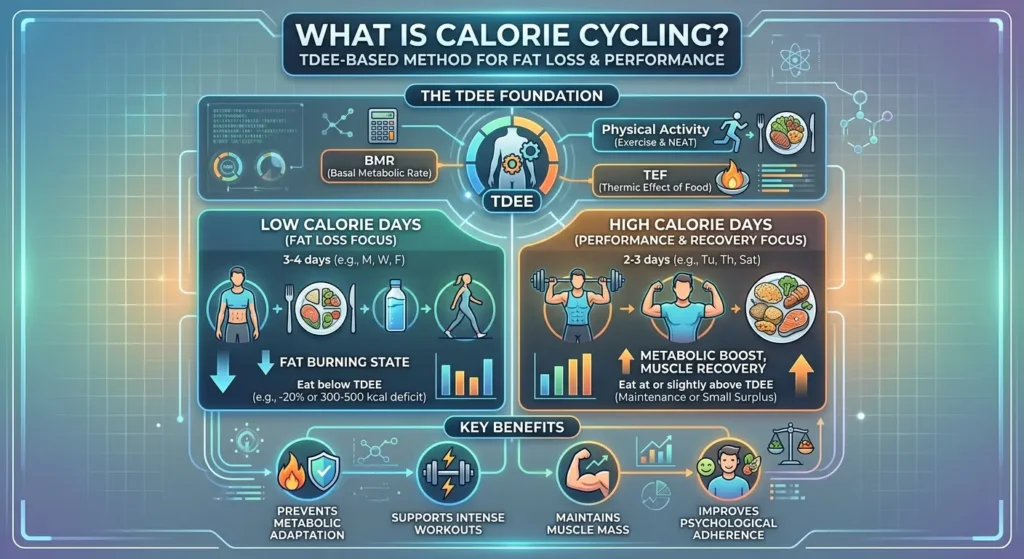
Calorie cycling solves this problem without changing the total weekly deficit at all. The definition, right upfront: calorie cycling means eating different calorie amounts on different days while keeping your weekly total in a deficit — typically more on training days, less on rest days. You are not eating more overall. You are spending the same weekly calorie budget more intelligently. Before you read further, calculate your TDEE here — that number is the starting point for everything in this guide.
What Is Calorie Cycling and How Does It Work?
The core idea is simple. Instead of eating 1,800 calories every day for seven days (total: 12,600), you eat 2,000 on training days and 1,500 on rest days. If you train four days and rest three, that is (4 × 2,000) + (3 × 1,500) = 8,000 + 4,500 = 12,500 — nearly identical to the flat approach, with a weekly deficit large enough to produce meaningful fat loss.
The table below makes this concrete using a real example: a moderately active person with a TDEE of 2,300 calories, running a 500-calorie daily deficit flat, compared to the same weekly budget distributed as a calorie-cycled approach across four training days and three rest days.
| Approach | Training Days (4) | Rest Days (3) | Weekly Total | Weekly Deficit |
|---|---|---|---|---|
| Flat daily deficit | 1,800 cal × 4 = 7,200 | 1,800 cal × 3 = 5,400 | 12,600 cal | 3,500 cal (~0.5 kg fat) |
| Calorie cycling | 2,000 cal × 4 = 8,000 | 1,450 cal × 3 = 4,350 | 12,350 cal | ~3,750 cal (~0.5 kg fat) |
The fat loss outcome is essentially identical. This is the table every competing article skips — and it is the most important one in this entire guide, because it proves that calorie cycling is not a metabolic shortcut. It is a budget redistribution strategy. The magic, such as it is, comes entirely from how you spend the budget — not from the budget itself.
Calorie Cycling vs a Flat Daily Deficit — What Actually Changes
Total fat loss over any given week is the same as a flat deficit with the same weekly total. That is the honest baseline, and it’s important to say it plainly because a lot of calorie cycling content online hints at metabolic superiority — “trick your metabolism,” “prevent adaptation,” “keep your body guessing.” None of those claims hold up under scrutiny, and fitness-literate readers will notice immediately. What genuinely changes with calorie cycling — and these are real, meaningful benefits — is adherence, training performance, and muscle retention. Those three things matter enormously for the quality of your fat loss outcome. They just don’t change the raw weekly calorie arithmetic.
The Real Benefits of Calorie Cycling — What the Evidence Actually Shows
Three benefits. Each one grounded in research. No overclaiming.
Better Adherence — Why Flexible Calorie Intake Is Easier to Maintain
A randomised controlled trial published in the Journal of the International Society of Sports Nutrition compared a flexible dieting approach against a rigid meal plan in resistance-trained individuals over a 10-week deficit phase. Both groups lost the same amount of weight — confirming that it is the weekly deficit, not the structure of how you hit it, that drives fat loss. But the flexible dieting group reported significantly lower psychological strain and, in the post-diet phase, regained lean mass more effectively. A separate study found that an increase in flexible dietary restraint, combined with a decrease in rigid restraint, independently predicted greater weight loss in a six-month behavioural intervention. The practical takeaway: higher training-day intake acts as a built-in relief valve. You’re not breaking the diet on the days you eat more — you have planned more. That psychological distinction matters more than most people expect, especially across a 12–16 week fat loss phase.
Better Training Performance — More Energy When You Actually Need It
Glycogen — the primary fuel for moderate-to-high intensity resistance training — is chronically depleted when you eat in a calorie deficit every day. This is one of the main reasons strength and rep performance drop during a standard cut. By pushing more calories, and specifically more carbohydrates, into training days, you go into your sessions with better-stocked glycogen stores. You can complete more volume, maintain rep ranges closer to your non-deficit performance, and recover faster between sets. On rest days, demand for glycogen is minimal. Low-intensity movement and recovery processes don’t require the same fuel supply, so the calorie reduction on those days causes no meaningful performance impairment. The result is a deficit that feels less punishing on the days that most determine training quality.
Better Muscle Retention — Fuelling Repair When the Body Needs It Most
Muscle protein synthesis — the process that repairs and builds muscle tissue — is elevated for 24–48 hours after a resistance training session. This is the window where calorie availability matters most for lean mass preservation. A flat deficit supplies the same (lower) calorie intake on both training days and rest days, which means the post-training repair window is being fuelled the same as a day when you sat at a desk. Calorie cycling aligns higher intake with the days when muscle repair demand is highest. Research on resistance training during caloric restriction consistently shows that protecting lean mass requires two things: adequate protein every day and enough total energy in the post-training window to support repair without the body breaking down existing tissue for fuel. Calorie cycling makes the second condition easier to meet without increasing the weekly deficit.
How to Set Up Calorie Cycling Using Your TDEE — Step by Step
Every step below uses one consistent example person so the numbers carry all the way through without confusion. Meet James: 30 years old, 82 kg, moderately active office worker who trains four days per week (Monday, Tuesday, Thursday, Saturday). His TDEE is 2,580 calories. Goal: lose approximately 0.5 kg of fat per week while keeping training performance as high as possible. If you want to follow along with your own numbers, use the TDEE calculator to get your personal starting figure before going through these steps.
Step 1 — Calculate Your TDEE and Weekly Calorie Budget
Multiply your TDEE by 7 to get your weekly maintenance calories. Then subtract the weekly deficit you want to create. A deficit of 3,500 calories per week produces approximately 0.5 kg of fat loss per week — a rate that is aggressive enough to make consistent progress but moderate enough to preserve muscle and training performance.
James’s calculation:
- Weekly maintenance: 2,580 × 7 = 18,060 calories
- Weekly deficit target: 3,500 calories
- Weekly calorie budget: 18,060 − 3,500 = 14,560 calories
That 14,560-calorie weekly budget is what you’re distributing across seven days. The distribution is what calorie cycling changes — not the total. For a deeper look at how TDEE is calculated and what the activity multipliers mean, our guide on what TDEE is and how it works covers the full methodology.
Step 2 — Split the Weekly Budget Between Training Days and Rest Days
Training day target: at or near your TDEE maintenance figure, or 100–200 calories below it. This keeps training performance close to normal while still contributing to the weekly deficit. Rest day target: divide the remaining weekly budget across the rest days.
James’s split (4 training days, 3 rest days):
| Day Type | Days | Daily Calories | Subtotal |
|---|---|---|---|
| Training days | Mon, Tue, Thu, Sat (4 days) | 2,480 cal (TDEE − 100) | 9,920 cal |
| Rest days | Wed, Fri, Sun (3 days) | 1,547 cal (remaining ÷ 3) | 4,641 cal |
| Weekly total | — | — | 14,561 cal |
Critical check before proceeding: James’s rest-day intake is 1,547 calories. His BMR (basal metabolic rate — the minimum calories his body needs to function at complete rest) is approximately 1,890 calories for his stats. His rest-day intake is below BMR, which is not ideal for extended periods. In this case, the correct fix is to reduce the weekly deficit slightly — for example, targeting 3,000 calories weekly deficit instead of 3,500. This raises both training-day and rest-day intake proportionally and keeps rest days above BMR. Checking this number is the step every online calorie cycling calculator skips, and it’s one of the most important safety checks in the setup.
For guidance on how different daily calorie levels affect your metabolism and rate of loss, our article on how many calories you should eat per day explains the reasoning behind these minimum thresholds in detail.
Step 3 — Set Protein the Same on Every Day
This is the step that is missing from almost every calorie cycling article, and it’s the most common setup mistake. Protein does not cycle. Set it at 1.8–2.2 g per kg of body weight on every single day — training days and rest days equally.
For James at 82 kg: protein target is 148–180 g per day, every day.
The extra calories on training days come from carbohydrates only. Carbohydrates replenish glycogen, fuel training performance, and support the post-training repair window. Fat stays roughly constant across all days at around 25–30% of total daily calories. The calorie reduction on rest days also comes from carbohydrates only — not from protein and not from fat. Cutting protein on rest days to save calories is the single fastest way to accelerate lean mass loss during a deficit, which is the opposite of what calorie cycling is designed to achieve.
Step 4 — Track the Weekly Average, Not the Daily Number
Once the system is set up, the only metric that matters is your 7-day total. Individual days will vary — that is the entire point. A rest day where you go 200 calories over target does not require a panic response or a compensation fast the next morning. It simply means one of the remaining rest days absorbs those 200 calories. As long as your weekly total stays within approximately 200 calories of your budget, fat loss continues on track.
This weekly-average mindset is the primary psychological advantage of calorie cycling over a flat daily deficit. It removes the “one bad day ruins the whole week” thinking that is one of the most common reasons people abandon flat deficits. In a flat-deficit structure, going 400 calories over on Saturday feels like failure. In a calorie-cycled structure, it is a minor weekly reallocation. The diet continues. The weekly deficit holds. Progress continues. To understand how this connects to the broader TDEE-based approach to weight loss, that guide covers the full mechanics of managing a deficit across different eating patterns.
Who Should Use Calorie Cycling — and Who Should Not
Calorie cycling is not a universal upgrade over a flat deficit. It is a better fit for some people and genuinely unhelpful for others.
Good fit: People who train consistently 3–5 days per week and already understand basic calorie tracking. People whose flat-deficit diets keep failing around week 3–4 due to rigidity fatigue. People who notice a clear drop in training performance, motivation, or strength after a few weeks of continuous deficit eating. And people whose social lives or work schedules make identical daily calorie targets logistically difficult — calorie cycling naturally accommodates higher-calorie social days when planned into training days.
Poor fit: Beginners who don’t yet have a consistent training schedule — without a regular training pattern, there’s no logical way to assign “training day” vs “rest day” calories, and the added complexity of two different daily targets can make an already steep learning curve worse. People who struggle to track calories accurately in the first place will find that running two separate daily targets amplifies the tracking problem, not reduces it. And people whose TDEE is below roughly 1,700 calories should approach this carefully — rest-day intake will approach BMR uncomfortably quickly, and the overall system loses its flexibility at that calorie level.
Is Calorie Cycling Better Than a Flat Deficit for Fat Loss?
No — not in terms of total fat lost over a given period. The weekly deficit drives fat loss. Calorie cycling does not change the weekly deficit. A flat deficit and a cycled deficit with the same weekly calorie total will produce the same fat loss. This is the most important statement in this article, and it’s the one most calorie cycling content gets wrong by omission.
What calorie cycling is genuinely better for — for the right person — is training performance during the deficit, lean mass retention across the cut phase, and long-term adherence. If those three things are already handled on a flat deficit with no problems, calorie cycling offers no additional fat loss benefit and there’s no meaningful reason to switch. The system earns its place for people whose flat deficit is failing at the adherence stage, not as a universal upgrade.
It’s also worth understanding the role of very large daily deficits in this conversation. If you’ve ever tried slashing calories dramatically to accelerate fat loss, our article on the problems with a 1,200-calorie daily deficit explains why extreme restriction tends to backfire — and why moderate, sustainable deficits distributed across the week consistently outperform aggressive cuts for actual body composition outcomes.
Frequently Asked Questions
What is calorie cycling and does it work?
Calorie cycling is a method of distributing a weekly calorie budget unevenly across days — typically higher on training days and lower on rest days — while keeping the overall weekly total in a deficit. It works for fat loss at the same rate as a flat deficit with the same weekly total. The benefits are not faster fat loss but better adherence, better training performance during the deficit, and better lean mass retention. It works best for consistent trainees who find rigid daily calorie targets psychologically difficult to sustain over a 10–16 week cut phase.
How many calories should I eat on training days vs rest days?
Training days: at or 100–200 calories below your TDEE maintenance figure. Rest days: the remaining weekly budget divided across remaining days — typically 300–600 calories below your training-day intake, depending on how many training and rest days you have per week. The non-negotiable check: rest-day intake must not fall below your BMR. If it does, reduce the overall weekly deficit and adjust both training-day and rest-day targets upward proportionally. Running below BMR for extended periods increases the risk of lean mass loss and metabolic adaptation regardless of how the deficit is structured.
Do I need to eat more carbs on training days?
Yes — and this is specific. All of the extra calories on training days should come from carbohydrates: oats, rice, potatoes, fruit, bread. Protein stays constant at 1.8–2.2 g per kg of body weight on every day. Dietary fat stays roughly constant across all days. Carbohydrates are the only macronutrient that cycles. This matters because carbohydrates are the direct precursor to glycogen, and glycogen is the primary fuel for resistance training performance. Increasing fat or protein on training days instead of carbohydrates does not produce the same performance or recovery benefit.
Can calorie cycling break a weight loss plateau?
Only if the plateau was caused by inconsistent adherence to a flat daily deficit — meaning the real daily intake was drifting higher than the target without the person realising it. In that case, switching to a more flexible weekly tracking approach can restore the actual deficit and restart fat loss. But if the plateau is the result of a genuinely reduced TDEE due to weight loss (your maintenance needs are lower now than when you started), or true metabolic adaptation from extended dieting, calorie cycling alone will not fix it. Recalculating TDEE at your current body weight, potentially taking a structured diet break, and adjusting the deficit from the new baseline are the appropriate tools in that situation. Our guide on what a weight loss plateau actually means covers those adjustment strategies in full.
Is calorie cycling the same as intermittent fasting?
No — they address different variables entirely. Intermittent fasting varies the timing window in which you eat within a single day (for example, eating only between noon and 8 pm). Calorie cycling varies the total calorie amount across different days. They are separate strategies that can be combined if someone finds both useful, but one does not imply the other. A person doing intermittent fasting can eat the same calories every day. A person doing calorie cycling can eat across all hours of the day. The shared feature is flexibility — both replace rigid uniformity with a structured pattern — but the mechanism and the variable each one adjusts are completely different.