If you’ve ever typed “should I cut or bulk first” into a search bar, you already know the frustration. Every article gives you a list of vague “it depends” factors and leaves you more confused than before you started. This article does something different. It uses body fat percentage as the primary decision variable, gives you specific thresholds for both men and women, and covers the skinny-fat situation that almost every other guide completely ignores.
If your body fat is above 20% (men) or 28% (women), cut first. If you’re below those numbers and want to build muscle, bulk first. Everything below explains the why — with the full nuance, including what to actually eat once you’ve made your decision.
The One Variable That Decides Everything — Body Fat Percentage
Most fitness articles frame the cut-or-bulk decision around goals, motivation, upcoming events, or how you “feel” about your body right now. Those things aren’t useless, but they’re also not objective. They mirror your own confusion back at you.
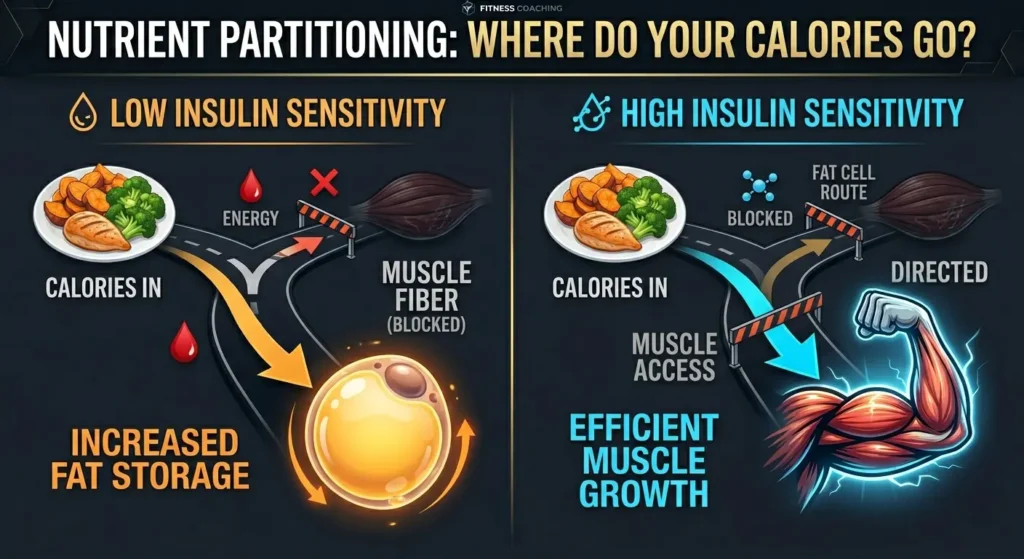
Body fat percentage is different. It’s a measurable, biological variable that directly determines how well your body responds to a calorie surplus. High body fat reduces insulin sensitivity, which in turn reduces nutrient partitioning efficiency — the process by which your body decides whether incoming calories go toward building muscle or storing fat. When you’re carrying excess body fat and you eat in a surplus, a larger proportion of those calories end up as additional fat rather than new muscle tissue. This is the actual science behind the thresholds. They aren’t arbitrary numbers pulled from a bodybuilding forum. They reflect the point at which your physiology becomes genuinely receptive to quality muscle growth.
Body Fat Thresholds — The Cut First or Bulk First Decision
The table below answers the question for most people within about ten seconds. Find your range, read the recommendation, and then continue reading to understand the full reasoning behind your specific situation.
| Body Fat Range (Men) | Body Fat Range (Women) | Recommended Phase | Key Reason |
|---|---|---|---|
| Above 20% | Above 28% | Cut first | High body fat reduces insulin sensitivity and lowers the quality of muscle gain during a surplus. |
| 12–20% | 20–28% | Bulk first | Optimal range for nutrient partitioning — lean muscle gains are highest here, and post-bulk cuts are shorter. |
| Below 12% | Below 20% | Bulk first, then cut | Very lean individuals get the most muscle per calorie in a surplus; cutting would reduce already-limited muscle mass. |
| Skinny fat (normal scale weight, low muscle, moderate fat) | Skinny fat (same profile) | Recomposition first | Neither bulk nor cut produces the right outcome — body recomposition addresses both problems simultaneously. |
Use our free TDEE calculator to get your total daily energy expenditure before you start either phase. That number is the foundation for everything that follows — whether you’re cutting, bulking, or recomping.
Cut First — Who Should Lose Fat Before Building Muscle
If you’re above 20% body fat as a man or above 28% as a woman, cutting first isn’t just an aesthetic choice — it’s the smarter physiological strategy. Here’s why that matters beyond just how you look in the mirror.
When body fat is elevated, fat cells produce higher levels of inflammatory cytokines and the body’s insulin signalling becomes less effective. In practical terms, this means that when you eat in a calorie surplus, your muscle cells are less responsive to the anabolic signals that trigger protein synthesis. Research published in peer-reviewed journals consistently shows a strong inverse relationship between body fat accumulation and insulin sensitivity — and insulin sensitivity is one of the primary drivers of how efficiently your body directs nutrients toward muscle rather than fat storage. By cutting first, you restore that sensitivity. The bulk that follows is genuinely more productive — you gain more muscle and less fat per calorie compared to bulking at high body fat.
In practice, a cut phase for someone starting above 20% body fat looks like this: run a 400–500 calorie daily deficit below your TDEE-based target, set protein at 2.0–2.4 g per kg of body weight, keep resistance training consistent, and aim to lose 0.4–0.6 kg per week. You stop the cut when you hit the 12–15% range (men) or 20–24% range (women) — not when an arbitrary number of weeks passes.
How Lean Do You Need to Get Before Bulking?
Men should cut down to 12–15% body fat before transitioning to a lean bulk. Women should cut to 20–24% body fat. At these levels, insulin sensitivity is restored, nutrient partitioning is significantly improved, and you have enough room to run a meaningful 4–6 month bulk before body fat climbs back to the upper threshold.
Going leaner than these targets before starting a bulk — say, trying to hit 8% as a man before you’ll allow yourself to eat more — is unnecessary and actively counterproductive. It extends the cut phase without meaningful benefit, increases the risk of muscle loss, and delays the muscle-building phase that is, after all, the goal. The finish line for your cut is 12–15% for men and 20–24% for women. Not lower. Once you’re there, transition to a calorie surplus and start building.
The Psychological Benefit of Cutting First
There’s a practical angle here that no one talks about honestly. If you’re starting above 20% body fat, cutting first produces visible results faster than any other approach. Within 8–12 weeks of a consistent deficit, your waist narrows, your face slims down, clothes fit differently, and the person looking back from the mirror is noticeably changed. That’s not vanity — it’s adherence psychology. People who see early, concrete results are significantly more likely to stay committed through the longer, slower muscle-building phase that follows. Starting with a bulk when you’re already carrying visible body fat tends to produce the opposite effect: the physique gets softer before it gets better, motivation fades, and the plan gets abandoned. Cutting first builds the kind of momentum that carries a 12–18 month transformation through to completion.
Bulk First — Who Should Build Muscle Before Losing Fat
If you’re already relatively lean — below 20% body fat as a man or below 28% as a woman — and your main complaint is that you don’t have enough muscle, cutting first would be a mistake. A lean individual attempting to run a calorie deficit has very little fat to lose. The body will look for fuel elsewhere, and in the absence of adequate calories, some of that fuel comes from muscle tissue. You’d end up lighter but not meaningfully leaner or more defined, because there wasn’t enough muscle in the first place to create definition once the fat came off.
Bulking first at this body fat range builds the muscular foundation that makes a subsequent cut actually look like something. A lean bulk for someone in the 15–18% range (men) or 22–26% range (women) means eating at a conservative 200–300 calorie surplus above TDEE — not the “dirty bulk” approach where you eat everything in sight. Protein stays at 1.6–2.2 g per kg of body weight. At this surplus, scale weight increases slowly (roughly 0.25–0.5 kg per month for intermediates), fat gain is minimal, and the quality of muscle gained per calorie is genuinely high. This phase should run for 4–6 months before reassessing body fat.
When to Stop the Bulk and Transition to a Cut
The stopping signal for a bulk is body fat, not the calendar. Men should transition out of a bulk when they reach 18–20% body fat. Women should transition at 27–30% body fat. Above these levels, insulin sensitivity starts to decrease again, nutrient partitioning worsens, and you begin gaining a higher proportion of fat per calorie relative to muscle. The bulk has passed its optimal window.
When you end the bulk and move into a cut, recalculate your TDEE at your new, heavier body weight using the TDEE calculator — not the number from the start of your bulk. You weigh more now, which means your maintenance calories are higher than they were. A 500-calorie deficit from this new TDEE figure is your daily cut target. Read our full guide on how many calories you should eat per day to understand how these numbers shift as your weight changes through each phase.
The Skinny Fat Problem — When Neither Bulk Nor Cut Is Obvious
This is the part that most fitness articles handle worst, and it’s arguably the most important section in this guide — because skinny fat individuals make up a significant portion of the people searching this very question.
The skinny fat profile looks like this: scale weight is in the normal BMI range, but the physique looks soft or undefined. There’s visible fat around the abdomen or hips despite a healthy overall weight. Strength is low relative to body weight. There’s little to no visible muscle development even though the person isn’t technically overweight. The classic situation is someone who weighs 75 kg as a man but has 22% body fat — normal on the scale, but not the physique they want.
If a skinny fat person cuts: the scale drops, but they become lighter and thinner with still-low muscle definition. Not the outcome they’re after. If they bulk: fat accumulates quickly on an already-soft physique, which feels discouraging and doesn’t move them closer to their goal. Neither direction works cleanly.
The actual answer is body recomposition first. At maintenance calories — meaning you’re eating at your exact TDEE, neither above nor below — combined with high protein intake and consistent progressive resistance training, a beginner or early-intermediate trainee can simultaneously reduce body fat and add muscle tissue. This happens because of how responsively untrained and undertrained muscle tissue responds to resistance exercise stimulus. It doesn’t require a surplus to grow, at least not initially.
After 3–4 months of recomposition work, the physique clarifies. The body fat drops slightly, some muscle is added, and the starting point for the next phase becomes obvious. At that point you reassess: if you now have reasonable muscle but still want to lose fat, cut. If the muscle base is there but you want more, do a lean bulk. The recomposition phase doesn’t have to last forever — it just needs to resolve the ambiguity that made the cut-or-bulk question so difficult in the first place. Check out our detailed breakdown of BMR vs TDEE for fat loss and muscle gain to understand exactly how maintenance calories work in a recomposition context.
How to Know if You Are Skinny Fat
You don’t need a DEXA scan to figure this out. Here are the practical signs. Your scale weight sits within the normal BMI range (roughly 18.5–24.9), but your physique looks soft or undefined in the mirror. You carry visible fat around your midsection despite not being overweight. Your strength is below average for your body weight — if you can’t perform five clean pull-ups, struggle with bodyweight squats to full depth, or can’t press a barbell roughly equal to your body weight, low muscle mass relative to your size is part of the picture. And finally, you look similar whether you’ve eaten a lot or a little — there’s no “pump” after training and no visible muscle separation anywhere on the body. That combination of normal weight plus relatively high body fat percentage plus low muscle mass is the defining marker. It’s distinct from simply being overweight (high weight, high fat) and distinct from being genuinely lean (low fat, adequate muscle).
How to Set Your Calories Once You Have Decided
Every competing article on this topic makes the decision and then abandons the reader. You’ve just figured out whether to cut, bulk, or recomp — and now you need actual numbers. Here’s how to set your calories for each path.
Start by calculating your TDEE. Use the TDEE calculator at mytdeecalculatorpro.com — it factors in your age, weight, height, and activity level to give you a personalised daily calorie target. Everything below builds on that number.
Calorie Setup for the Cut Phase
Take your TDEE and subtract 400–500 calories. That’s your daily cut target. Set protein at 2.0–2.4 g per kg of body weight — higher than you’d eat at maintenance because protein directly protects lean muscle mass during a calorie deficit, as shown in research on resistance training and caloric restriction. At this deficit, expect to lose roughly 0.4–0.6 kg of actual body fat per week. Recalculate your TDEE every time you lose 4–5 kg of body weight, because your maintenance needs decrease as you get lighter. For the full cutting protocol including training recommendations and plateau management, read our detailed guide on how to use your TDEE to lose weight.
Calorie Setup for the Bulk Phase
Take your TDEE and add 200–300 calories. That’s your lean bulk target. Set protein at 1.6–2.2 g per kg of body weight. At this modest surplus, scale weight typically increases at around 0.25–0.5 kg per month for someone with intermediate training experience — slow enough to keep fat accumulation minimal, fast enough to support genuine muscle protein synthesis. Recalculate your TDEE every 3–4 kg of weight gained, since your maintenance needs increase as you get heavier. Understanding the science behind what TDEE actually means will help you stay accurate as your numbers change throughout the bulk.
If you’re in the recomposition category, your target is your exact TDEE — no deficit, no surplus. Protein stays at the higher end (2.0–2.4 g per kg) and resistance training is non-negotiable. Progress will feel slower than a dedicated cut or bulk, but you’re moving in two directions at once.
Frequently Asked Questions
Should I cut or bulk first as a beginner?
It comes down entirely to where your body fat sits right now. Beginners above 20% (men) or 28% (women) should cut first — and the good news is that beginners often experience some muscle growth even while cutting, thanks to the newbie gains effect. Beginners below those thresholds should bulk first, because their untrained muscle tissue responds so aggressively to resistance training that a lean bulk produces significant muscle relatively quickly. Beginners who are skinny fat should recompose first — all three paths work, but the best one is determined by your starting body fat, not your experience level.
Can I bulk at 20% body fat?
For men, 20% is right at the upper boundary. A lean bulk is technically possible here, but insulin sensitivity is already declining, the quality of muscle gain per calorie is lower than it would be at 15%, and the risk of pushing past 25% before the bulk ends is high. The recommendation for men at or above 18–20% is to cut to 12–15% first and then bulk. For women, 20% is actually a lean and ideal starting point for a bulk — well below the upper threshold of 28–30% — so a lean bulk is absolutely appropriate here.
Will I lose muscle if I cut first?
Some lean mass loss during a cut is nearly unavoidable, but it can be minimised to almost nothing with two non-negotiable strategies: keeping the deficit moderate (400–500 calories below TDEE, not 800–1,000), and maintaining high protein intake (2.0–2.4 g per kg) combined with consistent resistance training throughout the cut. Studies consistently show that people who “lose muscle” while cutting are almost always either eating too little protein, running too aggressive a deficit, or abandoning resistance training. With the right setup, muscle loss during a cut is a minor and manageable variable. You can also read more about why very large calorie deficits backfire and why moderate deficits consistently outperform aggressive ones for body composition outcomes.
How long should each bulk and cut phase last?
For bulking: 4–6 months is the standard range for intermediates. Beginners can sometimes sustain longer bulk phases (12–18 months) because their muscle synthesis rate is high enough to keep fat accumulation low throughout. Stop when body fat hits the upper threshold, regardless of how long you’ve been bulking. For cutting: 8–16 weeks for most people, depending on how much fat was accumulated and how aggressive the deficit is. The cut ends when body fat drops back to the “bulk-ready” range — not when an arbitrary time limit is reached. Chasing a deadline rather than a target body fat is one of the most common reasons people end up in the wrong phase at the wrong time. For more on how to handle plateaus during a cut, especially when the scale stalls before you reach your target body fat, that guide covers the adjustment strategies in detail.
What if I cannot figure out my body fat percentage?
Use a mirror-based self-assessment combined with waist circumference as a practical proxy. Men: if you cannot see any abdominal muscle definition and your waist is above 90 cm, cut first. If you can see some definition and your waist is below 85 cm, bulk first. Women: if the waist is above 80 cm with no visible muscle tone, cut first. If waist is below 75 cm with visible shoulder or arm muscle, bulk first. These proxies aren’t as precise as a DEXA scan or skinfold calipers, but they’re accurate enough to make the right decision — and they require nothing more than a tape measure and a mirror. The self-assessment guidance for the skinny fat profile is described in the section above.