If you want to build muscle, you need to eat more calories than your body burns. That’s the starting point. No matter how hard you train, your muscles can’t grow without extra fuel and extra protein. This eating phase — where you intentionally eat above your maintenance calories — is called a bulk.
But here’s where people split into two camps. Some say eat everything in sight. Others say keep it clean and controlled. Both approaches get results, but they work very differently in your body. And understanding that difference could save you months of frustrating fat gain or frustratingly slow muscle growth.
Before you decide which approach fits your goals, you need to know one thing first: your Total Daily Energy Expenditure (TDEE). This is the total number of calories your body burns in a day based on your weight, height, age, sex, and activity level. Use the TDEE Calculator to find your exact number — because your bulk should always start from that baseline, not a random guess.
Dirty Bulk: What It Is, How It Works, and Who Uses It
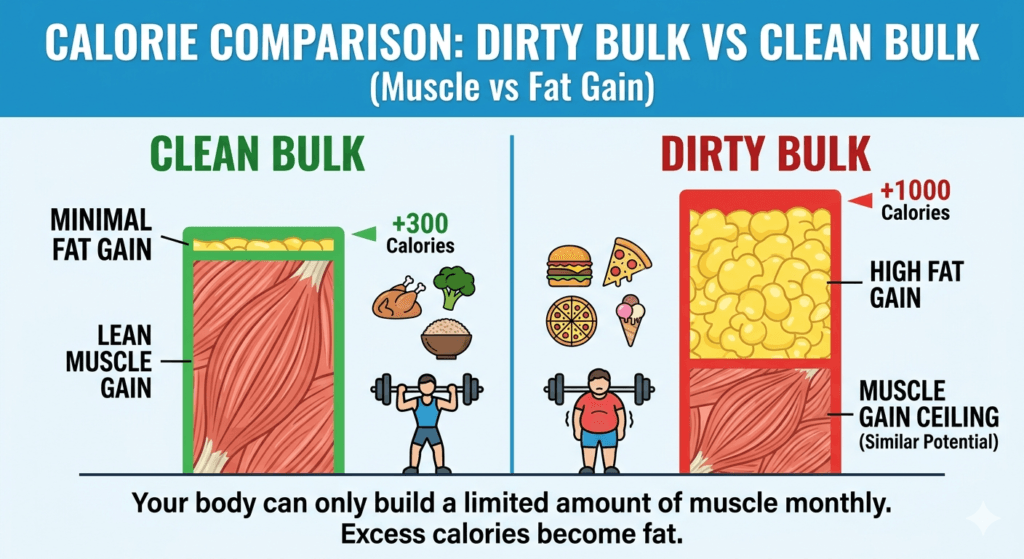
A dirty bulk is simple. You eat a lot. You eat often. And you don’t stress much about what’s on your plate. The whole idea is to create a large calorie surplus — sometimes 500, 800, even 1,000 calories above your TDEE every single day — so your muscles always have plenty of fuel to grow.
In practice, that looks like fast food, a few slices of pizza after dinner, big pasta bowls, and protein shakes stacked on top of regular meals. A single sitting can easily run 800 to 1,200+ calories depending on the pizza’s crust and toppings — which is exactly the kind of surplus that fuels a dirty bulk. The reasoning sounds logical: more calories, more muscle. And there’s some truth to it.
The Real Problem With Dirty Bulking
Here’s what most beginners find out the hard way. Your body can only build muscle so fast. Research published in the Journal of Strength and Conditioning Research suggests that natural lifters can gain roughly 1–2 pounds of actual muscle per month under ideal conditions. That’s around 0.25 lbs per week on a good day.
So when you’re eating 1,000 calories above maintenance every day, a massive chunk of those extra calories gets stored as body fat — not muscle. You might gain 15 lbs in three months on a dirty bulk, but only 4–5 lbs of that could be lean muscle tissue. The rest? Fat you’ll have to spend months cutting off.
There’s also the hormonal side. Consistently eating ultra-processed foods and refined sugars can increase insulin resistance over time, which actually makes fat storage easier and muscle building harder. Not exactly the trade-off you signed up for.
Lean Bulk vs Dirty Bulk: Is There a Real Difference?
People often use “lean bulk” and “clean bulk” interchangeably — and for most practical purposes, they are the same approach: a small, controlled calorie surplus (200–400 calories above TDEE) built around whole foods, designed to prioritize muscle gain over fat storage.
Lean bulk vs dirty bulk comes down to the same core trade-off as clean vs dirty: surplus size and food quality. A lean bulk sits at the disciplined end of the spectrum — measured calories, mostly whole foods. A dirty bulk sits at the opposite end — a large, unmeasured surplus without much attention to food source.
If you’re choosing between a lean bulk and a dirty bulk, the deciding factor isn’t muscle gain speed. Research shows natural lifters build muscle at roughly the same rate either way, capped by genetics and training volume. The real deciding factor is how much fat you’re willing to gain along the way — and how long you’re willing to spend cutting it back off afterward.
Clean Bulk: The Controlled Approach to Building Muscle
A clean bulk works differently. Instead of eating whatever’s available, you eat a measured surplus — usually 200 to 400 calories above your TDEE — made up of mostly whole, nutritious foods. Think lean proteins, complex carbohydrates, healthy fats, vegetables, and timed nutrition around your training sessions.
The goal is to give your body just enough extra fuel to support muscle protein synthesis without flooding your system with excess calories that end up as stored fat.
Why Clean Bulking Is More Efficient Long-Term
When you stay in a smaller, controlled surplus, your body has less reason to store fat aggressively. Your insulin sensitivity stays healthier. Your body composition improves more steadily. And when the time comes to cut, you’re not facing a 20-lb fat loss phase just to see the muscle you worked for.
Studies show that protein synthesis — the actual process of building new muscle tissue — doesn’t increase proportionally with dramatically higher calorie intakes. You hit a ceiling. Beyond a certain point, extra calories simply don’t convert to extra muscle. They convert to extra fat.
| Factor | Dirty Bulk | Clean Bulk |
|---|---|---|
| Calorie Surplus | 500–1,000+ calories above TDEE | 200–400 calories above TDEE |
| Food Quality | Anything goes (high calorie density, processed) | Mostly whole foods (lean proteins, complex carbs, healthy fats) |
| Muscle Gain Rate | Similar to clean bulk | Similar to dirty bulk |
| Fat Gain | High | Low to moderate |
| Health Markers | May worsen over time (lethargy, poor lipid profiles) | Maintained or improved |
| Cut Phase Needed | Long and aggressive | Short and manageable |
| Difficulty | Low (easy to overeat) | Moderate (requires tracking and meal prep) |
| Best For | Hard gainers, severely underweight lifters | Most intermediate lifters, athletes, health-conscious individuals |
How Many Calories Should You Eat on a Bulk?
This is where most people get it wrong. They pick a number out of nowhere — 3,500 calories, 4,000 calories — without understanding what their body actually needs. That’s like pouring petrol into a car without knowing the tank size.
The right starting point is always your TDEE. Once you know your maintenance calories, adding a 250–400 calorie surplus is enough to support consistent muscle growth without unnecessary fat gain. For most people, that puts muscle gain at roughly 0.5–1 lb per month in a lean bulk. Slow? Yes. But the muscle you gain actually stays when you’re done.
If you haven’t calculated your TDEE yet, it’s the most important number in your fitness journey. Every serious nutrition protocol starts there. You can also read more about what TDEE means and how it’s calculated to understand the full picture before you start eating in a surplus.
Calorie Surplus by Goal
- Lean/Clean Bulk: TDEE + 200–400 calories per day
- Moderate Bulk: TDEE + 400–600 calories per day
- Aggressive/Dirty Bulk: TDEE + 700–1,000+ calories per day
Your ideal surplus also depends on your training experience. Beginners can often build muscle faster and may tolerate a slightly larger surplus. Advanced lifters close to their genetic ceiling need the precision of a lean bulk to avoid excessive fat gain.
Protein Requirements During a Bulk
Calories matter, but protein is the actual building block. Without enough dietary protein, your body can’t repair and grow muscle tissue no matter how many calories you consume. Protein provides the amino acids — particularly leucine — that trigger muscle protein synthesis.
Most research points to a range of 0.7–1 gram of protein per pound of bodyweight as the sweet spot for muscle building. So if you weigh 170 lbs, aim for 120–170 grams of protein daily. Some researchers suggest going slightly higher — up to 1.2 g/lb — during a calorie surplus to maximize the muscle-building signal, especially if you’re also training at high intensity.
Best Protein Sources for Bulking
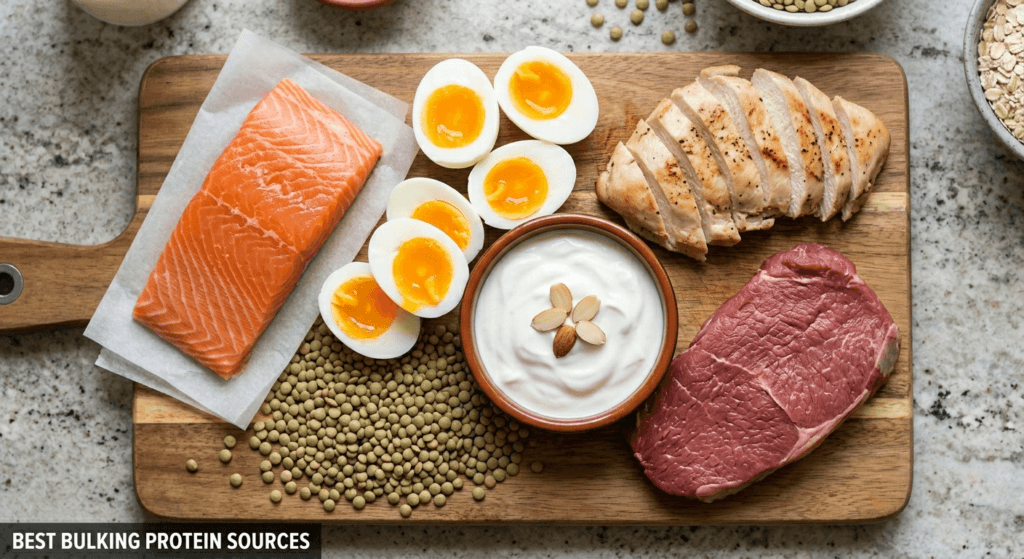
- Chicken breast and turkey — lean, high protein, easy to cook in bulk
- Eggs and egg whites — complete amino acid profile, very versatile
- Greek yogurt and cottage cheese — slow-digesting casein protein, great before bed
- Lean beef — rich in creatine and iron, excellent for gym performance
- Salmon and tuna — protein plus omega-3 fatty acids that reduce muscle inflammation
- Lentils and chickpeas — solid plant-based protein with added fiber
- Whey protein powder — fast absorbing, convenient post-workout option
Carbohydrates and Fats: Your Other Muscle-Building Allies
Protein gets all the attention, but carbohydrates are your training fuel. They replenish glycogen stores in your muscles, giving you the energy to push harder in the gym. When glycogen is low, your performance drops. And when your performance drops, the stimulus for muscle growth drops too.
Complex carbs like oats, brown rice, sweet potatoes, quinoa, and whole grain bread digest slowly, keeping your blood sugar stable and your energy levels consistent through training. Simple carbs like fruit and white rice are useful immediately post-workout when fast-digesting carbs help spike insulin and shuttle nutrients into muscle cells.
Dietary fats support testosterone production, which is directly linked to your ability to build and maintain muscle mass. Don’t go below 20% of your total calories from fat. Avocados, olive oil, nuts, seeds, and fatty fish are the best sources during a bulk.
Training Volume: The Real Driver of Muscle Growth
Food gives your body the raw materials to grow. But training is the signal that tells your body to actually use those materials for muscle — and not just store them as fat. If you eat in a calorie surplus without training hard, you’ll gain mostly fat regardless of whether your bulk is “clean” or “dirty.”
Progressive overload — consistently adding weight, reps, or sets over time — is the cornerstone of muscle building. Your muscles grow when they’re forced to handle more than they’re used to. Research from the International Society of Sports Nutrition consistently shows that resistance training performed with sufficient volume (10–20 sets per muscle group per week) produces the strongest hypertrophy response.
Sample Weekly Training Split for Bulking
- Day 1: Chest + Triceps (bench press, incline dumbbell press, cable flyes, tricep dips)
- Day 2: Back + Biceps (pull-ups, barbell rows, seated cable rows, hammer curls)
- Day 3: Rest or light cardio
- Day 4: Legs (squat, Romanian deadlift, leg press, walking lunges, calf raises)
- Day 5: Shoulders + Abs (overhead press, lateral raises, rear delt flyes, core work)
- Day 6: Optional full-body or weak point training
- Day 7: Full rest and recovery
How Long Should a Bulk Last?
There’s no universal timeline, but most experienced coaches recommend bulking phases lasting 3–6 months. Shorter than that, and you don’t allow enough time for meaningful muscle gain. Longer than 6 months without a diet phase can lead to excessive fat accumulation, hormonal shifts, and reduced insulin sensitivity that actually slows muscle building.
A practical approach used by many natural bodybuilders is mini-cut/bulk cycles: bulk for 12–16 weeks, mini-cut for 4–6 weeks, repeat. This keeps your body fat in a manageable range (typically 12–18% for men, 20–26% for women) so you can keep building efficiently without looking or feeling terrible.
Understanding how your calorie needs shift during a cut phase is just as important as the bulk itself. You can read more about how to use your TDEE to lose weight so you have a clear plan for when the bulk is done.
Common Bulking Mistakes That Kill Your Progress
Most people don’t fail because they’re not working hard enough. They fail because they’re making avoidable mistakes that undermine months of effort. Here are the ones that come up again and again.
Eating Too Much Too Fast
Going from maintenance to a 1,000-calorie surplus overnight is a recipe for fat gain. Your body doesn’t suddenly need 1,000 more calories because you started lifting. Start with a 200–300 calorie surplus and increase slowly as your training volume grows.
Not Tracking Protein Consistently
It’s easy to hit your calorie target on junk food and miss your protein by 60 grams. Protein is what actually drives muscle protein synthesis. If you’re not tracking it, you’re guessing — and guessing doesn’t build a great physique.
Skipping Sleep
Human Growth Hormone (HGH) — one of the most powerful muscle-building hormones in your body — is released primarily during deep sleep. Studies show that sleeping less than 6 hours significantly reduces anabolic hormone levels and increases cortisol, which breaks down muscle tissue. 7–9 hours of quality sleep isn’t optional during a bulk. It’s part of the plan.
Ignoring TDEE Changes Over Time
As you gain weight, your TDEE increases. The calorie surplus you calculated in month one isn’t the same surplus by month three. Recalculate your numbers every 4–6 weeks and adjust your intake accordingly. This is where understanding the difference between BMR and TDEE becomes practically useful — not just theoretical.
Should Beginners Dirty Bulk or Clean Bulk?
Beginners occupy a unique position. Due to “newbie gains” — the rapid muscle adaptations that happen when someone first starts resistance training — beginners can build muscle at a faster rate than intermediate or advanced lifters. This means they can handle a slightly larger surplus without packing on excessive fat.
That said, clean bulking is still the smarter default for beginners. Here’s why: beginners are still learning to eat well, track food, and train consistently. Getting into the habit of eating real food, hitting protein targets, and understanding portions from day one creates a foundation that pays off for years. Starting with a dirty bulk often leads to bad habits that are genuinely hard to unlearn.
The only time an aggressive bulk might make sense for a beginner is if they’re significantly underweight, have a very fast metabolism, or struggle to eat enough calories from whole foods alone. In that case, adding calorie-dense foods — nut butters, whole milk, oats with honey, dried fruit — makes more sense than a McDonald’s drive-through every day.
Supplements Worth Considering During a Bulk
Supplements don’t replace food. They fill gaps. But a few are backed by enough research to be worth the money during a muscle-building phase.
- Creatine monohydrate: The most researched supplement in sports nutrition. Increases phosphocreatine stores in muscle, allowing you to push harder in high-intensity sets. 3–5 grams daily is the standard dose. No loading phase required.
- Whey protein: Convenient way to hit your daily protein target. Most useful post-workout or when whole food protein is inconvenient.
- Vitamin D3: Low vitamin D is linked to reduced testosterone levels and slower recovery. Most people, especially in less sunny climates, are deficient.
- Omega-3 fatty acids: Reduce exercise-induced muscle inflammation and support joint health — both important when training volume is high.
- Magnesium: Involved in over 300 enzymatic processes including protein synthesis and energy production. Many active people are mildly deficient.
Skip the fat burners, testosterone boosters, and anything with outrageous claims. The basics — creatine, protein, sleep, food — are what move the needle.
What the Research Actually Says About Muscle Building Rates
One of the most grounding pieces of information any lifter can absorb is just how slowly natural muscle growth actually happens. Based on data from long-term resistance training studies and analysis compiled by researchers like Lyle McDonald and Alan Aragon, the realistic muscle gain potential for natural lifters looks like this:
- Beginner (0–1 year training): 1–2 lbs of muscle per month
- Intermediate (1–3 years): 0.5–1 lb per month
- Advanced (3+ years): 0.25–0.5 lbs per month
These numbers don’t change significantly whether you’re doing a dirty bulk or clean bulk. Your genetic ceiling for muscle protein synthesis is what it is. The advantage of clean bulking is that you reach the same muscle gain rate with far less fat accumulation — meaning less time cutting, and more time actually looking like you lift.
Understanding your calorie needs in precise terms also helps you avoid the plateau problem that stops so many people cold. If you’ve hit a wall in muscle growth, learning about what a plateau means and how to break through it can restart your progress without guessing.
Which Bulk Strategy Is Right for You?
The honest answer depends on your starting point, your goals, and your personality.
If you’re currently very lean (under 10% body fat for men, under 18% for women), a slightly more aggressive surplus makes sense. Your body is primed to put calories to good use, and you have plenty of room to gain before cutting becomes necessary.
If you’re already carrying some extra body fat, a clean bulk — or even a body recomposition phase at maintenance calories — is the smarter move. Adding more fat to a body that already has significant stores makes the eventual cut harder and keeps you further from the physique you actually want.
And if you’re someone who struggles to stay consistent with food tracking, start simple. Hit your protein. Eat mostly real food. Stay in a mild surplus. Recalculate your TDEE every few weeks as your weight changes. That’s really the whole framework.
For additional context on calorie management during a muscle-building phase, the team at NASM (National Academy of Sports Medicine) offers well-structured nutrition guidance that aligns with what exercise science research recommends for hypertrophy.
Research from the International Society of Sports Nutrition (ISSN) continues to publish position stands on protein intake, calorie cycling, and muscle building that are freely accessible and worth reading if you want the full scientific picture.
And if you’re looking at macronutrient targets specifically, the U.S. Dietary Guidelines provide a solid foundation for understanding macronutrient ranges, even when you’re eating above maintenance for muscle growth purposes.
Frequently Asked Questions (FAQ)
Is dirty bulking bad for your health?
Dirty bulking isn’t dangerous for short periods, but doing it for months at a time can raise blood pressure, worsen cholesterol levels, increase body fat significantly, and reduce insulin sensitivity. The main problem is that the extra muscle gained compared to a clean bulk isn’t meaningfully different — but the health cost and the fat loss effort afterwards are much higher.
How much of a calorie surplus do I need to build muscle?
A surplus of 200–400 calories per day above your TDEE is enough for most natural lifters to support consistent muscle growth. Going higher doesn’t result in more muscle — it results in more fat.
Can you build muscle without gaining fat?
Yes, to a degree. Body recomposition — building muscle while losing fat simultaneously — is possible, especially for beginners, people returning after a break, or those eating at roughly maintenance calories with very high protein intake and consistent training. It’s slower than a dedicated bulk, but it keeps body fat stable.
How many calories should I eat to bulk?
Start by calculating your TDEE, then add 250–400 calories on top. Your TDEE depends on your weight, height, age, sex, and activity level. Use a reliable TDEE calculator rather than guessing — even a 200-calorie error in your baseline adds up to over 6,000 calories a month.
What foods are best for clean bulking?
Lean proteins (chicken, eggs, fish, Greek yogurt), complex carbs (oats, sweet potatoes, brown rice, fruit), healthy fats (avocado, olive oil, almonds), and vegetables for micronutrients and gut health. These foods support muscle growth, training performance, and recovery without loading the body with processed ingredients.
Does cardio hurt muscle gain during a bulk?
Light to moderate cardio (2–3 sessions per week, 20–30 minutes) doesn’t hurt muscle growth and actually supports cardiovascular health and recovery. High volumes of intense cardio without adequate calorie compensation can reduce muscle gain by burning through the surplus you need for growth.
How do I know when to switch from bulking to cutting?
Most fitness coaches suggest switching to a cut when your body fat reaches 18–20% for men or 26–28% for women. Staying in that range keeps your hormonal environment favorable for muscle building and makes the eventual cut less extreme.
Is a lean bulk the same as a clean bulk?
Yes, practically speaking. Both describe a controlled 200–400 calorie surplus built from whole foods. “Lean bulk” and “clean bulk” are used interchangeably by most coaches and communities — the opposite term for both is “dirty bulk,” which describes a large, unmeasured surplus without attention to food quality.