You have hit your goal weight — or close enough. You have been eating in a calorie deficit for months and you are finally ready to stop. But now you are staring at a genuinely uncomfortable question: what do I eat tomorrow?
If the thought of eating more makes you nervous, that fear is completely rational. Your body has been running on restricted fuel for a long time, and it has adapted. The concern that eating more will immediately trigger fat regain is not paranoia — it is based on something real. The good news is that it does not have to happen, as long as you increase calories gradually and in the right order.
This article covers exactly that. You will learn what reverse dieting is, who genuinely needs it, and how to do it week by week with real numbers — not vague instructions. Before you go any further, use the TDEE Calculator at MyTDEECalculatorPro.com to find your current maintenance calories at your new body weight. That number is your target, and everything in this article builds toward it.
What Is Reverse Dieting?
Reverse dieting is the practice of gradually increasing your daily calorie intake by 50–100 calories every one to two weeks after a period of calorie restriction. The goal is to return to a higher maintenance intake without triggering significant fat regain.
Why does it need to be gradual? After months of eating at a deficit, your TDEE has dropped. This happens for two reasons: you weigh less (so your body needs fewer calories to function), and metabolic adaptation has reduced how efficiently your body burns calories. Jumping straight back to your old pre-diet maintenance calories would now represent a genuine surplus — not just a return to normal. Reverse dieting closes that gap slowly enough for your metabolism to keep pace.
Reverse Dieting vs a Diet Break — What Is the Difference?
This distinction matters a lot, and most articles blur it or skip it entirely.
A diet break is a short one to two week pause at your current TDEE maintenance level, used during an active diet phase. The purpose is to reset hormones like leptin and cortisol, reduce psychological fatigue, and make it easier to continue the deficit afterward. You are not finishing your diet — you are pausing it temporarily before continuing.
A reverse diet is a longer, structured transition out of dieting entirely. It lasts four to sixteen weeks and is used when the diet phase is genuinely finished — when you have reached your goal weight or decided to stop cutting. One is a temporary reset within a diet. The other is how you end the diet.
If you have hit a fat loss plateau and are wondering whether to take a break or end the diet entirely, that is a different question. The answer depends on how long you have been cutting and how close you are to your goal — not on whether to reverse diet now.
Who Should Reverse Diet — and Who Does Not Need To
Most articles on this topic say everyone who has dieted should reverse diet. That is not accurate, and pretending otherwise does not help anyone.
Reverse dieting is most beneficial for:
- People who have dieted aggressively — eating below 1,400 calories per day for women or below 1,700 calories per day for men — for more than 8 to 12 weeks
- Competitive athletes or bodybuilders finishing a prolonged cut
- Anyone showing clear signs of metabolic adaptation (covered below)
It is less necessary for:
- People who ran a moderate deficit of around 500 calories per day for fewer than 12 weeks
- People whose ending calorie intake is already close to their new, recalculated TDEE
- People who never dropped below a reasonable intake for their body weight
If your diet was relatively short and moderate, transitioning back to maintenance does not require a strict multi-week protocol. You can increase more quickly without significant risk. The rigid, slow reverse diet is designed for people who have pushed their intake down significantly and for a long time.
Signs Your Body Needs a Reverse Diet
These are concrete, recognisable signals — not vague suggestions. Go through this list honestly:
- Persistent fatigue that a full night of sleep does not fix
- Noticeable drop in gym performance — weights feel heavier, sets are harder to complete
- Constant hunger even right after meals
- Feeling cold most of the time, including in warm environments
- Irregular or missed menstrual cycles (in women)
- Hair thinning or increased shedding
- Low mood, reduced motivation, difficulty concentrating
If three or more of these apply to you, your body is showing signs of prolonged metabolic suppression. A structured reverse diet is the right next step — not another week of restriction. NEAT (non-exercise activity thermogenesis) — the unconscious movement your body does throughout the day — is one of the first things to drop during aggressive dieting, and restoring it takes time and more food.

How to Reverse Diet — A Week-by-Week Approach
This is where most articles let you down. They say “add 50–100 calories per week” and move on. That is not enough. What follows is a complete, worked example using the same person throughout — so you can see exactly how the numbers play out.
The example person: A woman, now 64 kg after losing 8 kg over four months. Her ending diet intake is 1,450 calories per day. Her recalculated TDEE at her current weight is 1,780 calories. She needs to add 330 calories total to reach maintenance.
That is the framework. Now the steps.
Step 1 — Calculate Your Current TDEE at Your New Body Weight
This is the step that competitors consistently skip, and skipping it causes real problems.
After losing weight, your TDEE is lower than it was before you started dieting — because you weigh less. If you calculate your new TDEE using your pre-diet weight, you will overshoot the target and end up in a genuine calorie surplus without realising it.
Use the TDEE calculator at MyTDEECalculatorPro.com with your current weight, height, age, and activity level. Do this now, before anything else. The number it gives you is your reverse diet endpoint — the maintenance intake you are working toward.
Step 2 — Find Your Weekly Calorie Increase Rate
There are two approaches, and which one you use depends on how aggressive your diet was.
Conservative pace (for people who dieted hard and long): Add 50 calories per week. This gives your metabolism the slowest possible ramp-up and causes the least scale movement. If your symptoms of metabolic adaptation are severe, start here.
Standard pace (for most people): Add 50–100 calories every one to two weeks. This is the approach the example woman will use.
Here is exactly what her reverse diet looks like at the standard pace:
| Week | Daily Calories |
|---|---|
| Starting point | 1,450 |
| Week 1 | 1,550 |
| Week 2 | 1,650 |
| Week 3 | 1,750 |
| Week 4 | 1,780 (maintenance reached) |
Four weeks. That is the full reverse diet at 100 calories per week. Simple — but only if you have the starting number right.
If she had used the conservative pace of 50 calories per week, it would have taken approximately seven weeks to reach the same endpoint. Neither approach is wrong — it depends entirely on how she feels and how much scale movement she is comfortable with during the process.
Step 3 — Where to Add the Extra Calories (Macros Matter)
This is the detail that no competitor article provides, and it genuinely changes the outcome.
Adding 100 calories is not the same regardless of where those calories come from. The recommendation, backed by how post-diet physiology actually works:
Add extra calories from carbohydrates first. Carbohydrates replenish muscle glycogen that has been depleted during restriction, restore training performance, and are less likely to be stored as fat during a reverse diet than dietary fat is. A carbohydrate-heavy refeed also supports leptin levels after dieting, which helps restore the hormonal signals that regulate hunger and metabolic rate.
Keep protein at or above your current intake throughout the reverse diet. Protein protects lean muscle during the metabolic transition. Do not reduce protein to make room for other macros.
Increase dietary fat modestly, if at all, until you reach maintenance. Fat is the most calorie-dense macro and the most easily stored in conditions of energy excess. During the early weeks of a reverse diet, when metabolic rate is still catching up, keeping fat intake stable while carbohydrates rise is the smarter approach.
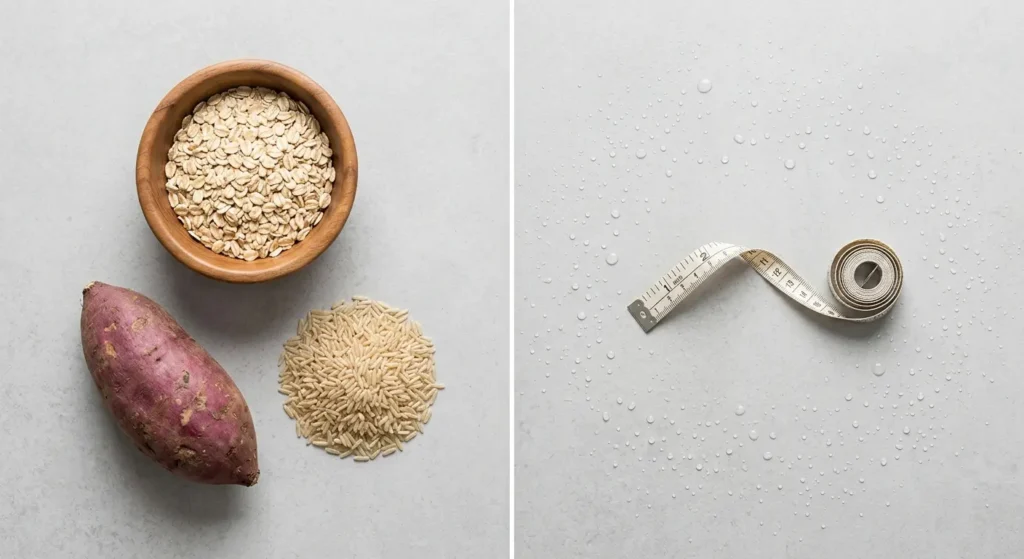
Practical application for the example woman adding 100 calories in week one: add roughly 25 grams of carbohydrate (100 calories = approximately 25g of carbs). An extra serving of oats, rice, or fruit achieves this without any complicated tracking adjustments.
Step 4 — What to Do When the Scale Goes Up
This is where most people abandon the reverse diet, and it is almost always the wrong decision.
The scale will go up. Understanding why is what keeps you from panicking.
When you add 100 grams of carbohydrate to your daily intake, your muscles store it as glycogen. Glycogen binds water at roughly a 3:1 ratio — so 100 grams of extra carbohydrate causes approximately 300 to 400 grams of water retention alongside it. This is not fat. It is water and glycogen filling back into muscles that have been depleted for months.
For the example woman: in week one, moving from 1,450 to 1,550 calories with the extra calories coming from carbs, she might see the scale rise by 0.3 to 0.7 kg. That is glycogen water weight — and it is a sign the process is working, not failing.
The practical rule:
- Scale rises 0.3–0.7 kg and stabilises: Continue adding calories as planned.
- Scale rises more than 1 kg in a single week: Hold at current intake for one to two weeks before adding more. Do not cut back down. Just pause the increases and let your body stabilise.
- Scale rises consistently week after week without stabilising: You may be overshooting your new TDEE. Recheck your calculator numbers and make sure portion sizes are accurate.
Actual fat requires a sustained calorie surplus to accumulate. A carefully controlled reverse diet — where weekly increases stay at 50–100 calories — does not create the surplus needed for significant fat gain.
What to Expect During a Reverse Diet — Week by Week
Back to the example woman. Here is what she actually experiences, not just what the spreadsheet shows:
Weeks 1–2 (1,450 → 1,650 calories): Energy improves noticeably — not dramatically, but the persistent fatigue starts to lift. The scale rises 0.3 to 0.6 kg, mostly water. Hunger begins to decrease. Training feels slightly better.
Weeks 3–4 (1,650 → 1,780 calories): Training performance is noticeably better — she is hitting weights she struggled with at the end of her diet. The scale either stabilises or rises only slightly. Mood and motivation improve. She is eating more food and not gaining visible fat.
Week 4 onward (at maintenance): She is now eating 330 more calories per day than she was at the end of her diet. The scale is up 0.5 to 1 kg from her diet-end weight. Almost all of that is glycogen and water — not fat. She feels recovered, fuelled, and capable of making a decision about what comes next.
This is the arc of a successful reverse diet. The maths are straightforward — the experience is what people need to understand before they start.
How Much Weight Gain Is Normal During a Reverse Diet?
Direct answer: a well-executed reverse diet typically produces 0.5 to 1.5 kg of total scale increase over the full process. Almost all of this is glycogen, water, and gut content — not body fat.
Actual fat gain during a properly executed reverse diet — one where weekly increases stay at 50–100 calories and total intake does not exceed the new TDEE — is typically under 0.3 kg over the entire process. That is not a meaningful setback after months of dieting.
Anyone who claims to have gained several kilograms of fat during a reverse diet either ate significantly above their calculated new maintenance level, miscounted calories consistently, or both. The process itself does not produce fat gain — eating past the new TDEE does.
Common Reverse Dieting Mistakes That Cause Real Fat Gain
Increasing Too Fast — Adding 300–500 Calories at Once
This is the most common mistake, and it is usually driven by the relief of being done with restriction. Jumping from 1,450 to 1,800 calories in a single week overwhelms the rate at which metabolic adaptation can reverse. Your NEAT has not recovered yet. Your thyroid output has not normalised. The extra calories arrive before the body has ramped up its expenditure to match — and the excess is stored.
If this has already happened to you: do not panic, and do not cut back down into restriction. Hold at your current intake for two weeks, let the scale stabilise, and then continue upward at 50–100 calories per week from there.
Eating Past Your New TDEE Maintenance
Some people overshoot — they feel so much better eating more that they keep going past maintenance and into a genuine surplus. This is the scenario that produces real fat regain, not the reverse diet itself.
This is why Step 1 matters so much. Calculate your new TDEE target before you start, write it down, and treat it as a ceiling — not a suggestion. Maintenance is the goal of a reverse diet. Once you reach it, the increases stop.
Stopping Resistance Training During the Reverse
Resistance training during a reverse diet serves a specific purpose: it directs the extra calories you are eating toward muscle glycogen replenishment and recovery rather than fat storage. People who stop training while increasing calories have a meaningfully higher rate of fat gain than those who maintain their training volume. You do not need to add training — just do not subtract it.
Frequently Asked Questions
How long should a reverse diet last?
Use this formula: total calories to add ÷ weekly increase rate = number of weeks.
Someone who needs to add 300 calories at 100 per week needs three weeks. Someone adding 600 calories at 50 calories per week needs twelve weeks. Most people complete a reverse diet in four to ten weeks. The example woman in this article — adding 330 calories at 100 per week — finished in four weeks.
Will I gain fat during a reverse diet?
Done correctly: minimal. Under 0.3 kg of actual fat over the full process is typical. The scale increase you see (0.5–1.5 kg) is almost entirely glycogen and water weight. Done incorrectly — adding calories too fast or going past your new TDEE — fat gain is possible. The reverse diet process itself does not cause fat gain. Eating above your new maintenance does.
Can I reverse diet if I still want to lose more weight?
Yes, in two situations. First, if metabolic adaptation is severe enough that your current deficit has stopped producing results, a reverse diet followed by a fresh moderate deficit from the restored higher maintenance level is more effective than continuing to eat less and less. Second, if you are mentally exhausted from restriction, a reverse diet gives you a psychological reset before starting again. In both cases, do the reverse diet first — then run the new deficit from the recovered TDEE. You will have more room to work with and the process will feel much more sustainable.
What should I eat during a reverse diet?
The same foods you ate during your diet — not a sudden reintroduction of takeaways and ultra-processed snacks. The only change is quantity. Add extra calories from carbohydrate-rich whole foods first: oats, rice, fruit, sweet potato, wholegrain bread. Keep protein at current levels. Avoid using the reverse diet as a reason to bring high-calorie processed foods back into regular rotation — they make accurate tracking significantly harder and can push your intake well past the planned weekly increase without you noticing.
What happens after the reverse diet is finished?
Two paths. First: maintain at the new TDEE level indefinitely and enter a body recomposition phase — eating at maintenance, training consistently, and slowly improving body composition without a formal cut. Second: begin a new moderate deficit from the higher TDEE for another fat loss phase. The reverse diet should have restored your maintenance to a level where a fresh 500-calorie deficit gives you a meaningfully higher calorie target than your previous diet’s ending intake — making the next cut more sustainable, less punishing, and more effective.
External References
For readers who want to go deeper into the physiology behind reverse dieting and metabolic adaptation:
- Metabolic adaptation to weight loss — review in Obesity Reviews — peer-reviewed research on how TDEE changes during and after calorie restriction
- Glycogen and water storage — American Journal of Clinical Nutrition — the science behind why the scale rises when you add carbohydrates back
- Leptin and energy balance after dieting — research overview via PubMed — explains why leptin levels drop during restriction and how food intake affects their recovery