Most people who start tracking their food hit the same wall within the first week: they know they need to “count macros,” but nobody explains how to actually get from their TDEE to real numbers in grams. The percentage split approach — eat 40% carbs, 30% protein, 30% fat — is everywhere online, but it produces completely different protein amounts depending on how many calories you eat. At 1,400 calories, 30% protein gives 105 g. At 2,200 calories, it gives 165 g. The same percentage, very different outcomes. That is why this article ignores percentages as a starting point entirely.
The correct method works in a specific order: protein first (in grams per kg of body weight), fat second (as a floor based on total calories), carbohydrates last (whatever is left over). That order is not arbitrary — it is the only sequence that guarantees physiologically adequate targets regardless of your calorie level. Start by calculating your TDEE here if you haven’t already. That number is the foundation everything else in this guide builds on.
Why Macros Are Calculated in a Specific Order — Protein, Fat, Carbs
Protein is set first because it is the only macro with a body-weight-based requirement that stays relatively constant regardless of total calorie intake. During a fat loss phase, protein protects lean muscle mass from being broken down for fuel — and the research on this is consistent: higher protein intakes (2.0–2.4 g per kg of body weight) during a deficit are associated with significantly better lean mass retention compared to lower intakes. The International Society of Sports Nutrition position stand confirms that intakes in the range of 2.3–3.1 g/kg/day may be needed to maximise muscle retention during a caloric deficit in resistance-trained individuals. Protein has to go first because its target is independent of the calorie budget — you calculate grams from body weight, then see what calorie space it occupies.
Fat is set second because it has a physiological minimum — not a preference, a floor. Research including a systematic review published in the Journal of Steroid Biochemistry and Molecular Biology found that low-fat diets (averaging around 19% of total energy) produced statistically significant reductions in total testosterone, free testosterone, and dihydrotestosterone compared to higher-fat diets. Fat-soluble vitamins A, D, E, and K also require dietary fat for absorption, and cell membrane function depends on adequate essential fatty acid intake. The minimum fat floor — 20–25% of total daily calories — is not optional regardless of your goal or dietary style.
Carbohydrates fill whatever is left after protein and fat are set. They are the most metabolically flexible macro — there is no minimum carbohydrate requirement the way there is a minimum fat requirement, and carb amounts adjust naturally up or down based on your total calorie budget. Competitors who tell readers to start with a percentage split first and then calculate grams are doing the calculation backwards. The percentage approach does not guarantee an adequate protein intake at different calorie levels. This method does.
Step-by-Step — How to Calculate Your Macros From Your TDEE
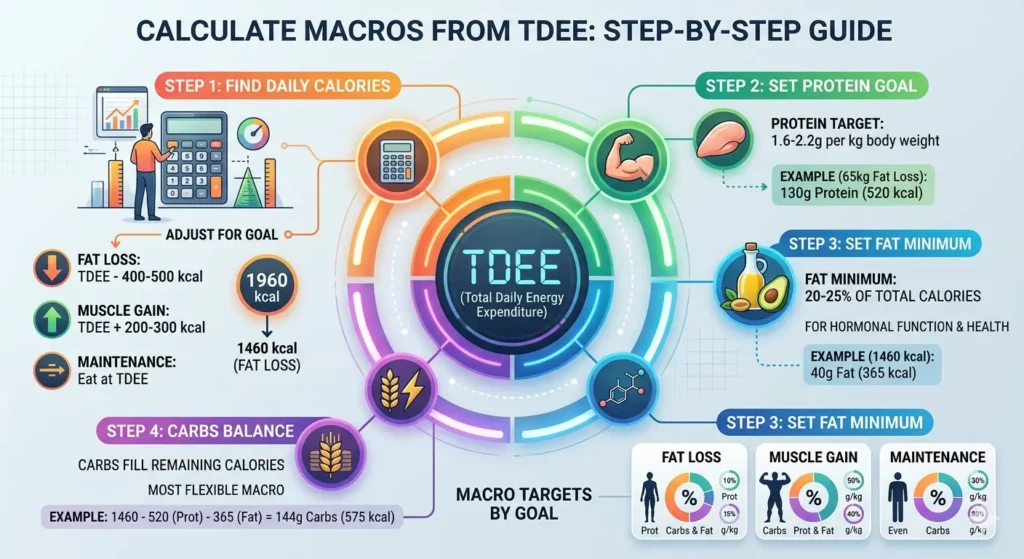
One example person is used across all four steps so the numbers stay connected. Meet Sarah: 28 years old, 65 kg, moderately active (desk job, 3–4 workouts per week), TDEE 1,960 calories, goal is fat loss. Her deficit target brings her to 1,460 calories per day — 500 below her TDEE, a moderate reduction that supports fat loss without aggressively breaking down lean mass. Every calculation below uses Sarah’s numbers. Substitute your own TDEE and body weight at each step to get your personal targets.
Step 1 — Find Your Daily Calorie Target From Your TDEE
Your TDEE is your maintenance level — the number of calories at which your weight stays the same. From there, you adjust based on your goal:
- Fat loss: TDEE minus 400–500 calories per day
- Muscle gain (lean bulk): TDEE plus 200–300 calories per day
- Maintenance or body recomposition: at TDEE
This is the calorie target — the total box that all macros must fit inside. It is fixed before any macro calculation begins. Use the TDEE calculator to get your number, then apply the appropriate adjustment.
Sarah’s Step 1: TDEE 1,960. Fat loss target: 1,960 − 500 = 1,460 calories per day.
Step 2 — Calculate Protein Target in Grams
Protein target = 1.6–2.2 g per kg of body weight. Use the higher end of the range during fat loss (2.0–2.2 g/kg) to maximise muscle protection. Use the lower end (1.6–1.8 g/kg) during a calorie surplus for muscle gain, because the surplus itself provides an anabolic environment that reduces the protein needed for muscle protection.
Once you have the gram target, convert to calories at 4 calories per gram, then subtract from your daily calorie target to see how many calories remain for fat and carbohydrates.
Sarah’s Step 2:
- Protein target: 2.0 × 65 kg = 130 g protein per day
- Calories from protein: 130 × 4 = 520 calories
- Remaining calories: 1,460 − 520 = 940 calories left for fat and carbs
Step 3 — Calculate Fat Target in Grams
Set fat at a minimum of 20–25% of your total daily calorie target — not of TDEE, of the actual calorie target you set in Step 1. This is the floor, not the ceiling. If you prefer more fat in your diet (some people perform better on higher fat and lower carbs), you can go higher — as long as the protein target is met first. But 20% is the absolute minimum for hormonal health and fat-soluble vitamin absorption. Do not go below it.
Convert fat to grams at 9 calories per gram, then subtract from the remaining calories to find what is left for carbohydrates.
Sarah’s Step 3:
- Fat minimum: 25% of 1,460 = 365 calories from fat
- Fat in grams: 365 ÷ 9 = approximately 40 g fat per day
- Remaining calories: 940 − 365 = 575 calories left for carbohydrates
Step 4 — Calculate Carbohydrate Target in Grams
Carbohydrates take whatever calories are left after protein and fat are set. Convert at 4 calories per gram.
Sarah’s Step 4:
- Carbohydrate target: 575 ÷ 4 = approximately 144 g carbohydrates per day
Sarah’s complete daily macro targets for fat loss:
| Macro | Grams | Calories | % of Total |
|---|---|---|---|
| Protein | 130 g | 520 cal | 36% |
| Fat | 40 g | 365 cal | 25% |
| Carbohydrates | 144 g | 575 cal | 39% |
| Total | — | 1,460 cal | 100% |
That is the complete result: a real person’s full macro setup derived from her TDEE, step by step, with every calculation visible. This is what you replicate with your own numbers. For a deeper understanding of how BMR and TDEE interact with fat loss and muscle gain, that guide covers the physiological mechanics behind the calorie targets you set in Step 1.
Macro Targets by Goal — Fat Loss, Muscle Gain, and Maintenance
The table below uses body-weight-based protein targets and a percentage minimum for fat — not fixed percentage splits. This means the targets stay accurate at any calorie level. A person eating 1,400 calories and a person eating 2,600 calories both get a protein target that is appropriate for their body weight, not a number that happens to look like a round percentage of their calorie intake.
| Variable | Fat Loss | Muscle Gain | Maintenance / Recomp |
|---|---|---|---|
| Daily calorie target | TDEE − 400–500 | TDEE + 200–300 | At TDEE |
| Protein (g/kg bodyweight) | 2.0–2.4 g/kg | 1.6–2.0 g/kg | 1.8–2.2 g/kg |
| Fat (% of total calories) | Minimum 20–25% | 25–30% | 25–30% |
| Carbohydrates | Remaining calories | Remaining calories | Remaining calories |
Macro Split for Fat Loss
During a fat loss phase, protein is set at its highest across all three goals — 2.0–2.4 g per kg of body weight. The reason is specific: a calorie deficit places the body under metabolic stress, and without sufficient dietary protein, it will increasingly break down muscle tissue to meet energy and amino acid needs. Research from the American Journal of Clinical Nutrition showed that during a significant energy deficit, participants consuming 2.4 g protein per kg per day gained lean mass and lost more fat compared to those consuming 1.2 g/kg, when combined with resistance training. This is why protein is the non-negotiable anchor in a fat loss macro setup.
Continuing with Sarah’s numbers from the worked example: her fat loss macro targets are 130 g protein, 40 g fat, and 144 g carbohydrates at 1,460 calories per day. These numbers are already set from the step-by-step calculation above. To understand how to structure the full deficit plan around these targets, our guide on using your TDEE to lose weight covers the complete approach including when to recalculate as weight drops.
Macro Split for Muscle Gain
In a calorie surplus, protein can be slightly lower than during fat loss — around 1.6–2.0 g per kg — because the surplus itself creates an anabolic environment that reduces the body’s tendency to use protein for fuel. The extra calories also mean significantly more room for carbohydrates after protein and fat are set, which supports training performance and glycogen replenishment.
Using Sarah at the same body weight but now on a muscle gain protocol: TDEE 1,960 + 250 = 2,210 calories per day.
- Protein: 1.8 × 65 kg = 117 g → 117 × 4 = 468 calories from protein
- Fat: 25% of 2,210 = 553 calories from fat → 553 ÷ 9 = 61 g fat
- Carbs: 2,210 − 468 − 553 = 1,189 calories remaining → 1,189 ÷ 4 = 297 g carbohydrates
The contrast matters: Sarah’s fat loss setup has 144 g carbs per day. Her muscle gain setup has 297 g. Same person, same body weight, same macro calculation method — but the surplus creates nearly double the carbohydrate availability. This is why training performance and recovery tend to feel noticeably better during a bulk than a cut.
Macro Split for Maintenance and Body Recomposition
At maintenance calories, protein stays at the higher end of the range (1.8–2.2 g/kg) because body recomposition — the simultaneous reduction of body fat and gain of muscle — requires both protein synthesis stimulus and muscle preservation signals running at the same time. Fat at 25–30% of total calories, carbohydrates filling the remainder.
Sarah at maintenance (1,960 calories): protein 1.9 × 65 = 124 g (496 cal), fat 25% of 1,960 = 490 cal ÷ 9 = 54 g fat, carbs = 1,960 − 496 − 490 = 974 cal ÷ 4 = 244 g carbohydrates.
The calorie setup for all three goals starts from the same foundation — your TDEE. Our guide on how many calories you should eat per day covers how TDEE changes as your body weight changes and how often to recalculate during each phase.
Low Carb vs Moderate Carb — Does the Split Actually Matter for Fat Loss?
This is one of the most debated topics in nutrition, and the research has a clear answer most people don’t expect: when total calories and protein are matched, low-carb and moderate-carb diets produce the same fat loss.
A landmark randomised trial published in the New England Journal of Medicine (Sacks et al., 2009) assigned 811 overweight adults to one of four diets with dramatically different macronutrient ratios — ranging from 15% to 65% carbohydrate and from 20% to 40% fat. At the two-year follow-up, all four groups had lost essentially the same amount of weight. The researchers concluded that it was the calorie reduction, not the macronutrient composition, that determined outcomes. You can read the full study on PubMed — the methodology is transparent and the sample size makes it one of the most credible studies on this question.
There is one meaningful exception: people with insulin resistance — a common feature of type 2 diabetes and metabolic syndrome — do show modestly better fat loss outcomes on lower carbohydrate diets, likely because reducing dietary carbohydrate reduces the glycaemic load on an already impaired insulin response. For everyone else, the carbohydrate-to-fat ratio is a preference and performance question, not a fat loss question. Choosing the split you can maintain consistently — and that supports your training performance — will always outperform the “optimal” split you abandon after three weeks.
Carbohydrate Intake Based on TDEE — How Much Is Right for You?
Using the protein-first calculation method, carbohydrates typically represent 35–55% of total daily calories for most people — but that percentage varies significantly based on TDEE. Someone with a higher TDEE who trains frequently will have more calories remaining after protein and fat are set, which translates to more carbs in absolute grams. Someone in a large calorie deficit will have fewer remaining calories, meaning fewer carbs.
Here’s a quick illustration. Two people, same body weight (70 kg), same protein target (140 g/day = 560 cal), same fat floor (25% of calories):
- Person A at 1,500 calories: fat = 375 cal (42 g), carbs = 1,500 − 560 − 375 = 565 cal ÷ 4 = 141 g carbs (38%)
- Person B at 2,500 calories: fat = 625 cal (69 g), carbs = 2,500 − 560 − 625 = 1,315 cal ÷ 4 = 329 g carbs (53%)
The right carb intake is whatever fills the remaining calories after protein and fat are set. There is no universal target — it is always a residual calculation, not a predetermined percentage.
How Many Calories From Fat Per Day — Setting the Right Fat Floor
The physiological minimum for dietary fat is 20% of total daily calories — not of TDEE, of the actual calorie target. Below this threshold, the body’s ability to produce sex hormones (testosterone and oestrogen both depend on dietary cholesterol and fatty acids as precursors), absorb fat-soluble vitamins (A, D, E, and K), and maintain cell membrane integrity is meaningfully compromised.
A systematic review and meta-analysis published in the Journal of Steroid Biochemistry and Molecular Biology found that low-fat diets averaging around 19% of total energy caused statistically significant reductions in total testosterone, free testosterone, and DHT in men compared to higher-fat control diets. Similar effects on oestrogen levels in women have been documented. The practical consequence — for anyone cutting calories aggressively — is that going below the fat floor does not make the diet work better. It makes it work worse, and it introduces hormonal and micronutrient disruption that can persist for weeks after the diet ends. You can read more about this in the ISSN protein position stand, which addresses macronutrient floors in the context of athletic performance.
Two quick examples to make the fat floor concrete:
- Person eating 1,600 calories: fat minimum = 1,600 × 0.20 = 320 cal ÷ 9 = 35 g fat per day
- Person eating 2,400 calories: fat minimum = 2,400 × 0.20 = 480 cal ÷ 9 = 53 g fat per day
The fat floor is absolute — it does not shift based on goal, dietary preference, or how large the calorie deficit is. If you cannot fit adequate protein, the minimum fat floor, and meaningful carbohydrates within your daily calorie budget, the deficit is too aggressive and needs to be reduced. Our article on why very large calorie deficits backfire explains the practical and physiological consequences of cutting too aggressively.
Common Macro Calculation Mistakes — and How to Avoid Them
This is the section most macro guides completely skip. These four mistakes are specific, common, and fixable in under a minute each.
Using Percentage Splits Instead of Body-Weight Protein Targets
A 30% protein split at 1,400 calories gives 105 g of protein per day — adequate for a 52 kg sedentary person but well below the 130–143 g a 65 kg person needs in a fat loss deficit. Percentage-based splits fail because they produce different protein amounts at different calorie levels. The fix: always calculate protein in g/kg first, convert to calories, then allocate the remaining calories to fat and carbohydrates. This is not a minor distinction — it is the difference between a macro setup that protects muscle and one that doesn’t.
Not Adjusting Macros When TDEE Changes
As body weight drops during a diet, TDEE drops too — because a lighter body requires fewer calories to maintain itself. When your calorie target decreases, so do the gram amounts for fat and carbohydrates. Protein also shifts slightly as body weight changes (g/kg × new weight). Macro targets set at the start of a diet will be meaningfully inaccurate after 4–6 kg of weight change. Recalculate your TDEE at the new body weight using the TDEE calculator, reset the daily calorie target, and run the four-step macro calculation again from Step 1. This is a 5-minute task that keeps your deficit accurate and your progress on track. For context on what happens when macros aren’t adjusted during a plateau, our guide on understanding weight loss plateaus covers exactly this scenario.
Tracking Macros but Not Checking the Total Calorie Count
Some people hit their macro gram targets but never verify that the calorie total matches their intended target. Consider: 150 g protein (600 cal) + 60 g fat (540 cal) + 200 g carbs (800 cal) = 1,940 calories total. If the intended target was 1,500, that is a 440-calorie overage that looks fine in a macro tracker showing green checkmarks against gram targets. Tracking macros in grams automatically produces a calorie total — but that total must be checked against the TDEE-based calorie target. The two are not automatically aligned. Always look at both numbers.
Going Below the Fat Minimum to Free Up More Carbs or Protein
On lower-calorie diets, it is tempting to reduce fat below 20% to free up calorie space for more carbohydrates (for energy) or more protein (for muscle protection). The physiological consequences of going below the fat floor include hormonal disruption, impaired fat-soluble vitamin absorption, persistent fatigue, and reduced recovery capacity — all of which undermine the fat loss goal they were intended to serve. The fat floor is non-negotiable. If the calorie budget is too tight to accommodate adequate protein, the minimum fat floor, and any meaningful amount of carbohydrates — the deficit is too large and should be reduced, not the fat target.
Frequently Asked Questions
How do I calculate my macros from my TDEE?
Four steps. First, calculate your TDEE and apply the appropriate adjustment for your goal to get a daily calorie target (deficit for fat loss, surplus for muscle gain, at TDEE for maintenance). Second, set protein at 1.6–2.4 g per kg of body weight — higher end for fat loss. Third, set fat at a minimum of 20–25% of your total daily calories. Fourth, fill the remaining calories with carbohydrates. Convert protein and carbs at 4 cal/g, fat at 9 cal/g. Example for a 65 kg woman cutting at 1,460 calories: 130 g protein (520 cal), 40 g fat (365 cal), 144 g carbs (575 cal). Use the TDEE calculator to get your starting number.
What is the best macro split for fat loss?
There is no single best percentage split. The variable that consistently determines fat loss outcomes is total weekly calorie deficit — and the variable that consistently determines body composition quality during the deficit is protein intake in g/kg of body weight. High protein (2.0–2.4 g/kg) is associated with better muscle retention and greater satiety during a calorie deficit. Beyond the protein target and fat floor, whether the remaining calories come from more carbs or more fat has no meaningful impact on fat loss when total calories are controlled. The best macro split for fat loss is the one you can maintain consistently for 10–16 weeks — full stop.
Should I track macros or just calories?
For pure fat loss in a sedentary person with no muscle retention priority, tracking total calories alongside an adequate protein target is sufficient. For anyone who trains and wants to preserve or build muscle while changing body weight, tracking all three macros gives meaningfully better body composition outcomes because both protein and fat floors are explicitly managed. Tracking macros automatically tracks calories, but tracking calories alone does not guarantee macro adequacy. If tracking all three feels overwhelming, prioritise protein grams and total calories — those two variables have the highest impact on both fat loss rate and muscle retention. Let fat and carbohydrates fill in around them.
Do my macros need to be exact every day?
No — and chasing exact gram targets every single day creates unnecessary stress that often reduces adherence over a longer diet phase. Aim to be within 10 g of your protein target, 5 g of your fat target, and 20 g of your carbohydrate target on any given day. Weekly averages matter far more than daily precision. The body does not run a daily macro accounting system — protein synthesis, fat oxidation, and glycogen storage all pool resources across 24–72 hours. A day 15 g short on protein is inconsequential if surrounding days are on target. Consistency over weeks matters significantly more than perfection on any individual day.
How many grams of carbs should I eat per day?
Carbohydrates fill whatever calories remain after protein and fat are set — they are the most flexible macro and the only one with no physiological floor. On a 1,600-calorie fat loss diet with 130 g protein and 40 g fat already allocated (520 + 360 = 880 calories), the remaining 720 calories gives 180 g carbs. On a 2,400-calorie maintenance diet with the same protein and fat allocation, carbs would be considerably higher. There is no universal daily carbohydrate target — it is always a residual number derived from the other two macros within your calorie budget.
What happens if I eat more protein than my macro target?
Eating modestly above your protein target (10–20 g extra) has no negative effect on fat loss or health — excess protein beyond what is used for muscle protein synthesis is converted to glucose via gluconeogenesis or used directly for energy. However, consistently eating significantly more protein than the target while staying within the same total calorie budget means either fat or carbohydrates are being displaced. If fat drops below 20% of total calories, the hormonal and vitamin absorption consequences described above apply. If carbohydrates drop very low, training performance and recovery suffer. Track the total calorie figure as the ceiling and let macros distribute within it.