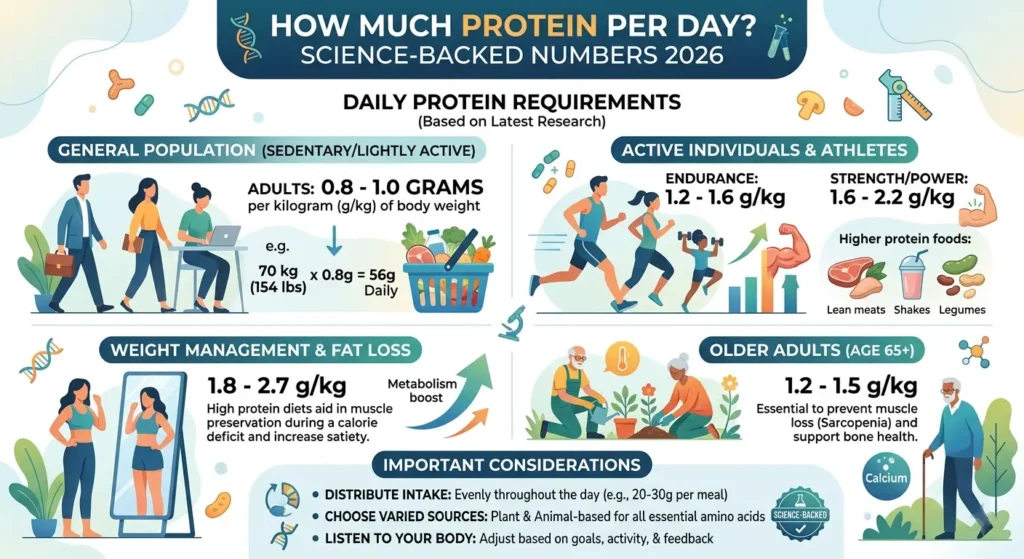
Here is the most confusing thing about protein: the number changes depending on who you ask, what your goal is, and how much you weigh. Almost every number floating around online is too low for people who actually train. The government’s 0.8 g/kg recommendation is not a performance target. It is a deficiency prevention threshold set for sedentary adults who do almost no physical activity.
This guide gives you the correct protein target for your specific goal — weight loss, muscle gain, maintenance, and if you are over 40. It explains why the targets differ and gives you worked examples you can apply to your own body weight today. For most active adults, the research-backed range is 1.6–2.4 g of protein per kilogram of body weight per day — not 0.8 g/kg.
Before setting your protein target, use the TDEE calculator to find your daily calorie needs first. Your protein target sits inside that calorie budget — not on top of it.
Why the Government’s 0.8 g/kg Recommendation Is Not Enough for Active People
The 0.8 g/kg RDA (Recommended Dietary Allowance) was designed for one purpose only: to prevent protein deficiency in a sedentary adult. Not to build muscle. Not to support fat loss. Not to help someone who trains three times a week hold on to their lean mass while eating in a calorie deficit.
It is the absolute minimum to stop your body from breaking down its own muscle just to survive. That is a very different thing from a performance or body composition target.
A large 2018 systematic review published in the British Journal of Sports Medicine analysed 49 studies involving more than 1,800 participants. The finding was clear: muscle gains continued increasing as protein intake rose up to 1.6 g/kg per day, with no meaningful additional benefit observed beyond approximately 2.2 g/kg. That is more than double the government recommendation. When the research ceiling for muscle gain sits at twice the official number, the official number is not a training target. It is a deficiency floor.
For anyone who exercises regularly, is eating in a calorie deficit, or is over 40, the RDA is simply the wrong number to build a nutrition plan around.
What 0.8 g/kg Actually Means in Practice
Let us make this real with a simple example.
A 75 kg adult following the government recommendation needs just 60 g of protein per day. That is roughly two chicken breasts. For a completely sedentary person who sits at a desk all day and does no formal exercise, 60 g prevents deficiency. That is all it needs to do for them.
But for someone doing resistance training three times a week, eating 400 calories below their maintenance — which you can calculate in under a minute using the TDEE calculator — or trying to hold on to muscle past the age of 40, 60 g of protein per day is not adequate for their goal.
The RDA is a floor. Not a target. This single reframe is what changes the way you think about protein entirely.
How Much Protein Per Day to Lose Weight Without Losing Muscle
The research-backed protein target during fat loss is 1.8–2.4 g per kilogram of body weight per day.
That is the direct answer. Here is how to apply it based on your situation.
The range exists because not every calorie deficit is the same. A moderate deficit of 300–400 calories below your TDEE requires less protein support than an aggressive deficit of 500–750 calories. The leaner your body is to begin with, the more it is willing to break down muscle for energy when calories are restricted — which is why protein needs climb as body fat drops.
| Deficit Size | Recommended Protein Target |
|---|---|
| Moderate (300–400 cal below TDEE) | 1.8 g/kg per day |
| Aggressive (500–750 cal below TDEE) | 2.0–2.4 g/kg per day |
| Very aggressive or already lean | 2.2–2.4 g/kg per day |
And here are the actual daily protein targets in grams for four common body weights, calculated at 2.0 g/kg:
| Body Weight | Daily Protein Target (2.0 g/kg) |
|---|---|
| 55 kg | 110 g per day |
| 65 kg | 130 g per day |
| 75 kg | 150 g per day |
| 85 kg | 170 g per day |
No calculation needed. Find your weight, read your number.
For a full walkthrough on structuring your calories and macros around these protein targets, the calorie deficit guide covers the complete process step by step.
Why Protein Needs Are Higher During a Calorie Deficit
When you eat less than your body burns, your body enters a catabolic state. It starts breaking down its own tissue to fill the energy gap. If dietary protein is not high enough, some of that tissue is muscle.
High protein intake keeps muscle protein synthesis elevated above the breakdown rate — so even in a calorie deficit, lean mass is preserved. Two people eating identical deficits but different protein intakes can finish a 12-week cut with completely different body compositions. The high-protein person loses mostly fat. The low-protein person loses fat and muscle — ending up lighter but not leaner.
Protein also has the highest thermic effect of any macronutrient. Around 25–30% of protein calories are burned during digestion itself. Carbohydrates burn off 5–10% and fat just 0–3%. This gives high protein eating a small but real metabolic advantage every single day during a calorie deficit — without any extra effort.
Does High Protein Help You Feel Fuller During a Diet?
Yes — and for most people this is the most immediately useful benefit of eating enough protein during fat loss.
Protein suppresses ghrelin — the hormone that drives hunger — more powerfully and for longer than carbohydrates or fat. It also raises peptide YY, a gut hormone that signals fullness to the brain. Together these two hormonal effects make eating at a calorie deficit feel far less difficult than it does on a low-protein diet.
Research shows that people eating high-protein diets spontaneously consume 400–500 fewer calories per day than people on lower-protein diets at the same calorie target — simply because they are less hungry. Not because they have more willpower. Because protein does the work for them. For anyone who has ever found dieting exhausting and unsustainable, this is one of the most practical reasons to take your protein target seriously.
How Much Protein Per Day to Build Muscle
The research consensus for muscle gain is 1.6–2.2 g of protein per kilogram of body weight per day.
That is the range where muscle protein synthesis is maximised for healthy adults. Going beyond 2.2 g/kg adds no additional muscle in the research. Protein above this threshold is simply oxidised for energy — the same as any other calorie source.
Here is what 1.8 g/kg looks like across four common body weights:
| Body Weight | Daily Protein Target (1.8 g/kg) |
|---|---|
| 55 kg | 99 g per day |
| 65 kg | 117 g per day |
| 75 kg | 135 g per day |
| 85 kg | 153 g per day |
Notice these numbers are lower than the fat loss targets above. That is intentional and it matters.
When you are eating in a calorie surplus to support muscle growth, the surplus itself is anabolic. Extra calories protect muscle from breakdown by supplying the energy your body needs. Protein does not have to work as hard in a defensive role, so less of it achieves the same muscle gain result compared to being in a deficit.
To calculate your bulking calorie surplus and understand how TDEE feeds into your muscle gain plan, the BMR and TDEE guide explains the full calculation.
Does Eating More Protein Than 2.2 g/kg Build More Muscle?
For healthy adults without pharmaceutical assistance: no.
The 2018 British Journal of Sports Medicine meta-analysis — the most comprehensive dataset on this question — found no additional muscle gain from protein intakes beyond 1.6 g/kg, with the upper confidence interval placing the research ceiling at approximately 2.2 g/kg. Eating above this is not harmful. It simply produces no additional muscle. You are replacing carbohydrates with protein at that point — and carbohydrates fuel training performance, which is one of the real drivers of muscle growth.
The one exception worth knowing: during an aggressive calorie deficit, intakes of 2.4–3.1 g/kg show specific benefits for protecting muscle during fat loss. That is a different situation entirely — covered in the weight loss section above.
The popular “1 gram per pound of bodyweight” rule from gym culture equals 2.2 g/kg. It sits at the very top of the research range — not a moderate conservative target. The lower end (1.6 g/kg) is sufficient for strong muscle gain results for most people, especially beginners and intermediates.
Does Protein Timing Matter — Should You Eat It Around Workouts?
The “anabolic window” — the idea that you must eat protein within 30 minutes of training or the growth signal is lost — has been significantly overstated by the supplement industry. Research has walked this back considerably over the past decade.
What actually matters is your total daily protein intake across the full day. Timing is a distant second consideration. What does help modestly is distributing your protein across three to five meals rather than eating most of it in one or two large sittings. Each protein-containing meal triggers a fresh round of muscle protein synthesis. More frequent stimulation across the day adds up meaningfully over weeks and months.
A protein serving around your workout is perfectly fine — and useful when it contributes to hitting your daily total. But there is no 30-minute window that will close on you. Hit your daily number, spread it reasonably across meals, and the timing details take care of themselves.
Protein Needs for Older Adults — Why the Target Increases After 40
This is the section that is almost entirely missing from every other protein article — despite the fact that a large proportion of people searching these questions are over 40, and they are exactly the people most likely to be undereating protein.
Starting around age 40, the body develops what researchers call anabolic resistance. Muscle protein synthesis becomes progressively less efficient at responding to the same protein stimulus that worked at 25. More protein is needed to produce the same anabolic response. The machinery for building and maintaining muscle is still there — it just needs a stronger input signal.
The PROT-AGE Study Group — a scientific panel convened by the European Union Geriatric Medicine Society specifically to review protein requirements across the lifespan — recommends 1.0–1.2 g/kg per day for sedentary older adults. That is already 25–50% above the general government recommendation. For older adults who are active or managing any health condition, the recommendation rises to 1.2–1.5 g/kg. For those doing structured resistance training, the target is 1.6–2.0 g/kg — essentially the same as a younger active adult, but harder to reach because appetite often decreases with age.
If you are over 40 and training regularly, you need as much protein per kilogram as a 25-year-old athlete. The science on this is not ambiguous.
Sarcopenia — Why Losing Muscle With Age Is Not Inevitable
Sarcopenia — the clinical term for age-related muscle loss — begins meaningfully around age 40 and accelerates significantly after 60. Research estimates that without intervention, adults lose 3–8% of muscle mass per decade. Over two or three decades that adds up to a substantial loss of functional strength, metabolic rate, and physical independence. Fall risk, fracture risk, and metabolic disease risk all rise as a direct consequence.
But sarcopenia is not inevitable. The two most effective interventions are resistance training and adequate protein intake — and they work far better together than either does alone. Resistance training two to three times per week combined with a protein intake of at least 1.2–1.6 g/kg creates the conditions for meaningful muscle maintenance well into later decades of life.
This is not about looking athletic. It is about remaining physically capable and independent. For a full picture of how fat loss and muscle maintenance can work simultaneously, the body recomposition guide covers the complete approach.
Is High Protein Intake Safe for the Kidneys?
This is the most common concern raised about high-protein diets — and it deserves a direct, clear answer rather than a vague disclaimer.
For healthy adults with normal kidney function: protein intakes up to 2.2 g/kg per day show no evidence of impairing kidney health in the existing research. Studies have tested intakes as high as 4.4 g/kg in healthy trained individuals with no adverse effects on kidney function markers. The kidneys of a healthy adult are well equipped to handle the byproducts of protein metabolism at fitness-relevant intakes.
The concern about protein and kidney damage comes from a specific and real population: people who already have chronic kidney disease (CKD) or significantly reduced kidney filtration capacity. In that group, high protein intake can accelerate existing damage. The concern is legitimate — but it applies to a diagnosed medical condition, not to healthy adults without kidney disease.
Research published in peer-reviewed journals on dietary protein and kidney health in healthy adults consistently confirms this distinction.
If you have been diagnosed with kidney disease or have any history of reduced kidney function, speak with your doctor before significantly increasing your protein intake. For everyone else, high protein at fitness-relevant levels is safe.
Best Sources of Protein — Complete vs Incomplete Proteins
Not all protein works the same way in the body. Understanding the difference between complete and incomplete protein sources is especially useful for plant-based eaters who need to plan their intake more carefully.
A complete protein contains all nine essential amino acids — the ones your body cannot manufacture and must get from food. Animal proteins are all complete: chicken, beef, fish, eggs, dairy, and whey protein all deliver the full amino acid profile your body needs for muscle protein synthesis.
Most plant proteins are incomplete. They are missing or low in one or more essential amino acids. This does not mean plant-based eaters cannot meet their protein needs — it just means combining different sources across the day is important. Lentils and rice, beans and bread, tofu and edamame together cover the full amino acid profile. You do not need to pair them in the same meal — your body pools amino acids throughout the day.
One amino acid matters more than the others for muscle protein synthesis: leucine. Whey protein, eggs, and beef are all high in leucine. Plant proteins tend to be lower in leucine per gram of total protein. As a result, vegetarians and vegans typically need to eat around 20–25% more total protein to achieve the same muscle-building stimulus as someone eating primarily animal protein. If that applies to you, add that buffer to your daily target.
High-Protein Foods and How Much Protein They Contain
Ten common protein sources with grams of protein per 100 g and per a realistic standard serving. The per-100g column helps you compare foods. The per-serving column helps you plan actual meals.
| Food | Protein per 100g | Protein per Standard Serving |
|---|---|---|
| Chicken breast (cooked) | 31g | 47g per 150g serving |
| Canned tuna (in water) | 25g | 30g per 120g can |
| Eggs (large) | 13g | 6g per egg |
| Greek yoghurt (plain) | 10g | 17g per 170g serving |
| Cottage cheese | 11g | 22g per 200g serving |
| Tempeh | 19g | 29g per 150g serving |
| Edamame (cooked) | 11g | 17g per 155g cup |
| Lentils (cooked) | 9g | 18g per 200g serving |
| Chickpeas (cooked) | 8.9g | 15g per 165g serving |
| Tofu (firm) | 8g | 10g per 125g serving |
To put this in practical terms: 150g of chicken breast, two eggs, 170g of Greek yoghurt, and 200g of cottage cheese gives you over 100g of protein from just four food sources. For a 65 kg person that is already 77% of their daily fat loss protein target before anything else is counted.
Do You Need Protein Supplements to Hit Your Target?
No. Whole food sources provide all the protein most people need to reach their daily target. Supplements are convenient — not essential.
That said, protein powder becomes genuinely useful in specific situations. If you struggle to eat enough protein from food due to low appetite, a tight calorie budget, limited food variety, or a schedule that does not allow time for meal prep — a protein shake fills the gap efficiently. A single scoop of whey protein provides around 20–25g of high-quality, high-leucine protein in approximately 100–150 calories. For someone trying to reach 150g protein on a 1,600-calorie daily budget, that calorie efficiency matters.
Whey protein has the highest leucine content and fastest absorption rate of any protein source — which is why it is the most studied supplement for muscle gain. Casein (slow-digesting) and plant-based blends such as pea and soy are solid alternatives for those who avoid dairy.
The answer is always food first, supplements when they solve a specific problem. For the full picture on how to set protein alongside carbohydrate and fat targets for your goal, the step-by-step macro calculation guide covers every number in sequence.
Your Personal Protein Target — A Simple Summary Table by Goal and Body Weight
Every protein target from this guide in one clean reference. Find your goal, find your body weight, read your daily protein number. No scrolling back through individual sections required.
| Goal | Per kg Target | 60 kg Person | 75 kg Person | 90 kg Person |
|---|---|---|---|---|
| Weight Loss — Moderate Deficit | 1.8 g/kg | 108g/day | 135g/day | 162g/day |
| Weight Loss — Aggressive Deficit | 2.2 g/kg | 132g/day | 165g/day | 198g/day |
| Muscle Gain (Bulk) | 1.8 g/kg | 108g/day | 135g/day | 162g/day |
| Maintenance & Body Recomposition | 1.6 g/kg | 96g/day | 120g/day | 144g/day |
| Older Adults (40+ Active) | 1.6–2.0 g/kg | 96–120g/day | 120–150g/day | 144–180g/day |
A few things worth noticing in this table. Muscle gain and moderate fat loss share almost identical protein targets. That makes sense — the research floor for muscle gain (1.6 g/kg) and the floor for muscle preservation during a deficit (1.8 g/kg) are very close to each other. The real difference shows up at the aggressive deficit end, where protein needs to climb to protect lean mass under significant energy restriction.
Older adults who are active need as much protein per kilogram as younger people training for muscle gain — just harder to actually reach when appetite tends to decrease with age.
For body recomposition — losing fat while building or maintaining muscle — the full science is covered in the body recomposition guide.
Frequently Asked Questions
How many grams of protein per day do I need to lose weight?
The research-backed target is 1.8–2.4 g per kilogram of body weight per day during fat loss. For a 65 kg person, that means 117–156 g of protein per day. Use the higher end (2.2–2.4 g/kg) if your calorie deficit is aggressive — more than 500 calories below your TDEE — or if your body fat is already relatively low. For a moderate deficit of 300–400 calories, 1.8 g/kg is sufficient to protect muscle effectively. Calculate your TDEE first using the free TDEE calculator, then set your protein target within that calorie budget.
How many grams of protein per day do I need to build muscle?
1.6–2.2 g per kilogram of body weight per day maximises muscle protein synthesis for the vast majority of healthy adults. For a 75 kg person, that is 120–165 g of protein per day. Intakes beyond 2.2 g/kg produce no additional muscle gain — the excess is used as energy. Beginners building muscle for the first time see strong results at the lower end of this range (1.6 g/kg). More advanced lifters benefit from the higher end. The “1 gram per pound” bodybuilding rule equals 2.2 g/kg — the very top of the research range, not a moderate or average target.
Is 100 grams of protein a day enough?
It depends entirely on your body weight and your goal. For a 50 kg woman aiming for maintenance, 100 g per day equals 2.0 g/kg — above the research minimum and well-placed for muscle protection and general health. For an 80 kg man trying to build muscle, 100 g per day is only 1.25 g/kg — below the 1.6 g/kg threshold the research identifies for maximising muscle gain and likely to limit results. Use the summary table above to check whether 100 g meets your specific needs based on your actual body weight.
Can you eat too much protein?
For healthy adults with normal kidney function, not at the intakes used in fitness contexts. Research has tested protein as high as 4.4 g/kg in healthy trained adults with no adverse health effects. The practical issue with very high protein above 2.5 g/kg is not safety but calorie displacement — very high protein leaves little room for carbohydrates and fat, which can reduce training energy and affect hormonal health over time. The kidney concern is real but applies specifically to people with existing kidney disease — not to healthy adults. Anyone with a kidney disease diagnosis should speak with their doctor before changing their protein intake.
What happens if I do not eat enough protein?
Three specific consequences in order of how quickly they affect you. First: during any calorie deficit, insufficient protein means a large portion of the weight you lose comes from muscle rather than fat. You finish the diet lighter but softer in body composition — often called skinny fat. Second: lower protein reduces satiety, making hunger harder to manage and overeating more likely throughout the day. Third: over months and years, chronically low protein contributes to reduced bone density, weakened immune function, and gradual loss of functional strength. The first consequence is the most immediately relevant and the most motivating reason to hit your protein target during a fat loss phase.
Should I use grams per kg or grams per pound to calculate protein?
Both work — they are the same calculation in different units. Grams per kilogram is the standard used in all peer-reviewed research, which is why this guide uses it throughout. Grams per pound is common in US-based fitness content. The “1 gram per pound” rule equals 2.2 g/kg — the top of the research range for muscle gain, not a moderate target. If you prefer working in pounds, multiply your g/kg target by 0.45 to convert. So 1.8 g/kg becomes approximately 0.81 g per pound of bodyweight. Use whichever unit you find easier — just be consistent and know which one you are applying when you track your intake.
Pingback: Philly Cheesesteak Calories: By Size, Meat & Brand
Pingback: Pho Calories: Chicken, Beef & Vegetarian Compared
Pingback: How Many Rotis to Lose Weight? (Full Guide)
Pingback: Fried Egg Calories: By Size, Oil & Method (2026)
Pingback: Slim Jim Calories: Mini to Monster Size Guide
Pingback: Cheese String Calories: Regular vs Light Compared