In 1832, a Belgian mathematician named Adolphe Quetelet sat down with population records from across Europe and tried to work out what an “average man” looked like, statistically speaking. He wasn’t a doctor. He had no interest in diagnosing individuals. He was trying to describe entire populations using numbers — and the formula he came up with, weight divided by height squared, became known as the Quetelet Index. It would take another 163 years before the World Health Organisation adopted it for clinical use, in 1995, mainly because it was cheap, fast, and only needed a scale and a measuring tape.
So the tool that tells millions of people every year that they’re “overweight” was originally built by a 19th-century statistician to study average citizens of Belgium, France, and other European nations — not to assess your personal health. In this guide, we’ll look at why BMI breaks down for muscular people, women, older adults, and Asian populations, what ideal body weight formulas actually calculate, and which three metrics give you a far more honest picture of your health than BMI ever could. If you want to see how your body composition connects to your daily calorie needs, our free TDEE calculator is the practical next step — it’s the tool you’ll actually use once you understand what these numbers mean for you.
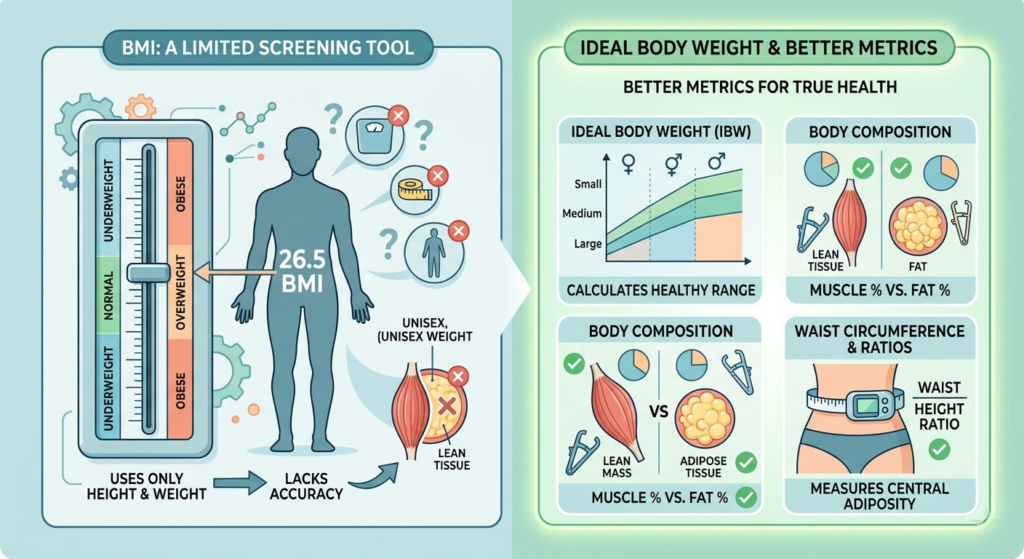
What BMI Is — and What It Was Actually Designed For
Most articles about BMI jump straight to the formula and the categories, as if the number had always existed to sort people into health groups. It didn’t. Adolphe Quetelet developed the index in 1832 while trying to identify the “average man” across European populations — a statistical exercise, not a medical one. He wasn’t measuring health. He was measuring averages.The formula itself is almost insultingly simple: weight in kilograms divided by height in metres squared. That’s it. No age, no sex, no muscle, no fat distribution, no waist measurement — just two numbers divided by each other. It was designed to be dimensionless and easy to calculate across thousands of people at once, which made it perfect for population-level observation and useless for anything more personal.The name “Body Mass Index” didn’t even exist until 1972, when physiologist Ancel Keys reviewed seven different ways of estimating body fat in a research paper and concluded that Quetelet’s old formula was the best simple proxy available — at the population level. Keys was explicit that it wasn’t meant for individual clinical assessment. That detail tends to get lost. The limitations we’re about to walk through aren’t bugs that crept in over time. They were baked into the tool from day one.What the Four BMI Categories Actually Mean
The categories most of us have memorised without really thinking about are: underweight (below 18.5), normal weight (18.5–24.9), overweight (25–29.9), and obese (30 and above). These thresholds were set by consensus in 1995, based on population risk data — not because there’s some biological cliff edge that suddenly appears the moment your number crosses 25.0.That distinction matters more than it sounds. The jump from “normal” to “overweight” at exactly 25.0 is an administrative line drawn on a chart, not a switch that flips in your body. These are probabilistic risk bands describing large groups of people, not individual diagnoses.Here’s a comparison that researchers at Stanford Medicine highlighted in November 2024: a person with a BMI of 26 who has excellent cardiovascular fitness, a healthy waist circumference, and no metabolic red flags carries less real health risk than someone with a BMI of 24.5 who is sedentary, carries fat around the midsection, and has elevated fasting glucose. The first person is technically “overweight.” The second is technically “normal.” If you only looked at BMI, you’d have it backwards.The Six Specific Populations Where BMI Is Consistently Wrong
Almost every article on this topic says something vague like “BMI doesn’t account for muscle mass” and moves on. That’s true, but it tells you nothing about who is actually affected, by how much, or what it means for your own number. Below are six groups where BMI consistently produces misleading results — with the actual research behind each one.Athletes and Resistance-Trained Individuals — Falsely Classified as Overweight or Obese
Muscle tissue is roughly 18% denser than fat tissue. So if two people are the same height but one has a lot more muscle and a lot less fat, the muscular person will weigh more — and therefore score higher on BMI — despite being in objectively better shape.The classic example is former NFL running back Herschel Walker. At peak conditioning, with roughly 4% body fat, his BMI was 31.8 — squarely in the “obese” category. A 2008 study published in the International Journal of Obesity by Romero-Corral and colleagues found that BMI misclassified body fat status in about 50% of men and 25% of women, with the errors running in opposite directions: BMI tends to under-detect true fat levels in some men while over-flagging highly muscular people as carrying excess fat.If you train consistently, have visible muscle definition, a waist circumference well within healthy range, and normal blood markers, a BMI sitting in the 25–29.9 “overweight” band is not, on its own, something to lose sleep over.Older Adults — Where a “Normal” BMI Predicts Worse Outcomes Than “Overweight”
This is one of those facts that quietly contradicts everything most people assume about weight and ageing, and it almost never makes it into mainstream health content. In geriatric medicine it’s called the obesity paradox: adults over 65 with a BMI in the “overweight” range (25–29.9) consistently show better survival outcomes than those classified as “normal” weight (18.5–24.9).A meta-analysis covering roughly 250,000 adults aged 65 and older found that the “overweight” BMI category was associated with the lowest all-cause mortality — lower than both the “normal” and “obese” categories. The likely explanation is sarcopenia, the age-related loss of muscle mass. An older adult can lose weight without losing fat, simply by losing muscle — which means a “normal” BMI in someone in their 70s may actually reflect the loss of protective lean tissue rather than healthy leanness.In practical terms, the “ideal” BMI for a 70-year-old looks different from the ideal BMI for a 30-year-old. Applying the same cutoff to both is a known limitation that even the WHO itself has acknowledged.Women — Why the Same BMI Means Different Body Fat Than in Men
Women carry more essential body fat than men by design — it’s tied to hormone production, reproductive function, and breast tissue. At a BMI of 25 (the “overweight” threshold for everyone), women typically sit around 33–35% body fat, while men sit around 22–24%.So the exact same number, BMI 25, describes two very different bodies depending on sex — yet the label and the implied health risk are presented as identical. Part of the issue traces back to history: the original BMI data was drawn predominantly from male populations and was never fully recalibrated for how women’s bodies are built. Researchers at the University of Pennsylvania’s Perelman School of Medicine have pointed to this as a genuine design flaw in how BMI gets applied to women in clinical settings.Asian Populations — Why the WHO Threshold Underestimates Risk at Lower BMI
This section matters enormously for a large share of readers, and it’s information that’s barely discussed outside specialist medical literature. People of South Asian, East Asian, and Southeast Asian descent tend to develop type 2 diabetes, heart disease, and other metabolic conditions at meaningfully lower BMI values than people of European descent.Research consistently shows that a BMI of 23 in a South Asian person carries roughly the same metabolic risk as a BMI of around 27.5 in a European person. Because of this, the WHO’s Asia-Pacific guidelines, published in 2000, recommend lower cutoffs for Asian populations: “overweight” begins at BMI 23 (rather than 25), and “obese” begins at BMI 27.5 (rather than 30).The real-world consequence is significant — a large number of South and East Asian adults who fall within the “normal” range on the standard international BMI scale may already be carrying elevated cardiometabolic risk by the standards that actually apply to their population. If you’re of South Asian heritage, this is arguably the single most personally relevant fact in this entire article.Children and Adolescents — Why Adult BMI Categories Do Not Apply
It’s worth saying plainly: the adult categories (18.5–24.9 normal, 25+ overweight) simply don’t apply to children. Paediatric BMI is assessed using growth charts based on age- and sex-specific percentiles — a child’s number is compared against other children of the same age and sex, not against a fixed adult scale.A BMI of 23 in a 12-year-old girl could land at the 75th percentile (a healthy weight for her age) or the 90th percentile (overweight for her age), depending on exactly how old she is and which growth reference is used. Using adult thresholds on a child’s BMI will produce the wrong answer almost every time, so don’t apply anything in this article to a child’s results.Pregnant Women — Weight Gain Is Intentional and Healthy
During pregnancy, BMI reflects far more than fat — it captures the placenta, amniotic fluid, increased blood volume, breast tissue changes, and the baby’s weight, all layered on top of any fat gained. Measuring this against standard adult BMI categories doesn’t tell you anything useful. The relevant benchmark during pregnancy is gestational weight gain compared against pre-pregnancy BMI guidelines, not a current BMI reading against the usual four categories. If you’re pregnant, none of the standard BMI interpretation in this article applies to you right now.Better Metrics — What to Use Instead of BMI Alone
This is where things get genuinely useful. Below are five metrics that give you a far clearer picture than BMI on its own — each with its formula, what it’s good for, and where it falls short. Most competing guides mention waist circumference and stop there. We’re covering five, starting with the most accessible.Waist Circumference — The Single Best Proxy for Metabolic Risk
Waist circumference measures central or visceral fat — the fat that sits around your internal organs and is the primary driver of insulin resistance, type 2 diabetes, heart disease, and high blood pressure. Unlike BMI, it isn’t thrown off by muscle mass, because it’s measuring a specific fat depot directly.The general thresholds: for men, increased risk above 94 cm (37 inches), and substantially increased risk above 102 cm (40 inches). For women, increased risk above 80 cm (31.5 inches), substantially increased above 88 cm (34.5 inches). For people of Asian descent, the WHO Asia-Pacific guidelines recommend tighter thresholds — above 90 cm for men and above 80 cm for women.One useful feature of waist circumference is that it’s height-independent in terms of risk — someone who’s 5’10” and someone who’s 5’2″ face roughly equivalent cardiometabolic risk at the same absolute waist measurement. To measure correctly, wrap the tape midway between the bottom of your ribs and the top of your hip bone, exhale normally, and don’t suck your stomach in.Waist-to-Height Ratio — A Better Population-Level Screening Tool Than BMI
Waist-to-height ratio (WHtR) is exactly what it sounds like — your waist circumference divided by your height, in the same units. The rule of thumb couldn’t be simpler: keep your waist circumference below half your height.For example, a man who’s 180 cm (about 5’11”) tall should aim to keep his waist under 90 cm. A woman who’s 163 cm (about 5’4″) should aim to keep hers under roughly 81.5 cm. A 2012 meta-analysis of 31 studies by Schneider and colleagues found that waist-to-height ratio outperformed BMI, waist circumference alone, and waist-to-hip ratio as a predictor of cardiometabolic risk.What makes this rule so useful is that it’s universal — it works across sexes and ethnic groups without needing separate charts, and it automatically scales for height in a way that raw waist circumference doesn’t. It’s one of the most practical, evidence-backed numbers in nutrition science, and it’s almost completely absent from mainstream BMI content.Body Fat Percentage — The Most Direct Measure of Adiposity
Where BMI estimates body composition indirectly through a height-weight ratio, body fat percentage measures the thing itself — the proportion of your total weight that’s made up of fat tissue. For men, roughly 10–20% is considered athletic to fit, 21–24% acceptable, and above 25% is generally considered overfat. For women, the equivalent ranges are roughly 18–28% athletic to fit, 29–31% acceptable, and above 32% overfat.Methods vary widely in accuracy. A DEXA scan (dual-energy X-ray absorptiometry) is the clinical gold standard, accurate to within about 1–2%, and available at private clinics and some universities. Hydrostatic (underwater) weighing and air displacement plethysmography (the BodPod) are also research-grade. Skinfold callipers, used correctly by a trained person, typically land within 4–6% error. Bioelectrical impedance analysis (BIA) — the kind built into many bathroom scales — is the most accessible option but carries 3–8% error and is highly sensitive to hydration. Visual estimation from a mirror can be off by 20% or more and shouldn’t be relied on for anything.The practical takeaway: if you want a single accurate number, a DEXA scan is worth the cost. If you’re using a BIA scale, treat the trend over weeks and months as the useful data, not any single reading — and always measure at the same time of day, in the same hydration state, with the same device.Fat-Free Mass Index — The Best Metric for Muscular Individuals
This is the metric that solves the “I lift weights and BMI calls me obese” problem more directly than anything else, and it’s almost never covered outside sports science circles. Fat-Free Mass Index (FFMI) looks at your lean body mass relative to your height, completely separating muscle from fat.The formula is: FFMI = lean body mass in kg ÷ (height in metres)². There’s also an adjusted version that corrects for height: adjusted FFMI = FFMI + (6.1 × (1.8 − height in metres)).Roughly speaking, an FFMI below 18 is below average lean mass for men, 18–20 is average, 20–22 is above average and suggests consistent training, and 22–25 indicates an advanced, seriously trained physique. Research by Kouri and colleagues established that an FFMI above roughly 25 for men is rare without performance-enhancing drug use — it’s the approximate natural ceiling for drug-free athletes. For women, the natural ceiling sits around 20–21.Here’s why this matters: two people can both have a BMI of 28. One might have an FFMI of 22 — heavily muscled, low body fat. The other might have an FFMI of 15 — low muscle, high fat. Same BMI, completely different bodies, completely different health implications. FFMI is the tool that tells you which one you’re looking at.Ideal Body Weight Formulas — What They Calculate and Their Limits
Ideal body weight (IBW) formulas were originally developed for clinical purposes — particularly for calculating medication dosages — not as personal weight-loss targets, though they get used that way constantly. There are three main versions.The Devine formula (1974), still the most widely used in clinical and pharmaceutical dosing, calculates IBW for men as 50 kg plus 2.3 kg for every inch over 5 feet, and for women as 45.5 kg plus 2.3 kg for every inch over 5 feet. The Hamwi formula (1964) uses 48 kg at 5 feet plus 2.7 kg per inch for men, and 45.5 kg at 5 feet plus 2.3 kg per inch for women. The Robinson formula (1983) uses 52 kg at 5 feet plus 1.9 kg per inch for men, and 49 kg at 5 feet plus 1.7 kg per inch for women.Worked examples using the Devine formula: a man who is 5’10” — that’s 10 inches over 5 feet — gets IBW = 50 + (10 × 2.3) = 73 kg. A woman who is 5’5″ — 5 inches over 5 feet — gets IBW = 45.5 + (5 × 2.3) = 57 kg.Now the important caveat: these formulas produce a single number based purely on height and sex, with zero regard for body composition. A highly muscular person will naturally and healthily sit well above their “ideal” weight. Someone with very little muscle and a higher fat percentage could land right at their IBW while still being in poor metabolic health. IBW is genuinely useful as a clinical reference point — it’s how doctors and pharmacists calculate certain drug dosages — but it was never meant to be a personal target on a bathroom scale.Using These Metrics Together — A Practical Assessment Framework
Here’s where all of this becomes actionable. You don’t need a lab, a clinic, or any special equipment — just ten minutes and a tape measure.Step 1: Calculate your BMI as a rough starting screen — not a verdict.Step 2: Measure your waist circumference and check it against the “half your height” rule from the waist-to-height section above.Step 3: If your BMI is above 25 and you’re physically active, estimate your body fat percentage using BIA or skinfold callipers. If it falls within a healthy range for your sex and age, your elevated BMI is most likely reflecting muscle, not excess fat.Putting BMI and waist circumference together gives you four possible combinations, and each one tells a different story:| BMI | Waist Circumference | What It Likely Means |
|---|---|---|
| Normal (18.5–24.9) | Low (within half-height rule) | Generally healthy body composition — low cardiometabolic risk. |
| Normal (18.5–24.9) | High (above half-height rule) | “Normal weight obesity” or “thin-fat” — often missed, but linked to elevated risk despite a normal BMI. |
| High (25+) | Low (within half-height rule) | Likely reflects muscle mass — common in trained individuals, lower actual risk than the BMI label suggests. |
| High (25+) | High (above half-height rule) | Both markers agree — the combination most strongly linked to elevated cardiometabolic risk. |
What to Tell Your Doctor If Your BMI Says Overweight but You Are Fit
If you’ve ever sat across from a doctor while they frowned at your BMI despite knowing you train regularly, you’re not alone — and you don’t have to just nod along. Here are four things worth saying:“I train consistently with weights, and my waist circumference is below half my height — could we look at body composition instead of BMI alone?”“My body fat percentage, estimated from [BIA / callipers / DEXA], is [X%] — which is within the healthy range for my sex and age.”“There’s research, including the Romero-Corral 2008 study in the International Journal of Obesity, showing BMI misclassifies body fat in around half of men — particularly overstating fat levels in muscular individuals.”“Could we look at my waist-to-height ratio as a cardiometabolic risk screen instead?”None of this is about dismissing your doctor’s concern — it’s about steering the conversation toward measurements that actually reflect your health.Frequently Asked Questions
Why is BMI not an accurate measure of health?
There are five core reasons. It doesn’t distinguish muscle from fat. Its math comes from 19th-century European population statistics never intended for individual assessment. It applies identical thresholds to men and women despite their different body compositions. It’s systematically inaccurate for Asian populations, who face higher metabolic risk at lower BMI values. And it fails older adults, where an “overweight” BMI is linked to better survival than a “normal” one. Waist circumference, waist-to-height ratio, and body fat percentage all do a better job individually.What is a healthy BMI for a woman?
The standard international WHO range is 18.5–24.9. For women of South or East Asian descent, meaningful health risk begins around BMI 23, making 18.5–22.9 a more appropriate “normal” range. For women over 65, a BMI of 25–27 may actually be associated with better outcomes than a BMI below 24. Context changes everything — a woman with a BMI of 26 and a waist under 80 cm faces considerably less risk than a woman with a BMI of 23 and a waist of 88 cm, even though the numbers suggest the opposite.What is a healthy BMI for a man?
The international range is 18.5–24.9. For men of South or East Asian descent, 18.5–22.9 is more appropriate, with risk increasing from BMI 23. For men over 65, several large studies link a BMI of 25–28 with better survival than below 25. For men who train regularly, a BMI of 25–28 combined with a waist circumference under 94 cm and an FFMI below 25 represents excellent body composition — not overweight status in any meaningful sense.What is the ideal body weight for my height?
Using the Devine formula: for men, it’s 50 kg for the first 5 feet plus 2.3 kg for every inch above that. For women, it’s 45.5 kg plus 2.3 kg per inch above 5 feet. A 5’8″ man works out to roughly 50 + (8 × 2.3) = 68.4 kg. A 5’4″ woman works out to roughly 45.5 + (4 × 2.3) = 54.7 kg. Treat these as rough reference points for conversation, not dieting goals — a muscular person will healthily sit above this number, and someone with low muscle mass could sit right at it despite poor body composition.What is the most accurate way to measure body fat at home?
For home use without equipment, bioelectrical impedance (BIA) scales and handheld devices are the most accessible, though accuracy shifts with hydration, time of day, and device quality. For useful trend tracking, use the same device, at the same time of day (ideally morning, before eating or drinking), in a consistent hydration state, weekly or every couple of weeks — the trend matters more than any single reading. For a more accurate single measurement without a clinic, skinfold callipers used by a trained person with the 3-site or 7-site protocol typically beat consumer BIA scales (around 3–4% error versus 5–8%). DEXA remains the gold standard if you want a precise baseline. Our guide on BMR vs TDEE goes further into how body composition feeds into your calorie calculations.Does BMI affect TDEE calculation?
No. TDEE is calculated from your actual body weight in kilograms, height in centimetres, age, sex, and activity level — typically via the Mifflin-St Jeor equation, which doesn’t include BMI as a variable anywhere. That said, body composition does affect how accurate the result is. The standard Mifflin-St Jeor formula uses total body weight without separating muscle from fat, so a muscular person’s real TDEE tends to run higher than the formula predicts, since muscle burns more calories at rest than fat does. If you know your body fat percentage, the Katch-McArdle formula — which is built around lean body mass — tends to give a more accurate picture. You can read more about the differences in our Mifflin-St Jeor vs Harris-Benedict vs Katch-McArdle comparison, or run your own numbers through the TDEE calculator directly.Once you’ve got a clearer picture of your body composition using waist circumference, waist-to-height ratio, or an estimated body fat percentage, the next useful step is figuring out how many calories your body actually needs — and that’s where TDEE comes in. If you’re training to build muscle while keeping fat in check, our guide on body recomposition walks through how to apply these numbers practically. And if you’re earlier in the process and just want to understand your daily calorie needs from scratch, start with what TDEE actually is and how it’s calculated.For further reading on the research referenced throughout this article, the original 2008 Romero-Corral study on BMI misclassification is available via International Journal of Obesity, the WHO’s Asia-Pacific BMI guidance can be found via the World Health Organization, and Stanford Medicine’s reporting on the limitations of BMI as an individual health measure is covered in their November 2024 article.