You have probably heard that you can “boost” your metabolism — through supplements, spicy food, cold showers, eating every two hours. Some of it sounds convincing. Some of it comes in a bottle with a bold claim on the label. The problem is that almost nobody tells you how much any of it actually does, or whether it is worth the effort. This article does not give you a tips list. It does something different: it ranks every major metabolism intervention by how many calories it actually produces — separating the ones with a meaningful, sustained effect from the ones with a small real effect, and the ones with essentially no evidence behind them at all. By the end you will know exactly which three things are worth prioritising, which five produce minor but real supplementary effects, and which popular claims are mostly marketing dressed up as science.
One framing to keep in mind throughout: metabolism is not a single dial you turn up or down. It is the sum of four components — BMR (your basal rate, roughly 60 to 75% of daily calorie burn), NEAT (non-exercise activity thermogenesis, 15 to 30%), exercise activity (5 to 15% for active people), and the thermic effect of food (around 10%). Every intervention in this article targets at least one of these components. Understanding which component an intervention affects — and by how much — is what tells you whether it is actually worth doing. Check your current TDEE here before reading on. It shows you exactly where your calories are being burned and which component represents the biggest opportunity for your specific situation.
What “Speeding Up Metabolism” Actually Means — and Why the Term Is Misleading
Most people who search this topic want to burn more calories without adding more effort. That is a completely reasonable thing to want. But the term “speeding up metabolism” is misleading because it implies there is a single rate to increase — when in reality, your daily calorie burn has four very different components, each with very different levels of modifiability.
Here is the breakdown that changes everything:
🔥 BMR (Basal Metabolic Rate) — 60 to 75% of TDEE — largely fixed for a given body size and composition
🚶 NEAT (Non-Exercise Activity Thermogenesis) — 15 to 30% of TDEE — the most modifiable component in daily life
🏋️ Exercise Activity (EAT) — 5 to 15% for active people — variable day to day
🍽️ Thermic Effect of Food (TEF) — approximately 10% of TDEE — influenced by protein intake
Here is the insight that no other metabolism article makes explicit: NEAT is the largest modifiable component of your daily energy expenditure — not BMR. All the supplements, spices, and coffee in the world target TEF and BMR — and together they shift daily calorie burn by 50 to 150 calories at most. Meanwhile, the difference between a low-NEAT and high-NEAT lifestyle is 300 to 800 calories per day. Six to eight times larger. The person sitting at a desk all day burns 300 to 700 fewer calories than the person who paces during calls, stands while working, walks short distances, and takes the stairs — without a single gym session between them. If you came here looking for the most powerful metabolism intervention, this is it. It is not in a bottle. It is in how you move through an ordinary day.
The Three Components You Can Actually Change
Not everything about your metabolism is in your control. But three components respond meaningfully to behaviour:
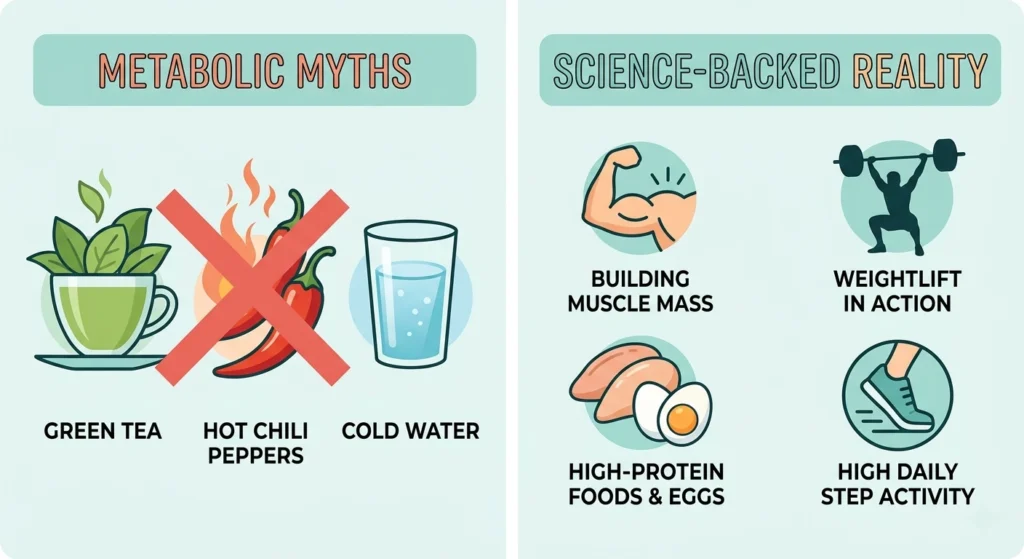
NEAT — ranked first. The largest modifiable metabolic variable for the average adult. Requires no gym membership, no equipment, and no structured time set aside. Just more movement woven into daily life.
Lean muscle mass — ranked second. Each kilogram of muscle added raises resting BMR by approximately 13 calories per day. Modest per kilogram, meaningful over months and years of consistent resistance training, and permanent for as long as the muscle is maintained.
Structured exercise — ranked third. Valuable for many reasons, but not the primary metabolic lever most people think it is. Exercise contributes to daily burn through the session itself and through EPOC (the elevated calorie burn in the hours after training). It does not meaningfully raise BMR beyond the lean mass it helps build over time.
That ranking is the honest one. It challenges the gym-centric view of metabolism and it is what the evidence actually supports. The sections below follow this ranking through every major intervention.
High Impact — The Three Things That Meaningfully Raise Daily Calorie Burn
These three interventions have the strongest, most consistent evidence for producing a real, sustained increase in daily energy expenditure. Each one comes with specific calorie numbers — not vague directional language.
Increasing NEAT — The Single Most Powerful Daily Metabolic Lever
NEAT is the energy burned through everything that is not structured exercise — walking, standing, fidgeting, pacing, household tasks, gesturing while talking, taking stairs. It sounds small. The numbers say otherwise.
Research from the Mayo Clinic (Levine et al., 2006, published in Science) found NEAT differences between sedentary and active non-exercising individuals of up to 2,000 calories per day. For the average office worker, the practical difference between a low-NEAT and high-NEAT day is more conservatively 300 to 700 calories — but that is still more than most people burn in a dedicated gym session.
Here is what specific NEAT habits actually contribute in calorie terms:
| NEAT Activity | Extra Calories Burned |
|---|---|
| Standing instead of sitting (per hour) | ~50 calories |
| Walking short trips instead of driving (30 min) | ~80–120 calories |
| Pacing during phone calls (20 min) | ~40–60 calories |
| 5–10 minute walk every 90 minutes (4 walks) | ~80–130 calories |
| Stairs instead of lifts throughout the day | ~20–50 calories |
None of these individually seem significant. But combined across an 8 to 10 hour waking day, they produce 300 to 600 additional calories of burn — without a gym session, a supplement, or a structured workout. That is the NEAT effect. It is the most underused and most practically accessible metabolic lever most people have access to.
Understanding how NEAT fits into your full TDEE picture is important before you decide how to increase it. If you want to see how calorie cycling and varying activity levels interact across different days, that guide connects directly to what you are reading here.
Resistance Training — Building the Long-Term Metabolic Engine
Resistance training raises daily calorie burn through two separate mechanisms, and both are worth understanding clearly.
EPOC — the afterburn effect. EPOC stands for excess post-exercise oxygen consumption — the elevated calorie burn that continues for 12 to 48 hours after a strength training session while the body repairs muscle tissue, restores glycogen, and returns to homeostasis. A 45-minute strength training session produces 50 to 200 calories of post-exercise calorie burn above the session itself. Compare that to a 45-minute steady-state cardio session, which produces 15 to 50 calories of post-exercise burn. Resistance training wins on EPOC, and that difference compounds over weeks and months of training.
Long-term lean mass accumulation. Each kilogram of muscle gained raises resting BMR by approximately 13 calories per day. A person who gains 5 kg of muscle over two years of consistent training increases their BMR by approximately 65 calories per day — the equivalent of an extra 500 ml glass of milk worth of metabolic allowance, permanently, as long as the muscle is maintained. That is not dramatic. But it is real, it is cumulative, and it compounds indefinitely with consistent training.
The honest framing: resistance training is worth doing for EPOC, for lean mass, for long-term metabolic health, and for the many health benefits beyond calorie burn. It is not a rapid metabolism transformer. It is a slow, compounding metabolic investment that pays off over years. For the full picture of how lean mass, BMR, and organ contribution interact, the BMR vs TDEE complete guide covers the organ-level breakdown in detail.
High Protein Intake — The Thermic Effect That Works All Day
Protein has a thermic effect of 25 to 30% — meaning 25 to 30% of every protein calorie you eat is burned during digestion and processing. Carbohydrates burn 5 to 10% during digestion. Fats burn just 0 to 3%. This difference is not trivial when you calculate it across a full day’s eating.
Protein Thermic Effect — The Daily Calorie Math
Person eating 60 g protein/day (average RDA level):
60 g × 4 kcal/g = 240 kcal from protein → 25% burned in digestion = 60 kcal thermic cost
Person eating 150 g protein/day (higher protein approach):
150 g × 4 kcal/g = 600 kcal from protein → 25% burned in digestion = 150 kcal thermic cost
Difference: approximately 90–110 extra calories burned per day — at the same total calorie intake
Over 30 days: ~3,000–3,300 extra calories burned from protein’s thermic effect alone
That is roughly 0.4 kg of additional fat loss per month from simply eating more protein — without changing total calories. No exercise change, no supplement, no structured plan beyond prioritising protein at each meal. High protein also preserves lean muscle mass during a calorie deficit, which prevents the BMR reduction that comes from losing muscle alongside fat. This is why protein is the most cost-effective nutritional intervention for supporting metabolism during fat loss. The macro calculation guide shows exactly how to set your protein target based on your body weight and goal.
Moderate Impact — Real Effects but Modest in Scale
These interventions have genuine, research-backed effects on energy expenditure. The effects are real — but smaller than the high-impact tier. Knowing the actual calorie ranges helps you decide how much effort each is worth.
HIIT — Higher EPOC Than Steady-State Cardio, but Not a Metabolism Transformer
High-intensity interval training produces meaningfully higher EPOC than steady-state cardio. Post-session calorie burn continues for up to 24 hours after a HIIT session and can total 100 to 200 additional calories above the session itself. A 45-minute steady-state jog produces 15 to 50 calories of post-exercise burn by comparison. The gap is real and it is the legitimate metabolic argument for including HIIT in a training plan.
What HIIT does not do: permanently raise BMR. The metabolic advantage of HIIT over steady-state cardio is measured in dozens of calories per day — not hundreds. HIIT also supports lean mass preservation better than steady-state cardio during a calorie deficit, which has a secondary positive effect on BMR over time. The practical verdict: include HIIT for its EPOC advantage, time efficiency, and lean mass benefits — but do not expect it to transform your resting metabolic rate. It is a useful tool, not a solution by itself.
Sleep — Restoring the Metabolic Rate That Chronic Deprivation Suppresses
This framing matters and almost no article gets it right: better sleep does not boost metabolism above normal. It restores the metabolic rate that sleep deprivation has suppressed.
Research shows sleeping under 6 hours per night consecutively reduces RMR by 5 to 20% through three pathways: disruption of thyroid hormone secretion (which directly regulates metabolic rate), reduced growth hormone release (which predominantly occurs during deep sleep and supports lean mass maintenance overnight), and imbalance of leptin and ghrelin (the appetite and satiety hormones — sleep deprivation raises ghrelin and lowers leptin simultaneously, increasing appetite while reducing metabolic rate).
For someone sleeping 5 hours per night, improving to 7 to 8 hours can restore 80 to 200 calories per day of suppressed metabolic burn. That is not a new calorie expenditure — it is recovery of calories that were being lost to poor sleep. Still genuinely worth doing, and one of the highest-effort-to-reward improvements available to chronically sleep-deprived adults. Poor sleep also drives overeating through ghrelin — meaning the appetite effect compounds the metabolic effect in the wrong direction.
Water and Caffeine — Small Real Effects With Important Limits
Cold water. Drinking 500 ml of cold water increases metabolic rate by 24 to 30% for 30 to 40 minutes in controlled studies — the body burns energy heating the water to core temperature. Total additional calorie burn: approximately 20 to 30 calories per 500 ml of cold water. Drinking 2 to 3 litres of cold water daily produces roughly 40 to 80 extra calories of thermogenic burn. Real, consistent, small.
Caffeine. Stimulates the central nervous system and raises metabolic rate by 3 to 11% for 1 to 3 hours after consumption depending on dose. Two cups of coffee raise metabolic rate by approximately 80 to 150 calories per day in non-habitual users. In habitual daily coffee drinkers, tolerance significantly reduces this effect over time — meaning the metabolic benefit of coffee is highest when consumption is not constant. Both effects are real. Both are small. Neither constitutes a metabolism strategy on its own — they are supplementary contributors at best.
Brown Adipose Tissue — The Overlooked Metabolic Tissue Science Is Still Unlocking
This section covers something genuinely new — something most metabolism articles do not touch at all, and the ones that do mostly get wrong.
Brown adipose tissue (BAT) is a type of fat that generates heat by burning calories rather than storing them. Unlike white fat — the storage tissue most people think of when they think of body fat — brown fat is densely packed with mitochondria and is metabolically active. It burns energy to produce warmth. Until 2009, brown fat was believed to exist only in infants and to disappear in adults. Then a landmark study in the New England Journal of Medicine used PET-CT scanning to confirm functional brown fat in adult humans — present in the neck, supraclavicular area, and chest. The same study found BAT activity was significantly lower in overweight and obese individuals than in lean subjects (428 kBq in lean vs 102 kBq in overweight participants).
A 2014 NIH study (Celi et al.) then showed that four weeks of sleeping in a 19°C (66°F) room nearly doubled participants’ brown fat volume and modestly increased daily calorie burn. The mechanism is the sympathetic nervous system — cold exposure activates BAT through the same pathway stimulated by cold showers, cold water immersion, or simply sleeping in a cooler room.
What the research actually shows: BAT activation through cold exposure is scientifically real, physiologically interesting, and may improve insulin sensitivity and lipid metabolism beyond direct calorie burn. The pure weight-loss effect from BAT activation at the cold exposure durations studied in humans is modest. This is not a weight loss strategy by itself. It is a genuine and emerging area of metabolic science with real biology behind it — just not the dramatic fat-melting solution that wellness content often implies.
Can You Increase Brown Fat Activity Through Cold Exposure?
Yes — with specific conditions and realistic expectations. The NIH four-week study found sleeping in 19°C rooms for one month nearly doubled brown fat volume in lean adult men. A separate JCI study confirmed cold-induced BAT activation drives genuine non-shivering thermogenesis in humans — measured directly using PET-CT with carbon-11 acetate tracers to quantify BAT oxidative metabolism. This is not animal model data extrapolated to humans. It is measured in humans.
Practical cold exposure options that activate BAT: cold showers at 15°C or below for 2 to 5 minutes, sleeping in a room kept at 18 to 19°C, and brief cold water immersion. The additional calorie burn during and immediately after cold exposure is real. The effect is acute — it stops when the cold stimulus ends. Long-term cold acclimation over four or more weeks appears to increase BAT volume and oxidative capacity in a lasting way.
The important context: BAT activity is significantly lower in people with higher body fat percentages — meaning the people most interested in this intervention tend to have the lowest starting BAT activity. Cold exposure may improve this over time, but the weight loss benefits in human clinical studies remain modest. It is worth doing for its metabolic health effects. It is not a replacement for NEAT, protein, and resistance training.
Low or No Impact — Popular Claims That Do Not Hold Up
This section builds more trust than any positive claim in the article — because naming what does not work demonstrates genuine independence from the supplement and wellness industry. These are the most widely repeated metabolism claims that the evidence does not support.
Eating Small Frequent Meals — The “Stoke the Metabolic Fire” Myth
The idea that eating 5 to 6 small meals per day “keeps metabolism high” has been directly tested in controlled research — and refuted. The thermic effect of food is proportional to the total amount consumed, not to the number of times you eat. The same daily calorie total split across 3 meals or across 6 meals produces the same total thermic effect. A 2010 systematic review in the British Journal of Nutrition examined studies comparing 2 to 7 meals per day and found no measurable metabolic rate difference when total calories and protein were matched. Meal frequency matters for adherence, training performance, and protein distribution across the day. It does not matter for metabolic rate. Full stop.
Metabolism-Boosting Supplements — What the Evidence Actually Shows
The category includes green tea extract, capsaicin, L-carnitine, raspberry ketones, CLA, and most branded thermogenic blends. Here is the honest summary for each:
- Green tea extract (EGCG + caffeine): modest 4 to 5% increase in energy expenditure for 1 to 3 hours — similar to caffeine alone, and largely attributable to the caffeine content
- Capsaicin: real but brief thermogenic effect — approximately 50 extra calories on days of consumption; tolerance develops rapidly with regular use
- L-carnitine: no evidence of increased metabolic rate in people without a deficiency
- Raspberry ketones: studied only in animal models at doses far exceeding anything a human would consume — no meaningful clinical human evidence
- Thermogenic blends: the metabolic effects of most commercial thermogenics are almost entirely attributable to their caffeine content; the other ingredients contribute negligible additional effect
No supplement currently available produces a sustained, meaningful elevation of BMR in healthy adults without accompanying health risks. The most responsible thing this article can tell you is: save the money and spend the effort on NEAT and protein instead — both produce larger, more consistent, and completely free metabolic improvements.
Spicy Foods, Cinnamon, and Apple Cider Vinegar
Spicy food (capsaicin): real but small thermogenic effect — approximately 50 extra calories per high-capsaicin meal. Non-cumulative across the day, and tolerance develops quickly with regular consumption. Cinnamon: no human evidence for meaningful metabolic rate change. There is modest research on post-meal blood glucose management in people with insulin resistance — but that is a different mechanism entirely, not thermogenic. Apple cider vinegar: no clinical evidence for increased metabolic rate in humans. Some research on post-meal satiety and blood glucose response exists — the “metabolism boost” claim is extrapolated from animal studies and does not translate into measurable energy expenditure effects in human clinical trials. All three are fine to include in a diet for reasons unrelated to metabolism. None of them move the calorie needle in a meaningful way.
Why Metabolism Slows With Age — and What Actually Slows It
The conventional answer — “your metabolism slows as you get older” — is technically true but misleading in a way that causes most people to accept something they actually have significant control over.
Yes, BMR declines by approximately 1 to 2% per decade after age 30. But here is what that statistic leaves out: most of that decline is not from intrinsic cellular metabolic slowdown. It is from lean mass loss — sarcopenia, the gradual reduction of muscle tissue that begins in the early thirties and accelerates after forty in people who do not actively counter it.
A landmark 2021 study published in Science (Pontzer et al.) tracked the metabolic rates of 6,400 people aged 8 to 95 using doubly labelled water — the most accurate non-clinical measurement method available. The finding: metabolic rate per unit of lean mass is stable from age 20 to 60. The metabolic decline most people experience across those four decades is almost entirely attributable to the lean mass they are losing — not to their cells becoming less metabolically active. After age 60, there is a genuine additional intrinsic decline of approximately 0.7% per year even with lean mass maintained — but even that is reduced in people who maintain high physical activity levels.
This finding completely changes the practical narrative. Age is not a metabolic sentence. Muscle loss is — and muscle loss is largely preventable.
How Much of the Age-Related Metabolic Decline Is Actually Within Your Control
Before age 60: the majority of metabolic decline is from lean mass loss, which begins around 30 and accelerates after 40. Research consistently shows this is largely preventable through resistance training (2 to 3 sessions per week) and adequate protein intake (1.2 to 2.0 g per kg of body weight daily). A person who starts resistance training at 35 and maintains their muscle mass can have a meaningfully higher metabolic rate at 55 than they did at 30 on a sedentary lifestyle — because the lean mass effect outweighs the intrinsic age-related decline for the first two decades of the process. This is specific, research-backed, and directly actionable.
After age 60: genuine additional intrinsic metabolic decline adds approximately 0.7% per year beyond the lean mass effect. This is real and not fully preventable — but it is meaningfully reduced in people who maintain high physical activity into their sixties and beyond. The combination of resistance training and staying active does not stop the clock, but it slows it considerably. For a full understanding of how BMR changes with body weight and how to recalculate after weight loss, the complete TDEE beginner’s guide walks through every variable that affects your calorie needs at different life stages.
If you are over 40 and noticing your weight is harder to manage than it used to be, the explanation is almost always lean mass loss — and the solution is resistance training and protein, not accepting a slower metabolism as inevitable. The body recomposition guide covers exactly how to address this — losing fat and rebuilding lean mass simultaneously, even after years of sedentary lifestyle.
The Practical Metabolism Plan — Ranked by Impact and Effort
Everything above in one table. This is the honest, ranked answer to how to speed up your metabolism — with specific daily calorie impact ranges and honest effort assessments.
| Intervention | Daily Calorie Impact | Effort Required | Sustained? |
|---|---|---|---|
| Increase NEAT (stand, walk, pace) | 300–700 cal/day | Low — mostly habit shifts | Yes, while habits maintained |
| Resistance training 3× per week | 50–200 cal EPOC + 65 cal/day long-term | Moderate — structured sessions | Yes — compounds over years |
| Increase protein to 1.8–2.4 g/kg | 100–120 cal/day TEF increase | Low — dietary adjustment only | Yes, while intake maintained |
| Improve sleep to 7–8 hours | 80–200 cal/day restored | Low — behavioural adjustment | Yes, while sleep maintained |
| Daily coffee + cool sleeping environment | 40–150 cal/day combined | Very low | Partially — caffeine tolerance builds |
The combined realistic daily impact of all five: 570 to 1,170 extra calories per day above a fully sedentary, low-protein, sleep-deprived baseline. That is not a supplement. That is not a trend. That is the honest picture of what the evidence actually shows.
For people who are currently eating at a deficit but not seeing results despite these habits in place, the issue is usually tracking accuracy rather than a genuinely slow metabolism. The weight loss plateau guide covers the three most common causes and gives a specific diagnosis path for each. And if you have been in a long calorie deficit and your metabolism feels genuinely suppressed, reverse dieting is the structured approach to restoring metabolic rate without regaining fat.
Three external sources worth reading if you want to go deeper into the research behind this article. The Levine et al. 2006 NEAT study in Science is the foundational research behind the 2,000-calorie NEAT variation finding — the most important single paper for understanding why daily movement matters more than most gym-focused content acknowledges. The Pontzer et al. 2021 study in Science covering 6,400 people across 8 to 95 years is the definitive research on how metabolism actually changes across the lifespan — including the finding that metabolic rate per unit of lean mass is stable from age 20 to 60. And the 2009 NEJM brown adipose tissue study is the landmark paper confirming functional BAT in adult humans using PET-CT — the foundation of everything currently being researched about cold exposure and brown fat activation.
Frequently Asked Questions
Can you permanently increase your metabolism?
Yes — in two meaningful ways. Building lean muscle mass raises BMR by approximately 13 calories per kilogram per day at rest, permanently, for as long as the muscle is maintained. Increasing habitual NEAT permanently raises daily energy expenditure for as long as the activity patterns are kept. Both require ongoing commitment — muscle is lost if training stops, NEAT drops if lifestyle reverts. Beyond these two, no supplement, food, or technique produces a permanent, meaningful increase in BMR for healthy adults. This is the honest answer and it is the most useful one.
Does eating breakfast boost metabolism?
No. Eating breakfast does not raise metabolic rate above what the same food would contribute if eaten at a different time of day. The thermic effect of breakfast is identical to the thermic effect of the same calories eaten at lunch or dinner. The “breakfast kick-starts your metabolism” claim is not supported by controlled research. What is true: some people find eating breakfast helps with appetite regulation and total daily intake — a behavioural benefit, not a metabolic one. Skipping breakfast through intermittent fasting does not impair metabolic rate when total daily calories and protein are maintained.
Is a slow metabolism why I cannot lose weight?
Rarely. Genetic metabolic variation between people of identical age, sex, height, and weight is approximately ±10% — meaning a genuinely slow metabolism differs from the average by around 150 to 250 calories per day, not 500 to 1,000. Most people who believe they have a slow metabolism and cannot lose weight are in a smaller deficit than they think — due to tracking inaccuracy, overestimating activity level, or a TDEE that has decreased with weight loss and was never recalculated. The real exceptions are confirmed hypothyroidism, significant metabolic adaptation from very long-term calorie restriction, and rare conditions like Cushing syndrome. For the vast majority, the solution is an accurate TDEE calculation, honest calorie tracking, and a genuine deficit — not a faster metabolism.
How much does muscle really increase metabolism?
Approximately 13 calories per kilogram of muscle per day at rest — significantly less than the “50 calories per pound” figure that circulates widely in fitness culture. Over the whole body, an average 70 kg man with 40% lean mass (approximately 28 kg of muscle) burns around 364 calories per day from skeletal muscle at rest. Gaining 5 kg of additional muscle over two years of consistent training raises this by approximately 65 calories per day — real, cumulative, and permanent. The larger metabolic benefit of resistance training comes from EPOC during and after training sessions and from the lean mass protection that prevents BMR decline during dieting — not from the resting muscle calorie burn per kilogram alone.
Do cold showers or cold water increase metabolism?
Yes — through two mechanisms. First, thermoregulation: the body burns calories maintaining core temperature during cold water exposure. Drinking cold water adds approximately 20 to 30 extra calories per 500 ml consumed as the body heats it to core temperature. Second, brown adipose tissue activation: cold exposure stimulates BAT-driven non-shivering thermogenesis as described in the BAT section of this article, producing additional heat and calorie expenditure. The combined daily effect of a 2 to 5 minute cold shower at 15°C or below is real but modest — approximately 40 to 100 extra calories during and immediately after exposure. Long-term cold acclimation over four or more weeks increases BAT volume and capacity meaningfully. Worth doing for metabolic health and circulatory benefits — not worth relying on as a primary weight loss strategy.