You’re eating the same way you always have — maybe even less — and the scale keeps climbing anyway. The jeans that fit fine at 38 are tight at 44. The exact eating pattern that kept your weight steady at 32 isn’t working at 48. If this sounds familiar, you’re not imagining it, and it isn’t a failure of willpower.
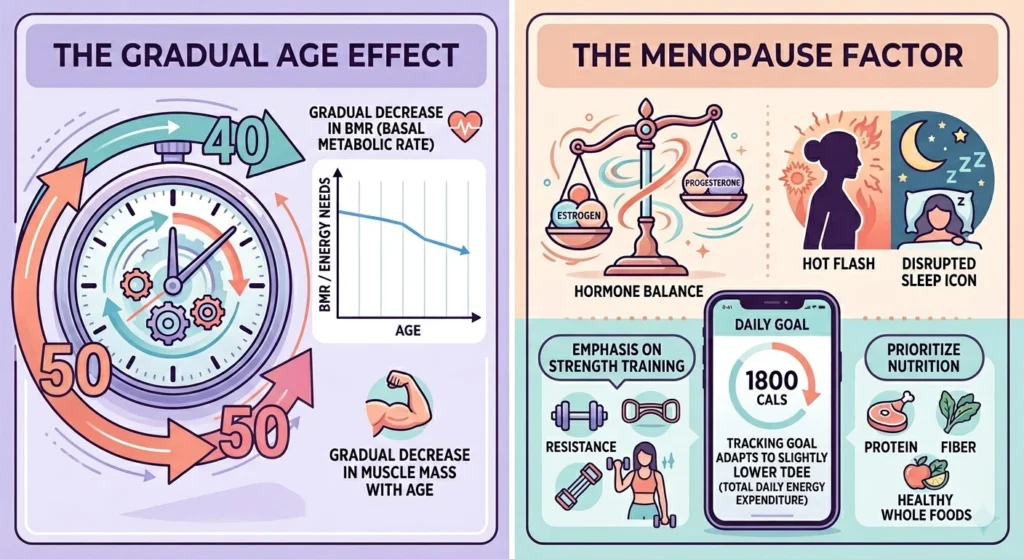
Something has genuinely changed, and it’s happening on three fronts at once. After 40, you’re naturally losing muscle mass, your hormones are shifting in ways that directly affect how your body burns energy, and you’re moving less throughout the day without realising it. Each of these lowers your total daily energy expenditure (TDEE) on its own — and together, they often add up to 200–400 fewer calories burned per day compared to a decade earlier. That’s the equivalent of an entire extra meal your body used to burn off automatically and now doesn’t.
Here’s the part that matters most: most of this decline is preventable, and a meaningful chunk of it is reversible. This article walks through exactly how much TDEE changes per decade, what menopause specifically does to your calorie needs (separate from ordinary ageing), how to calculate an accurate TDEE for where you are right now, the interventions that actually move the needle, and worked calorie targets for different ages and activity levels. Before making any changes to your eating, the first step is getting an accurate starting number — head over to the free TDEE calculator and run your current stats. Everything below will make a lot more sense once you have that baseline in front of you.
How Much Does TDEE Actually Change After 40 — The Real Numbers
Most articles on this topic gesture vaguely at “metabolism slowing down” without ever putting a number on it — which leaves you with no way to judge whether what you’re experiencing is normal or whether something more significant is going on. So let’s put actual numbers on it.
A large 2021 study published in Science by Pontzer and colleagues, which tracked metabolic rate in over 6,400 people aged 8 to 95, found something that reframes this whole conversation: metabolic rate per unit of lean mass is essentially stable from age 20 to 60. The decline in total metabolism during this window comes almost entirely from losing lean mass — not from your cells themselves becoming less efficient. After age 60, there’s a separate, genuine decline of roughly 0.7% per year that happens even if lean mass is maintained — but that’s a story for later decades.
So what does this look like in real numbers for a woman in her 40s? Going from age 30 to 40, the intrinsic age-related metabolic decline is roughly 50–100 calories per day. On top of that, the average woman loses around 1–2 kg of lean mass over that decade without resistance training, which adds another 13–26 calories per day of reduced BMR. Put together, a sedentary woman’s TDEE typically drops by roughly 100–200 calories per day from 30 to 40.
From 40 to 50, the same mechanisms keep running — but menopause adds its own distinct layer on top, which we’ll get into in the next section. By the time you look at the full picture from peak TDEE around age 25–30 to age 60, the cumulative decline in a sedentary woman can total 250–400 calories per day. That’s not a vague sense of “things changing” — that’s a real, measurable shift in how many calories your body burns just existing.
Why Most of This Decline Is Preventable, Not Inevitable
The Pontzer findings change the entire framing here. If most of the decline before age 60 comes from losing lean mass — rather than some unavoidable cellular slowdown — then the obvious follow-up question is: what happens if you don’t lose the lean mass?
A 2019 trial published in the journal Menopause gives a direct answer. Postmenopausal women who did resistance training three times a week maintained their lean mass and showed significantly smaller declines in metabolic rate than women who didn’t train. The practical implication is genuinely striking: a 50-year-old woman who has trained consistently through her 40s can have a higher TDEE than a sedentary woman ten years younger.
To be clear about what resistance training can and can’t do — it doesn’t fully erase the age-related component of metabolic decline. But it can preserve roughly 60–80% of the lean-mass-driven portion of that decline. That’s not a small effect. That’s the difference between losing 200 calories of daily expenditure and losing 40–80.
What Menopause Specifically Does to TDEE — Beyond Normal Ageing
Menopause isn’t just “ageing, but faster.” It’s a distinct hormonal transition with its own specific effects on how many calories your body burns — effects that stack on top of, rather than replace, the normal ageing decline already covered above.
Research published in the Journal of Clinical Endocrinology and Metabolism found that menopausal women experience a metabolic rate reduction of roughly 100–300 calories per day compared to their pre-menopausal baseline — and this is specifically tied to declining oestrogen, not just the passage of time. This is the number that explains the experience so many women describe: the exact eating pattern that kept weight stable at 42 is now causing slow weight gain at 50, despite nothing in the diet changing.
Put the two effects together — normal ageing plus the menopausal hormonal shift during the perimenopausal-to-menopausal transition, typically ages 45 to 55 — and you get a combined TDEE drop of roughly 7–12%. For a woman whose TDEE was around 2,000 calories entering perimenopause, that’s a reduction of approximately 140–240 calories per day. Nothing about her behaviour changed. Her body’s energy requirements did.
The Three Specific Ways Oestrogen Decline Lowers TDEE
It helps to break this down into the three distinct things that are actually happening, because each one points to a different solution.
The first is accelerated muscle loss. Oestrogen plays a direct role in supporting muscle protein synthesis — your body’s ability to build and maintain muscle tissue. As oestrogen declines through perimenopause, that process becomes less efficient, which speeds up sarcopenia (age-related muscle loss) beyond what normal ageing alone would produce. Less muscle means a lower resting metabolic rate. This effect alone is estimated to account for an additional 50–100 calories per day of BMR reduction, on top of the lean mass loss that happens with age regardless of hormones.
The second is fat redistribution. As oestrogen drops, fat storage tends to shift from subcutaneous locations — under the skin, around the hips and thighs — toward visceral fat, the kind that sits around your internal organs. Visceral fat is metabolically less active than subcutaneous fat, and it’s linked to insulin resistance. This doesn’t directly lower TDEE in the same way muscle loss does, but it makes your body less efficient at directing calories toward muscle repair and more inclined to store extra calories as abdominal fat — which compounds the muscle-loss problem over time.
The third is a quiet drop in spontaneous movement — the unconscious fidgeting, pacing, and general daily motion that’s part of what’s called non-exercise activity thermogenesis (NEAT). Hot flushes, disrupted sleep, and general fatigue during menopause reduce this kind of movement without you ever deciding to “move less.” This NEAT reduction is estimated to account for another 50–150 calories per day. None of these three mechanisms requires a dramatic life event to notice — they’re quietly running in the background, and understanding each one is what makes it possible to push back against them individually.
Perimenopause vs Menopause vs Post-Menopause — When Each Phase Affects TDEE
Most discussions treat menopause as a single switch that flips on a particular day. In reality, it’s a multi-year process with three distinct phases, and each one affects your calorie needs differently.
Perimenopause typically runs from around age 40 to 51, with an average onset around 47. During this phase, oestrogen begins fluctuating and gradually declining — and the metabolic effects start showing up, though inconsistently. You might notice your weight responding differently to the same eating pattern from month to month, partly tracking your hormonal cycle. Over the 4–8 years of perimenopause, TDEE typically drops by roughly 50–150 calories per day, progressively.
Menopause itself is defined clinically as the point after 12 consecutive months without a period — the moment oestrogen reaches its lowest point. By this stage, TDEE has typically already declined by 100–200 calories per day from the pre-perimenopausal baseline.
Post-menopause covers everything afterward. TDEE generally stabilises at this new, lower level, though it continues to decline gradually with age as it would for anyone. Many women find that over the 2–3 years following menopause, their body adapts to the new hormonal environment — and weight gain that felt relentless during the transition itself often levels off.
What this means practically: the hardest stretch for weight management usually isn’t “being postmenopausal” in general — it’s the 3 to 5 years surrounding the transition itself, when TDEE is actively dropping and the body hasn’t yet adjusted. Knowing this can be genuinely reassuring if you’re in the middle of it right now.
How to Calculate Your TDEE Accurately After 40
“Just use a TDEE calculator” is technically correct advice, but it skips over three specific errors that make standard TDEE estimates less reliable once you’re past 40 — and fixing these before you plug in your numbers makes a real difference.
Error one: choosing an activity level based on intentions rather than actual movement. After 40, the gym sessions might stay exactly the same, but the incidental movement around them — walking to colleagues’ desks, standing while on calls, fidgeting, general daily errands — often quietly decreases without anyone noticing. If “moderately active” feels like the right description, it’s worth deliberately choosing “lightly active” instead and checking how your results track against reality over 4–6 weeks.
Error two: reusing a calorie target that worked at 35 without recalculating. Age is a direct variable in TDEE formulas — a 50-year-old woman generates a lower BMR than a 35-year-old woman of identical height and weight. If you haven’t recalculated since your mid-30s, the number you’re working from is already outdated before menopause even enters the picture.
Error three: not accounting for the menopausal adjustment at all. Standard formulas like Mifflin-St Jeor don’t include any hormonal correction. For women in or past menopause, real-world TDEE often runs 100–200 calories below what the formula predicts. The fix isn’t to abandon the formula — it’s to apply a slightly smaller deficit, or lean toward the more conservative end of your activity range, to account for that gap.
Worked Examples — TDEE at 40, 45, 50, and 55 for the Same Woman
To make this concrete, here’s the same woman — 165 cm tall, 68 kg, lightly active — calculated at four different ages using the Mifflin-St Jeor equation.
| Age | BMR (Calories/Day) | Formula TDEE | Real-World Adjustment |
|---|---|---|---|
| 40 | ~1,413 | ~1,943 | Formula generally accurate |
| 45 | ~1,388 | ~1,909 | Formula generally accurate |
| 50 (Menopausal) | ~1,363 | ~1,874 | ~1,650–1,774 (100–200 cal below formula) |
| 55 (Post-Menopausal) | ~1,338 | ~1,840 | Adaptation largely complete, formula closer to accurate |
Looking purely at the formula, the change from 40 to 55 is about 103 calories — a relatively modest drop. But the menopausal period adds its own additional 100–200 calorie real-world reduction on top of that. Put together, the practical TDEE change from age 40 to around 52 is roughly 200–300 calories per day lower than what the formula would have predicted back at 40. If you’ve been wondering why the calculator’s number “felt too high” during your late 40s or early 50s, this is exactly why — and it’s also why it’s worth recalculating rather than assuming the same formula output still applies.
How Many Calories Should a Woman Over 40 Eat Per Day?
Here’s the direct answer, before anything else: a moderately active woman aged 40–49 typically needs around 1,900–2,100 calories for maintenance, or 1,400–1,600 for fat loss. A lightly active woman in the same age range typically needs around 1,650–1,850 for maintenance, or 1,200–1,400 for fat loss — never going below 1,200 without medical supervision. For women aged 50–59 who are menopausal or postmenopausal and moderately active, maintenance sits around 1,700–1,900, with fat loss around 1,300–1,500. For sedentary women aged 50–59, maintenance is typically 1,400–1,600, with fat loss around 1,100–1,300 (again, not below 1,200 without medical oversight).
| Age Group | Activity Level | Maintenance Calories | Fat Loss Calories |
|---|---|---|---|
| 40–49 | Moderately Active | 1,900–2,100 | 1,400–1,600 |
| 40–49 | Lightly Active | 1,650–1,850 | 1,200–1,400 |
| 50–59 | Moderately Active | 1,700–1,900 | 1,300–1,500 |
| 50–59 | Sedentary | 1,400–1,600 | 1,100–1,300 |
Notice how closely the 50–59 moderately active row tracks the worked example from the previous section — the 1,650–1,774 real-world TDEE we calculated for our 50-year-old falls right in line with the maintenance range here. These aren’t disconnected numbers; they’re the same underlying picture from two angles.
Why Cutting Calories Too Aggressively After 40 Backfires
Here’s the part that trips up so many women, and it’s worth being direct about it: the instinctive response to menopausal weight gain — cutting calories hard, often down to 1,200 — tends to make the underlying problem worse, not better.
If your TDEE has already dropped by 200–300 calories, and you respond by cutting to 1,200, you might only be eating 200–400 calories above your actual BMR. At that level, a few things happen at once. Your body starts suppressing its metabolic rate further in response to what it reads as a scarcity signal — that’s metabolic adaptation kicking in. With insufficient calories and protein, your body starts breaking down muscle for energy rather than just fat. And because oestrogen’s protective effect on muscle is already reduced or gone, this muscle loss happens faster than it would have at 30.
The end result is what’s sometimes called “skinny fat” — the scale number goes down, but body fat percentage actually goes up, and your TDEE ends up lower than before you started. You’ve lost weight and made the original problem more entrenched. The evidence-based alternative is a moderate deficit — 250–400 calories below your menopausal-adjusted TDEE, not 500 or more.
The Most Effective Interventions — What Actually Works After 40
These four interventions are ranked by the strength of evidence specifically in perimenopausal and postmenopausal women — not general population studies that may not translate to this stage of life.
Resistance Training — The Single Most Impactful Intervention
The 2019 Menopause journal trial referenced earlier is the clearest piece of evidence here. Postmenopausal women doing resistance training three times a week preserved lean mass, maintained their metabolic rate significantly better than non-training controls, and reduced visceral fat — even without a calorie deficit.
Resistance training does two things simultaneously after menopause. It directly rebuilds and preserves the lean mass that oestrogen used to help protect, and it produces what’s called excess post-exercise oxygen consumption (EPOC) — your body continuing to burn extra calories for hours after a session, typically adding 50–150 calories of additional expenditure. The practical version: two to three sessions a week of compound movements — squats, deadlifts, rows, presses — with progressive overload over time. Changes in body composition are typically visible within 8–12 weeks. If there’s one thing in this entire article worth prioritising, it’s this.
Increasing Protein Intake — More Important After 40 Than at Any Earlier Age
After menopause, something called anabolic resistance increases — your muscles become less responsive to protein per gram consumed, meaning you need more of it to get the same muscle-building or muscle-preserving effect. The PROT-AGE Study Group recommends 1.2–1.6 g/kg of body weight for active older women, well above the general RDA of 0.8 g/kg, specifically because of this reduced efficiency.
For women over 40 who are in a calorie deficit, the target should sit even higher — 1.8–2.2 g/kg — because the combination of eating less and having less oestrogen creates the highest risk of muscle loss of any life stage. For our 68 kg worked example, that’s 122–150 grams of protein per day.
There’s an added benefit specific to this stage of life: protein is the most filling of the three macronutrients, suppressing the hunger hormone ghrelin more effectively than carbohydrate or fat. This matters because menopause is linked to leptin resistance — your brain becomes less responsive to the hormone that signals fullness, which is part of why appetite can feel less predictable during this transition. Prioritising protein is one of the few dietary levers that directly counters this.
NEAT Preservation — Counteracting the Unconscious Activity Drop
Remember the 50–150 calorie per day drop in spontaneous movement mentioned earlier — the one that happens from hot flushes, disrupted sleep, and fatigue without any deliberate choice? The countermeasure is to deliberately rebuild that movement back in.
Practical targets: aim for 8,000–10,000 steps a day, stand rather than sit during parts of the workday, walk for short errands instead of driving, and take a 10-minute walk after meals. That last one carries a second benefit specific to this age group — research shows a 10-minute walk after eating reduces the blood sugar spike from that meal by roughly 25–30% compared to sitting. This matters more after 40 because oestrogen decline increases insulin resistance — the same plate of food produces a bigger blood glucose response in a postmenopausal woman than it would have a decade earlier. A short walk after meals is a small, free intervention that directly addresses this.
Sleep — The Underestimated Metabolic Lever in Menopause
Sleep disruption is one of the most common menopausal experiences — hot flushes and night sweats affect roughly 75% of perimenopausal women, and they disrupt the structure of sleep even on nights when you don’t fully wake up and remember it.
This isn’t just a quality-of-life issue — it’s a metabolic one. Chronic sleep deprivation reduces resting metabolic rate by roughly 5–20%, independent of any change in body composition. It also raises ghrelin (increasing hunger by around 24% in some studies), lowers leptin (weakening fullness signals), and makes the body more inclined to store fat. For women already dealing with a lower TDEE and reduced oestrogen, poor sleep compounds every other factor in this article.
Treating sleep as a metabolic intervention — not just a comfort issue — means it’s worth taking seriously. Practical approaches include keeping the bedroom cool, around 18–19°C, trying cognitive behavioural therapy for insomnia (CBT-I), which clinical trials show outperforms sleep medication for menopausal insomnia, and discussing hot flush management with a GP — HRT remains the most effective option for night sweats that are disrupting sleep.
Calorie Needs During Menopause — A Practical Adjustment Guide
Pulling all of this together into something you can act on today:
Step 1: Recalculate your TDEE right now, using your current age and weight — not numbers from five or ten years ago. Use the TDEE calculator, and if you want the full background on how the calculation works, our beginner’s guide to TDEE covers it from the ground up.
Step 2: Choose an activity multiplier one level more conservative than feels accurate — for the reasons covered earlier, this usually produces a more realistic starting point.
Step 3: Subtract 250–400 calories from that adjusted figure for a fat loss target — not 500 or more. If you want to understand exactly how this deficit translates into actual weight change over time, our guide on calorie deficits and weight loss goes through the mechanics in detail.
Step 4: Set protein at 1.8–2.2 g/kg before anything else — carbs and fats can flex around this, but protein is the foundation. Once you’ve got your calorie target and protein number sorted, the macros from TDEE guide walks you through filling in the rest of your plate.
Frequently Asked Questions
How many calories does a woman over 40 need per day?
Moderately active women aged 40–49 typically need around 1,900–2,100 calories for maintenance. Lightly active women in the same age range need around 1,650–1,850. For women aged 50–59, whether menopausal or postmenopausal, maintenance generally falls between 1,600–1,900 depending on activity level. For fat loss, subtract 250–400 calories from your maintenance estimate. Never go below 1,200 calories without medical supervision. For the most accurate personal figure, calculate using your current age, weight, and height rather than relying on these general ranges alone.
Why am I gaining weight during menopause despite eating the same?
Three things are happening at once, all lowering your daily calorie burn without any change to your diet. Oestrogen decline accelerates muscle loss, which lowers your BMR by roughly an additional 50–100 calories per day beyond what normal ageing already causes. Fat storage shifts toward visceral fat, which reduces metabolic efficiency and insulin sensitivity. And spontaneous daily movement drops by roughly 50–150 calories per day due to fatigue and disrupted sleep. Combined, research published in the Journal of Clinical Endocrinology and Metabolism puts the total menopausal TDEE reduction at 100–300 calories per day. Eating the same amount that maintained your weight at 42 will produce slow weight gain at 50 — not from any failure on your part, but because your body’s energy requirements have genuinely changed. The fix is recalculating your TDEE at your current age and adjusting intake to match, alongside resistance training, increased protein, and rebuilding NEAT.
Does menopause permanently slow your metabolism?
The menopausal transition itself — typically 3 to 7 years — produces the biggest drop, around 100–300 calories per day. After that, most women find their TDEE stabilises at this new, lower level as the body adapts to its new hormonal baseline. The encouraging part is that most of this decline comes from lean mass loss and reduced NEAT — both of which respond well to resistance training and deliberate activity. A postmenopausal woman who takes up resistance training and maintains adequate protein can recover roughly 60–80% of the lean-mass-driven portion of the decline. The remaining piece — roughly 50 calories per day tied to pure oestrogen effects — may not be fully recoverable without hormone replacement therapy, but it’s a relatively small fraction of the total change.
Should I eat fewer calories after 50?
Yes, modestly — but the key word is modestly, and the approach matters more than the number. TDEE genuinely declines after 50 for the reasons covered throughout this article, so the same intake that maintained your weight at 40 will likely cause slow weight gain at 55. The right adjustment is to recalculate TDEE using your current age and weight, recognise that the formula may run 100–200 calories higher than your real-world number during and after menopause, and set your maintenance target from that adjusted figure. For fat loss, a 250–400 calorie deficit from this adjusted maintenance is appropriate. What doesn’t work is cutting hard to 1,200 calories — that accelerates muscle loss and metabolic adaptation, both of which make the long-term picture worse. The goal is a moderate, sustainable deficit combined with resistance training, adequate protein, and attention to sleep and movement.
Does HRT (hormone replacement therapy) affect TDEE or weight?
Research suggests HRT can partially reverse some of the oestrogen-driven effects of menopause — particularly the acceleration of muscle loss, the shift toward visceral fat storage, and the sleep disruption from hot flushes that suppresses NEAT. However, the evidence doesn’t support the idea that HRT directly boosts TDEE by a large margin on its own — any benefit appears to work indirectly, through better-preserved lean mass and improved sleep that makes it easier to stay physically active. HRT is a medical decision to make with a GP based on your individual health history and risk profile — it isn’t a weight management tool in the same category as adjusting calories or training. Some women find weight management noticeably easier on HRT; others notice little difference. If menopausal symptoms are significantly affecting your sleep, daily function, or quality of life, it’s worth raising with a healthcare provider regardless of the metabolic angle.
The most useful next step from here is simple: recalculate your numbers using the TDEE calculator with your current age and weight, then use the four-step adjustment guide above to set a realistic target. If you’re not sure how a moderate deficit translates into real progress over time, our article on what a plateau actually means is worth reading too — plateaus look different (and often mean something different) after 40 than they did at 25.
For further reading on the research referenced in this article, the 2021 Pontzer et al. study on metabolism and ageing was published in Science, a systematic review on resistance training for postmenopausal women is available via PubMed, and protein and resistance training research in postmenopausal women is discussed in this National Library of Medicine study.